Get Full Government Meeting Transcripts, Videos, & Alerts Forever!
Get email alerts on the Corrections And Reentry topic
No spam. Unsubscribe anytime.
Sawyer County CJCC hears jail population figures and updates on TAD, MAT planning and peer navigator hires
Summary
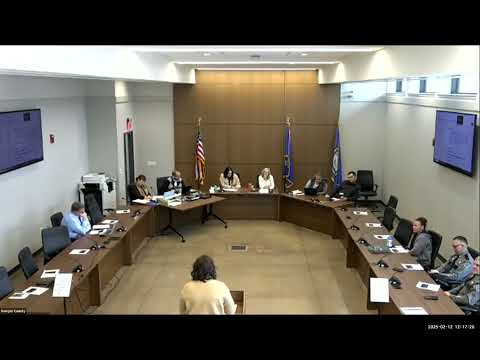
At its Jan. 25 meeting, the Sawyer County Criminal Justice Coordinating Council reviewed jail population figures and heard updates on Treatment Alternatives and Diversion (TAD) funding, a Building Bridges MAT planning grant, and newly hired peer systems navigators focused on pre‑arrest deflection and post‑release transition.
The Sawyer County Criminal Justice Coordinating Council on Jan. 25 reviewed current jail population figures and received program updates on Treatment Alternatives and Diversion (TAD) funding and several jail‑based services, including plans to recruit and post a peer systems navigator position.
The council opened the substantive report on the jail with population metrics: “January 25, we’re starting off the year…59 for average daily population, 14 of those being females, 45 being males,” a jail presenter said. The presenter also reported 16 average probation incarcerations, 32 pre‑sentence incarcerations and 11 sentence incarcerations, and said four people were on electronic monitoring. The report noted a slightly different total population number (58) in the data extract used to compile the packet.
Those numbers matter because the Criminal Justice Coordinator also briefed members on TAD funding for 2025. “We’re in our fifth year of our TAD funding that began on January 1,” the coordinator said, adding that the program is performing well though federal or state grant administrators did not increase the award. The coordinator said the county has been awarded $100,000 for a separate Reaching Rural program and intends to use part of that funding to hire a peer systems navigator focused on post‑release transition services; the position is expected to be posted in March.
The coordinator described two additional peer systems navigators already hired for pre‑arrest deflection work and said those staff and a coordinator “have their equipment. They have their telephone numbers,” so law enforcement could contact them immediately after training. The coordinator added the county plans a refresher training for law enforcement on the deflection protocol in March, noting that the original training in December 2023 occurred before the navigators were in place.
Council members also heard about a Building Bridges planning initiative aimed at launching medication‑assisted treatment (MAT) services in the jail. The coordinator said the local planning team includes “Chief Deputy Sedara, Julia Lyons, Julie McCallum, myself,” and named additional clinical partners, and that the county will apply for a follow‑on implementation grant worth up to $200,000 (not guaranteed) and is considering a larger COSA grant due in March or April that could total about $1 million over three years.
Separately, the coordinator reviewed ongoing jail programs (about 10 active programs) and said the county is working to transfer some program duties to a coordinator because staff capacity is strained. She said a parenting program, Parenting Inside Out, will be reimplemented with UW Extension after prior funding lapsed, and noted GED completions for the 2024–25 school year totaled eight. The coordinator also asked for donations to support sober events organized by peer systems navigators.
Meeting business included a routine approval of minutes. “I’ll make a motion to approve those minutes,” a member moved; another member seconded and the motion carried by voice vote.
The council did not take further formal action tied to the program updates during the meeting but asked staff to continue recruitment and training and to return with budget details for grant applications and program staffing.
Looking ahead, members flagged requests to finalize opioid‑settlement budgeting and to schedule joint meetings with tribal partners to discuss jail population breakdowns and related contracts.