Get Full Government Meeting Transcripts, Videos, & Alerts Forever!
Get email alerts on the School Health Diabetes topic
No spam. Unsubscribe anytime.
Committee hears substitute to consolidate diabetes-care rules for Virginia schools; action postponed
Summary
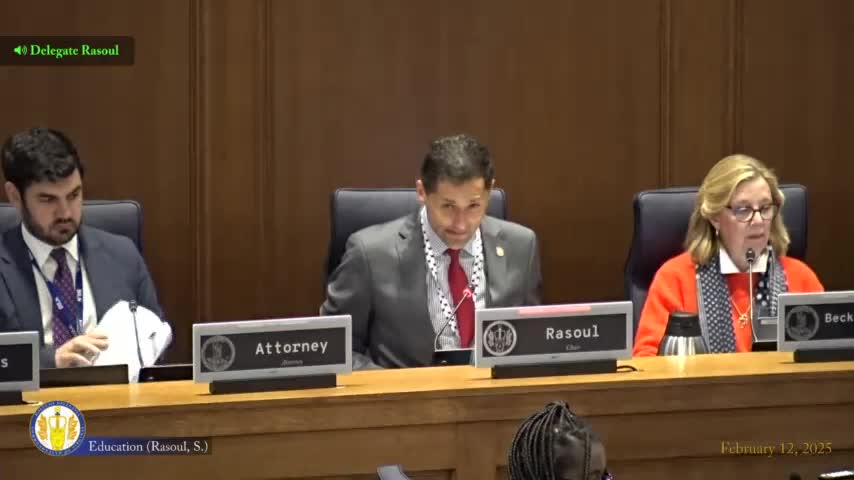
Senate Bill 13-03, a measure to consolidate and update Virginia law on diabetes management in schools, was presented to the House Committee on Education and taken "by for the day" after the committee adopted a substitute and heard extended testimony.
Senate Bill 13-03, a measure to consolidate and update Virginia law on diabetes management in schools, was presented to the House Committee on Education and taken "by for the day" after the committee adopted a substitute and heard extended testimony.
The substitute, offered by Senator McPike, would combine several provisions into a single, updated code section addressing diabetes management in schools, clarify how diabetes management medical plans (DMMPs) should be implemented, limit a requirement for glucagon to schools that have a diagnosed student with a DMMP in place, and make certain training levels permissive in accordance with the Virginia Department of Education (VDOE) guidance. "Senate Bill 13-03, with the substitute, combines and amends outdated and insufficient Virginia codes pertaining to diabetes management care," Senator McPike told the committee.
Supporters told the committee the substitute reflects stakeholder changes made in recent weeks. Carrie Murphy, founder of Follow21Ds, described the condition and the need for statewide clarity: "Type 1 diabetes is a chronic, life threatening autoimmune disease with no cure. Managing it requires 20 fourseven glucose monitoring and insulin delivery to prevent dangerous blood sugar swings that can lead to seizures, coma, and can sometimes be fatal," she said, adding that the substitute incorporates requested amendments from the Virginia Association of School Nurses, the Virginia School Boards Association and the American Diabetes Association.
Other parents, school nurses and education groups testified in favor. Chad Stewart with the Virginia Education Association said the measure's liability protection for staff was important: "Teachers and school staff want to do the best by students to protect them," he said. Kelly Veil and Jennifer Economie, parents of children with type 1 diabetes, described inconsistent experiences getting school districts to accept doctors' orders and DMMPs. School-nursing groups praised the negotiated changes but said they needed time to review the final substitute. Andrew Lamar, speaking for the Virginia Association of School Nurses, said the association's major concerns had been addressed but that some new language merited further review.
Witnesses who identified remaining concerns included Stacy Haney of the Virginia School Boards Association and Patrick Finner, who said some districts had not yet had time to review the substitute. Tom Smith of the Virginia Association of School Superintendents said the timing had limited districts' ability to review the new text. The American Diabetes Association representative recommended two clarifications for committee consideration: that level-3 trainees be supervised in person or virtually, and that the bill require training and care be provided in accordance with ADA Standards of Care.
Committee members asked several substantive questions about how the bill treats students who self-manage, how it compares to episodic treatments such as epinephrine and albuterol, and whether extensive detail belongs in statute versus guidance. McPike said the bill relies on the DMMP (doctor's orders) for individual determinations and that VDOE guidance already describes training levels; he said the substitute makes training permissive and removes certain prior provisions such as the bus-driver requirement.
After discussion, the committee adopted the substitute by voice vote and then "passed" the bill by for the day (the committee chair said the motion was "to pass Senate Bill 13-03 by for the day"). That action leaves the bill eligible for further amendment and final action at the committee's next meeting.
Votes at this hearing on SB 13-03 were procedural: the substitute was adopted by voice vote and the committee later approved the motion to pass the bill by for the day. No final enactment or final affirmative vote on the bill's merits occurred at this meeting.
Next steps noted by the chair: any additional substitute language should be delivered to committee counsel and posted in advance of the committee's next meeting to allow review. The chair encouraged stakeholders to provide written comments and told staff the committee would take final action at a later date.