Get Full Government Meeting Transcripts, Videos, & Alerts Forever!
Get email alerts on the Illegal Dumping topic
No spam. Unsubscribe anytime.
Subcommittee backs bill aimed at curbing illegal construction dumping with higher fines and shorter appeals
Summary
Senate Bill 1422, reported by the House subcommittee 7-0, would increase penalties and shorten appeal timelines to deter illegal dumping of construction debris that local officials say is damaging rural roads, streams and drinking-water sources in Fauquier and Prince William counties.
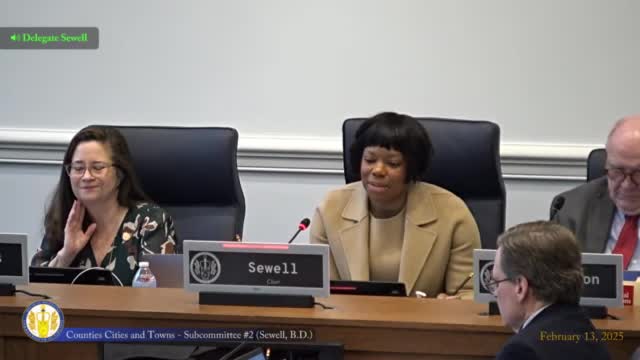
The House Committee on Counties, Cities and Towns Subcommittee 2 voted 7-0 to report Senate Bill 1422 after hearing testimony from county officials and residents who said illegal dumping of construction debris is increasing in rural parts of northern Virginia.
Senator Reeves, the bill’s patron, described the problem as contractors hauling construction debris to rural sites and leaving it in fields and ravines. "What you have basically in layman's terms is a lot of these contractors going to our rural areas, getting to farmers and bringing all their construction debris and basically dumping them out in the middle of nowhere," Reeves said.
Local officials said the activity causes road damage, erosion and potential water-quality risks. Supervisor Broadus of Fauquier County testified that sites show erosion and lack erosion- and sediment-control measures; he said the problem has grown rapidly and is in part driven by large construction projects that generate large volumes of fill. Holly Mead, director of community development for Fauquier County, told the committee that fines currently available to localities are so small they are treated as a cost of doing business and urged penalties aligned with larger penalty structures in code.
Speakers from Prince William County, including a Brentsville District supervisor (Gordy), and residents described heavy truck traffic—cited by one engineer as "300 trucks a day" for large sites—and risks to roads and drinking-water sources. An engineer who said he represents a family with agriculture and excavation interests illustrated the economics: at $50 per truck for 300 trucks a day, sites could take in roughly $15,000 per day; after basic expenses the remaining revenue could make small fines an acceptable business cost. "A fine that averages out to less than $1,000 a day will not put that site out of business," he said.
Testimony also flagged the potential threat to the Aquia Reservoir watershed, which supplies drinking water for a large regional population. County officials urged the committee to give localities stronger enforcement tools, including higher fines and a shortened timeline for appeals.
The motion to report Senate Bill 1422 was made and seconded (mover/second not specified in the transcript); the subcommittee reported the bill by a 7–0 vote. Senator Reeves said he would monitor the bill’s effectiveness and consider further action if penalties do not deter the activity.
Votes at a glance Senate Bill 1422 — Reported by subcommittee, 7–0.