Get Full Government Meeting Transcripts, Videos, & Alerts Forever!
Get email alerts on the Property Tax topic
No spam. Unsubscribe anytime.
Houston County Board votes 6-0 to opt out of House Bill 581 homestead-cap provisions after public hearing
Summary
After a third required public hearing that drew residents both for and against, the Houston County Board of Education voted 6-0 to adopt the superintendent’s recommendation to opt out of portions of House Bill 581 that create a statewide floating homestead exemption and revise assessment notices.
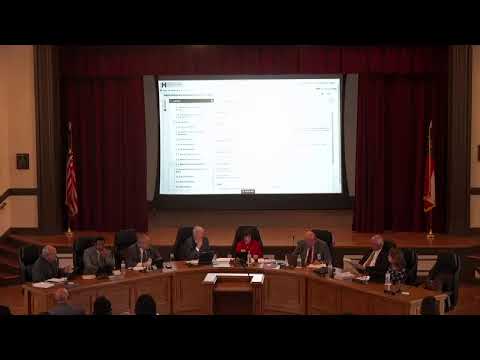
The Houston County Board of Education voted 6-0 Tuesday to opt out of provisions in House Bill 581 that would create a statewide floating homestead exemption and change assessment notices, following the third and final public hearing on the measure.
Board members heard a presentation from district staff outlining potential revenue impacts and then received public comment both supporting and opposing the opt-out. The board acted on a motion to “approve the superintendent’s recommendation to opt out of House Bill 5 81 as written,” made by Board Member Mitchell Nichols and seconded (second not specified), which passed by voice with a 6-0 tally.
The superintendent’s staff presented a fiscal analysis that said, if the statewide homestead cap had been in effect for the 2024 tax year, Houston County Schools “would have lost over $4,000,000,” and that limiting assessed value growth for homesteaded properties would reduce the district’s property-tax revenue used to fund teacher and support-staff salaries, school resource officers, instructional materials and transportation. The presenter said the district’s millage rate “has not increased in the past 16 years,” and noted the district reduced its millage by 1.46 mills in 2024 to 11.719 mills, “the lowest since 1992.” (Statement read at the hearing by district staff.)
During the public hearing, speakers voiced differing views. Rob Charles, identifying himself as a Perry resident, urged the board not to opt out, saying the bill’s passage was intended to limit what he called “back-door tax increases” and pointing to perceived areas of spending to examine; he also noted the superintendent’s salary, saying “the superintendent has received a salary of $372,000 annually” (comment from a resident). Kathy Peterson, another resident, said many voters supported the bill and asked the board to consider taxpayer relief, noting recent increases in housing values and personal tax bills. Resident Riley Glover said the cap protects homeowners on fixed incomes and vulnerable residents from rapid increases and urged the board not to opt out. Joseph Batten, speaking later, urged the board to study the bill’s details and said the district’s staff presentation overstated the projected loss, arguing that the bill’s intent is to smooth inflationary increases in assessed value over time rather than permanently remove revenue for schools.
Board Member Mitchell Nichols urged trust in local stewardship of tax dollars and framed the opt-out vote as preserving local control over millage and budgeting decisions. After discussion, Nichols moved to approve the superintendent’s recommendation to opt out; the board approved the motion by a 6-0 vote.
The record at the meeting shows the board gave formal notice and followed the statutory procedure of holding three public hearings before taking action. The public commenter record included both supporters and opponents; the board’s formal action was to opt out of the House Bill 581 provisions as presented in the superintendent’s recommendation.
The board did not record an itemized roll-call vote in the transcript; the motion passed by voice and was reported as “Motion approved, 6 0.”
Board action and public comment at the hearing make clear the decision responds to the district’s view of potential budgetary risk, while residents cited competing concerns about taxpayer burden and the bill’s intent to limit rapid property-tax increases.
The board’s action to opt out is final as entered in the meeting minutes and will be implemented by the superintendent’s office according to usual administrative practice.