Get Full Government Meeting Transcripts, Videos, & Alerts Forever!
Get email alerts on the Property Tax Homestead Exemption topic
No spam. Unsubscribe anytime.
Augusta public hearing outlines how House Bill 581 would shift property tax burden, introduces possible half‑cent sales tax
Summary
Augusta City officials and residents met at a public hearing in the Municipal Building chambers to review House Bill 581, the state measure that creates a "floating" homestead exemption and an option for a local floating sales tax if the city remains "in." The governing body must decide by March 1 whether to opt in or opt out.
Augusta City officials and residents met at a public hearing in the Municipal Building chambers to review House Bill 581, the state measure that creates a "floating" homestead exemption and an option for a local floating sales tax if a local governing body remains "in." The governing body has not decided whether to opt in or opt out; that decision must be made by March 1 under the law, officials said.
The city's chief appraiser, Scott Rountree, described the floating homestead as an assessment cap tied to the prior year's consumer price index. "The floating homestead works by increasing the value of your homestead exemption to offset inflation based on the prior year's consumer price index," Rountree said, noting that the CPI for 2024 was 2.9 percent. He emphasized, "This is not a tax cap. This is an assessment cap." Rountree said the new exemption would be added on top of existing homestead exemptions and would reset when a property is sold or when a substantial change is made to the property.
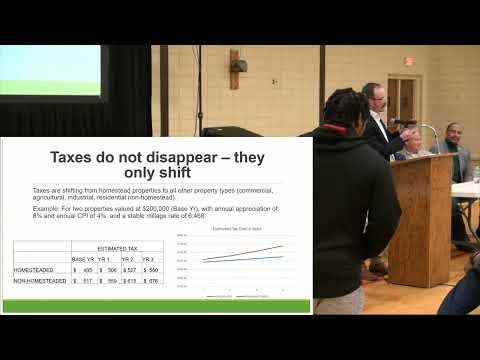
Interim Finance Director Tim Schreier explained the related sales-tax option. If Augusta remains in under House Bill 581, the city could ask voters to approve a FLOST of up to 0.5 percentage point (half a cent), subject to state limits and voter approval. "It is relatively revenue neutral for Augusta," Schreier said, adding that the practical effect is a shift in who pays: lower assessed increases for homesteaded residences and higher shares for non‑homesteaded property, including commercial and rental properties.
Tax office examples and county figures were used to show scale. Rountree said that, in a hypothetical where the provision started in 2024, exemptions would have grown by about $7,071,000,000 and roughly 9,000 of the county's 31,000 homestead properties would have benefited in that first-year model. He said the county's ad valorem tax collections are about $52 million a year and that the share paid by residential property owners (about 53 percent in the most recent year) would decline over time under the floating exemption scenario.
Members of the public raised questions about who benefits and who pays. Sue Parr, retired president of the Augusta Metro Chamber of Commerce, urged caution: "Only 38 percent of the properties in Richmond County are homesteaded, which leaves 62 percent commercial," she said, warning that the tax shift would fall disproportionately on businesses and renters and that sales taxes can be regressive. Several residents who own rental properties said higher tax bills for commercial or rental property owners could lead to rent increases.
Public comments also reflected uncertainty about the ballot language that placed House Bill 581 before voters last fall. Commissioner Sean Frantom, who attended and spoke at the hearing, said he had voted on the ballot measure in November but described the subject as complicated and said his present inclination was to opt out: "My opinion now would be to opt out," he said, adding that the governing body could later consider locally tailored exemptions if it opts out of the state structure.
Officials repeated procedural points: the governing body must decide by March 1 whether to opt out. The administrator told attendees that hearings are part of the opt‑out process and that Augusta will hold another hearing on February 18 at 11 a.m. in the chambers. Officials also urged residents to check homestead and other exemption filings by the April 1 deadlines cited by the tax office.
The hearing produced no formal vote; it was a required public forum for information and comment. Commissioners and staff said they were collecting public input before making the statutory decision.
Questions or requests for information were directed to the tax assessor's office and the city administrator; staff said the presentation materials would be posted on the city's website and social media accounts.
Ending: The governing body must decide by March 1 whether to opt in to House Bill 581's floating homestead and the attached FLOST option. Officials scheduled another public hearing for February 18 at 11 a.m. in the Municipal Building chambers to continue receiving resident input.