Get Full Government Meeting Transcripts, Videos, & Alerts Forever!
Get email alerts on the Nonprofit Funding topic
No spam. Unsubscribe anytime.
Pueblo leaders push to update CSAC IGA, bylaws and grant process
Summary
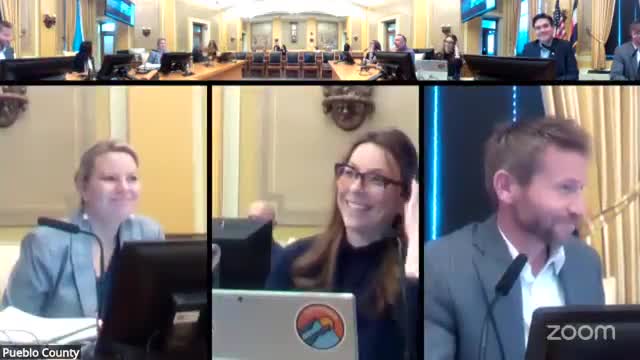
Pueblo County commissioners, Pueblo City Council members and CSAC commissioners met in an afternoon work session to review the commission’s IGA, bylaws and grant processes and asked staff to circulate updated documents and return in about a month with draft revisions.
Pueblo County commissioners, Pueblo City Council members and commissioners of the Community Services Advisory Commission (CSAC) met in an afternoon work session to review CSAC’s role, intergovernmental agreement and bylaws and to seek clearer guidance for how taxpayer-funded grants are prioritized and awarded.
The session focused on reducing duplicated grant requests to city and county, updating a roughly 20-year-old intergovernmental agreement (IGA) that repeatedly references CDBG funds, and giving CSAC clearer priorities and procedures so the commission can vet applicants more efficiently. Gina Lopez Ferguson, a CSAC commissioner, summarized CSAC’s current work: “We are a commission that is appointed by the city and county. … We meet monthly and our purpose and role, my understanding is that, I wanna say in 02/2003, I think was when the initial resolution was created.”
Why it matters: CSAC administers a shared pool of local funding intended to support nonprofits across the city and county. Commissioners and council members said the current documents and timelines leave nonprofits and the commission unclear about priorities, application timing and how city- or county-level grant decisions should relate to CSAC recommendations. Several speakers said the pot of funds handled through CSAC is under $1 million and that the commission typically receives 30–35 applications across a wide range of needs.
Most important developments
- Governance and documents: Multiple officials asked for an updated IGA and revised bylaws that reflect current funding sources and clearly define CSAC’s scope. A county legal official noted the IGA already instructs the commission to “attempt to reasonably allocate available funding based on articulable criteria developed by the Commission,” but several elected officials said the language and referenced programs (for example, CDBG) are out of date.
- Priorities and scope: CSAC members and elected officials recommended clearer funding priorities so the commission can concentrate limited funds on demonstrable community needs rather than spreading modest awards across many categories. Daniel McHenry, a CSAC commissioner, said he would have found it “more efficient to have had a needs assessment and then some guidance from commission and city council when we're focusing on who should get these limited funds.” Mary Lee, another CSAC member, listed the wide array of application categories—early childhood, health services, senior services, youth services, homeless services, arts and more—and warned that “to try to address any of those well with less than a million dollars is near impossible.”
- Process and onboarding: CSAC members said onboarding materials, clearer timelines and a more consistent grant-management schedule are needed. Commissioners asked CSAC to produce a short onboarding packet describing the cycle, site-visit expectations and reporting requirements; CSAC members agreed they could draft procedural materials once priorities and timelines are clarified. Gina Lopez Ferguson said CSAC had revised some internal documents but still lacked firm guidance: “For us, it doesn't give a lot of guidance, and so it's difficult to prioritize, categorize, you know, what are the outcomes that you're wanting with this grant making program?”
- Timing and outstanding approvals: Melissa Cook, interim housing administrator, said the commission’s final funding recommendations are on the City Council agenda for Monday night (final reading). Several participants urged both governing bodies to approve the most recent recommendations quickly so nonprofits are not left waiting. Commissioners and CSAC agreed to aim for a follow-up meeting in about a month to begin drafting prioritized guidance and bylaw updates ahead of the next application cycle.
Points of disagreement and caution
Some elected officials opposed funneling all city and county nonprofit funding exclusively through CSAC. One participant (identified in the meeting as Mark Aliff) cautioned against consolidating all grant decisions into CSAC, noting the city and county have historically funded some organizations for reasons that might not fit a single centralized process: “I don't think intermingling those, in my opinion, is a wise thing to do.” Others, including County Commissioner Zach Swearingen, urged giving CSAC a larger share of the joint funding pot and routing nonprofit requests through the commission to reduce duplication.
Other recurring concerns included whether CSAC funds should be used for operating costs or personnel (some speakers argued for programmatic funding over salaries), the need for clearer accountability and reporting, and vacant or nonparticipating CSAC seats. A CSAC member recommended stronger attendance requirements and removal procedures to ensure the commission functions with active members.
Clarifying details and context
- CSAC origin: Participants said the commission’s enabling resolution dates to about 2003 and was originally tied to CDBG funding; several speakers recommended the IGA be revised to reflect current funding sources and priorities. - Typical application volume and funding: CSAC members said the commission typically received 30–35 applications in recent cycles and that the combined funding pot administered through CSAC is under $1,000,000 (figure not specified precisely in the meeting). - IGA/bylaws paperwork: The IGA is nine pages, and revised bylaws have been drafted in the past but still require review and approval by the city and county. - On-site visits: CSAC members said site visits and application vetting are central to the commission’s work. - Timeline: CSAC’s next application cycle was discussed as occurring in late summer; meeting comments referenced both July 1 and September as possible milestones for applications and scheduling, and officials said calendar alignment with municipal budget cycles should be part of the revisions (dates were not finalized in the session).
Next steps
Officials asked staff to circulate the current IGA and the most recent draft bylaws for review, to place the pending funding recommendations on the county and city agendas where appropriate, and to reconvene the governing bodies and CSAC in about a month to begin drafting updated priorities and an aligned timeline. CSAC commissioners committed to producing basic onboarding materials and to refining their procedures once governing guidance is provided.
Ending
Participants agreed the work session was a first step toward clarifying CSAC’s role, priorities and procedures; they asked legal and staff to help produce updated documents and scheduled a follow-up meeting to finalize guidance before the next application cycle.