Get Full Government Meeting Transcripts, Videos, & Alerts Forever!
Get email alerts on the Fire Department Operations topic
No spam. Unsubscribe anytime.
Town hears fire department warn staffing strains are lengthening response times
Summary
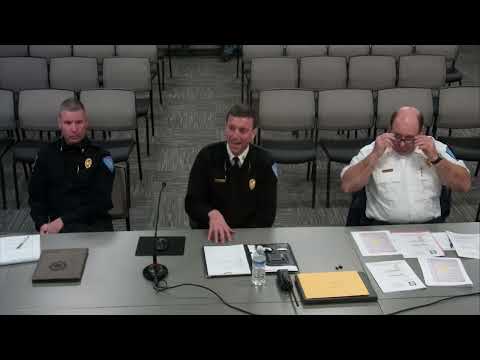
At a Feb. 10 Town Council workshop, fire department leaders said rising call volumes, staffing shortages and geography are stretching response times, prompting plans to add personnel, pursue grants and rely on mutual aid and the call company.
Town Council members and fire department leaders at a Feb. 10 workshop heard that rising emergency medical service (EMS) demand, limited staffing and the town’s geography are lengthening response times and increasing reliance on mutual aid.
Fire department leaders said the department answered roughly 1,400 calls in the last full year and that medical calls make up the majority of that workload. Deputy Chief Andy Turicotte said the department’s average response time was “just under 9 minutes,” compared with an internal target of about 7 minutes, and that when mutual‑aid arrivals are included the average can climb to about 13 minutes for some incidents.
The timing matters for high‑acuity cases such as cardiac arrest and stroke, the chief and other speakers said. “When you look at those strokes, cardiac arrest, those minutes matter,” one presenter said, adding that the town’s limited on‑duty staffing makes it hard to get personnel on scene quickly and to meet minimum staffing rules for fire entry.
Town and department speakers outlined several reasons for the delay: the department presently staffs a single ambulance on duty; two of four daily shifts have only two people and two shifts have three people; call concurrency means the crew is committed on another incident about a quarter of the time; and the town’s road network and distance to parts of town extend travel times.
To reduce risk the department is proposing a stepped staffing plan. Presenters said adding enough personnel to reach four people on every shift would require six additional full‑time positions (two to complete last year’s hires and four to fill the four‑shift rotation). Longer term, leaders said, a six‑person shift model would better allow cross‑staffing a second ambulance and an engine and to reciprocate mutual aid to neighbors.
Until full staffing can be achieved, the department will continue to rely on mutual aid agreements with Falmouth, Yarmouth, Gray and other neighboring departments, automatic aid on highways and a volunteer “call company” that provides people to drive apparatus, perform firefighter duties, or assist with traffic and rescue tasks. The department reported providing or receiving roughly one mutual‑aid call per day last year and said about 100 times crews had to summon an out‑of‑town ambulance because local units were already committed.
Speakers described specific public‑safety pressure points on regional highways. A department member said the Main Turnpike and Interstate 295 were “probably your worst danger zone,” estimating that “50” of the roughly 70 motor‑vehicle accidents last year occurred there. The department also raised concerns about incident severity at several local intersections and about construction zones that may complicate traffic management.
The workshop covered nonresponse topics that affect operations. The department said it does not routinely bill for fire alarm responses because previous collection efforts cost more than they returned; it does bill for EMS transports, and the town retains about 6 percent of EMS collections. Department staff also noted a municipal ordinance that imposes escalating fees after three false alarms in a calendar year, and they asked council members to remind businesses and residents about monitored alarm testing and detector maintenance.
Health and personnel retention were addressed. Andy Turicotte and another presenter described a countywide, one‑time legislative appropriation of $2 million that will be applied for through Cumberland County to support occupational health screenings (cardiometabolic and cancer screenings) and other preventive services for public‑safety workers; the department said the current fiscal year has short‑term grant and donation support but that recurring funding will be a future budget consideration.
The meeting included examples of operational complexity: the department’s heavy rescue carries extrication equipment and responds on major crashes; OSHA and NFPA 2‑in/2‑out requirements limit what two or three on‑duty people can safely do at structure fires; and certain call types (hazmat, carbon monoxide) require specialized meters and protocols even when they do not escalate to full hazmat response.
Speakers urged the council to consider staged hiring, per‑diem coverage, and continued investment in the call company as the town grows. The presentation closed with a request that the council and staff factor in the department’s staffing proposal when preparing budgets and long‑range planning for new subdivisions, roundabout work and commercial growth that could raise call volume.
The workshop did not include any formal votes or final council actions on staffing, funding or ordinances; those items were identified as topics for follow‑up in the budget and policy process.