Get Full Government Meeting Transcripts, Videos, & Alerts Forever!
Get email alerts on the Stranded Minerals topic
No spam. Unsubscribe anytime.
Committee hears rising concerns over 'stranded minerals' as carbon‑capture projects advance
Summary
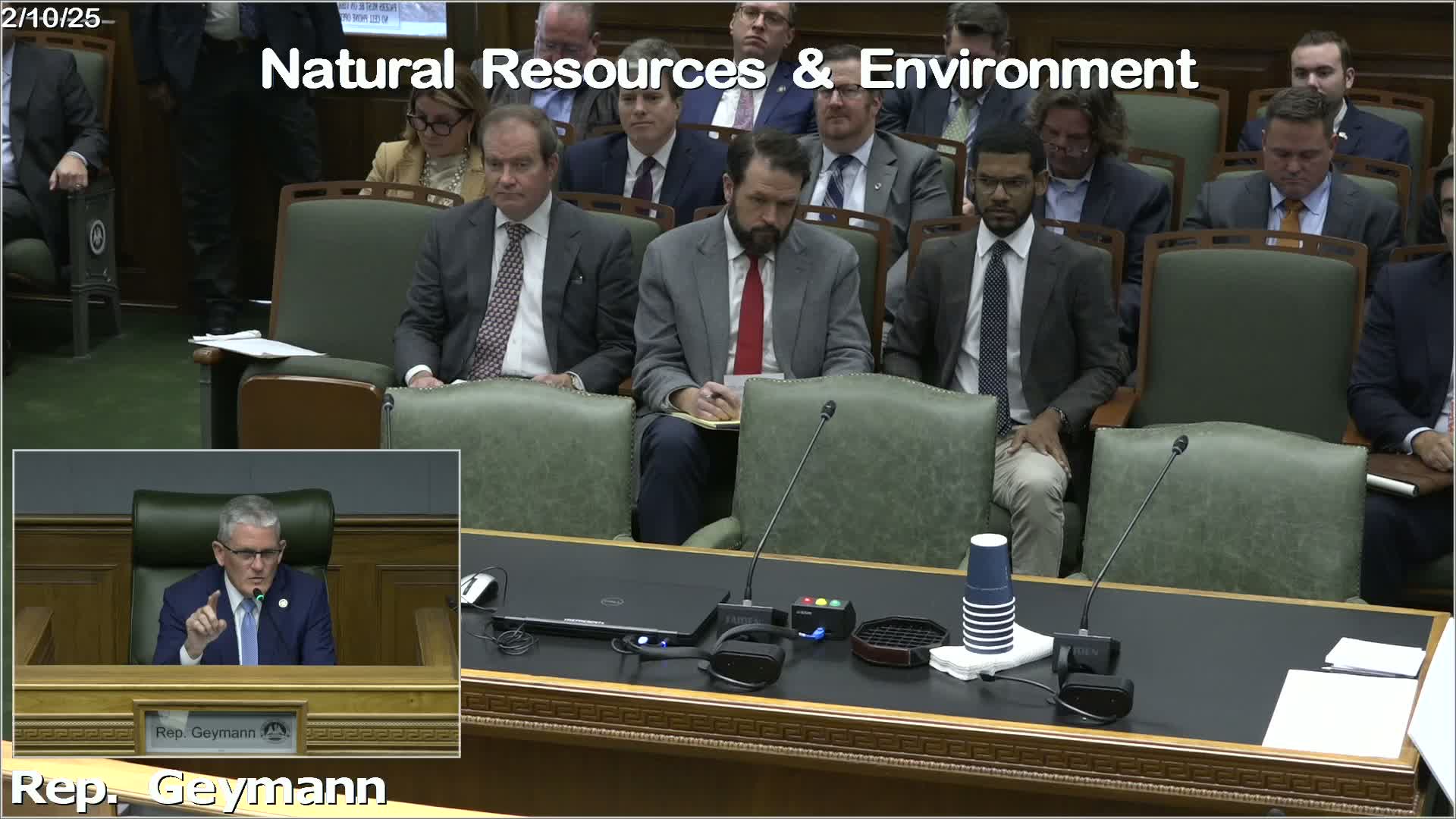
Baton Rouge — Lawmakers and stakeholders on the House Natural Resources and Environment Committee spent several hours in February reviewing how proposed carbon capture and storage projects could render subsurface mineral rights inaccessible and whether existing state rules protect landowners, mineral servitude holders and local governments.
Baton Rouge — Lawmakers and stakeholders on the House Natural Resources and Environment Committee spent several hours in February reviewing how proposed carbon capture and storage (CCS) projects could render subsurface mineral rights inaccessible — so‑called “stranded minerals” — and whether Louisiana’s current rules and permitting practices protect landowners, mineral servitude holders and local governments.
The committee convened to consider House Study Resolution No. 6, filed by Representative Jack McCormick (sponsor), which asks the state to study how CCS unitization and permitting interact with private mineral rights and local revenues. The hearing drew regulators from the state Department of Energy and Natural Resources (DENR), industry trade groups, LSU researchers and law professors, mineral‑servitude owners and parish officials.
Why it matters: CCS projects in Louisiana are being proposed at scales and depths that stakeholders say differ from traditional oil‑and‑gas units. Witnesses warned projects can cover thousands — in some testimony, tens of thousands — of acres and may inject CO2 into multiple subsurface intervals. That scale and geological uncertainty could complicate future oil and gas recovery, pit surface owners against mineral owners, and affect parish severance tax revenue.
“If there was one cookie‑cutter, one size‑fits‑all solution to this problem, we wouldn't be here talking about it right now,” Dustin Davidson, deputy secretary at the Department of Energy and Natural Resources, told the committee, summarizing DENR’s view that decisions will be highly project specific.
Regulatory framework and DENR’s view
Blake Campbell, executive counsel for DENR, told the committee the state’s unitization rules require consent by a supermajority of acreage in a proposed storage unit; witnesses clarified the law uses a 75% acreage consent threshold in practice. Campbell and Davidson said the department views many technical questions — for example, allowable injection pressures, compatibility of materials with CO2‑rich fluids, and whether a particular subsurface interval will be permeable or safely isolated — as fact‑specific and part of the Class VI permitting process under the state primacy program.
DENR recommended exploring voluntary alternative dispute resolution for mineral valuation and said the Commissioner of Conservation has discretion under the agency’s authority to prevent waste to consider impacts to hydrocarbon recovery when reviewing CCS projects.
Industry and economics
Tommy Faucher, president of Lamoga (an industry trade group), told the committee his members are engaging early with DENR and companies seeking to site CCS projects and urged caution before statutory fixes are adopted. “We continue to want to lean forward and see a successful CCS industry continue to grow,” Faucher said, adding that companies are adjusting siting to avoid concentrated mineral development where practical.
Greg Upton, executive director of the LSU Center for Energy Studies, framed the issue from an economic and land‑use perspective, comparing CCS unitization to oil and gas unitization: both raise questions about whether a single landowner can block a project, and both force property owners to weigh present deals against uncertain future value. Upton noted two practical differences for sequestration: expected storage units are much larger than typical oil and gas regulatory units, and the plume location and pressure field will be monitored and may change over time.
Legal standards and property rights
Keith Hall, professor at LSU Law School and director of its Mineral Law Institute, told the committee Louisiana law treats subsurface pore space as a property interest and summarized the applicable property doctrines. “The civil code of Louisiana does provide that the landowner owns the subsurface,” Hall said, citing Civil Code Article 4 90 (as discussed in his presentation), and explained how mineral servitudes give third parties the right to explore and produce minerals.
Hall and several witnesses described the accommodation/correlative‑rights doctrine in the Louisiana Mineral Code (Article 11): when surface and mineral rights conflict, courts apply a fact‑specific “reasonable regard” standard that sometimes requires mineral operators to use alternative methods (for example, directional drilling) when reasonable industry alternatives exist. But Hall and others emphasized the doctrine is flexible and case‑specific, not a bright‑line statutory rule.
Landowners, local officials and safety concerns
Landowner groups and parish officials warned of economic and safety risks. Brad LeBlanc, a geoscientist for Sweet Lake Land and Oil, described examples from other states and company files in which drilling into a high‑concentration CO2 plume or a ruptured CO2 pipeline produced dense surface‑level CO2 clouds. “You will create a plume that's about a 50,000 part per million concentration at the surface,” LeBlanc said, warning those clouds can cause asphyxiation and complicate emergency response.
Danny Ford, representing the Louisiana Mineral Servitude Group, summarized local concerns: “We are not opposed to carbon capture, we are opposed to stranding minerals,” he said, urging the committee to weigh potential lost severance tax revenue and long‑term impacts on parish finances.
Uncertainties, costs and monitoring
Witnesses agreed on many uncertainties. DENR said the technical analysis that applicants submit (including plume modeling) will be reviewed by the state primacy program; applicants commonly provide modeling developed by their technical teams and DENR said it reviews that material and can ask for independent analyses. Upton and academic and industry witnesses said plume modeling, injection chemistry, reservoir mineralogy and pressure regimes vary by site, making across‑the‑board answers impractical.
Speakers gave illustrative figures during the hearing but stressed project‑specific detail is required: one witness cited a figure of roughly $1,700 per foot for specialty alloys for wells expected to see highly corrosive CO2‑rich fluids; DENR and industry agreed that whether such materials are required depends on the CO2 stream chemistry and operational design. Testimony also cited the federal 45Q tax credit (expanded and extended by the Inflation Reduction Act) as a major driver of CCS project economics; LSU and industry witnesses noted 45Q payments can substantially affect project viability (witnesses quoted a common top‑end value for tax credits discussed in project planning).
Committee next steps and open questions
Committee members pressed witnesses on who would be compensated if a unit is approved over nonconsenting acreage, how mineral valuation would be performed, whether the state should limit unit size, and whether clearer statutory language is needed. DENR said it is reviewing multiple pending Class VI applications and expects permit reviews and notices of deficiency to continue; agency staff said they were pushing to reach a first Class VI permit decision within months but emphasized each technical review is project specific.
No legislative action or vote occurred during the hearing; the session was a fact‑finding forum under a study resolution.
The hearing made clear areas for follow‑up: whether the Legislature should set clearer rules on unit size and compensation, whether to require independent plume modeling or third‑party review as part of permitting, and whether statutory changes should clarify how surface and mineral interests are identified and notified during the application process.
A closing note: speakers from parish governments and landowner groups asked for clearer notice and for a defined process to ensure parish revenues and small mineral owners are not left uncompensated should a large storage unit be approved over nonconsenting acreage.