Get Full Government Meeting Transcripts, Videos, & Alerts Forever!
Get email alerts on the Nuclear Recycling topic
No spam. Unsubscribe anytime.
Company tells Louisiana committee recycling used fuel can cut waste and supply new reactor fuel
Summary
Ed McGinnis of Curio told a joint Natural Resources committee that advanced recycling of used nuclear fuel and new reactors could reduce high‑level waste to about 3–4% of its current volume, supply fuel for reactors and create thousands of jobs; state and federal licensing and siting were discussed during a lengthy question-and-answer session.
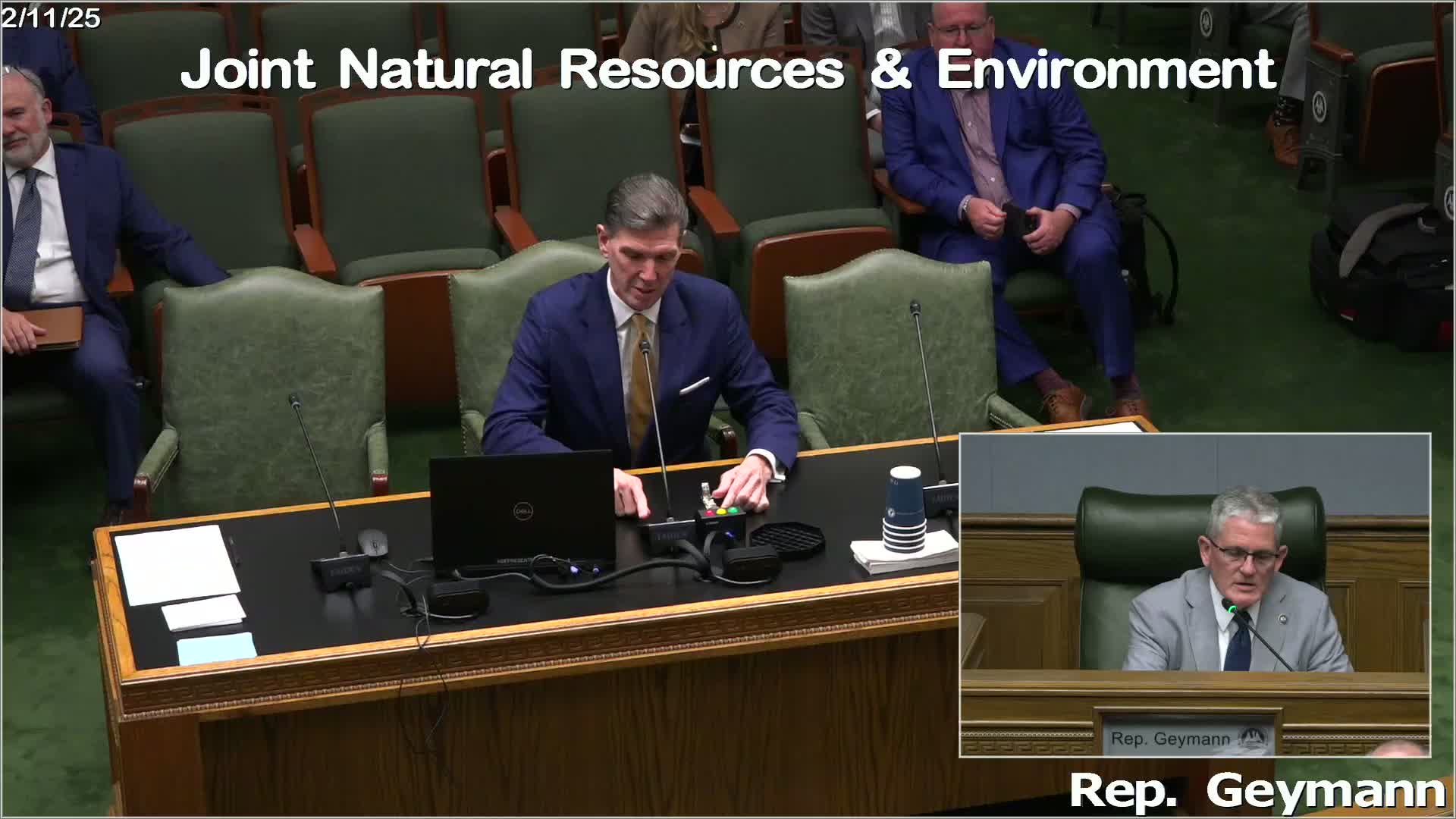
Ed McGinnis, a presenter identified as representing Curio, told the joint House and Senate committees on Natural Resources that his firm is developing an integrated fuel‑cycle approach that combines recycling of used nuclear fuel, advanced reactors and on‑site waste disposition.
McGinnis said the United States has about 90,000 metric tons of used nuclear fuel and that Curio’s “new cycle” recycling process would reduce the volume of high‑level radioactive material to about 3–4 percent of the original amount while recovering uranium, plutonium and valuable isotopes. “We want to unlock the full potential of the nuclear sector,” McGinnis said.
The presentation outlined three elements Curio says are required for a full nuclear fuel cycle: reactors, fuel and waste disposition. McGinnis described a recycling plant sized to process about 4,000 metric tons of used fuel per year and a reuse pathway in which recovered fuel could be returned to reactors. He also said Curio plans to supply plutonium‑based and uranium‑based fuels, and to offtake medical and industrial isotopes recovered during processing.
Why this matters: McGinnis said recycling sharply reduces the quantity of permanent high‑level waste that would require geological disposal, which the company argues would lower the federal cost and community burden associated with long‑term storage. He and committee members framed the proposal as one possible way to supply fuel, reduce waste volumes and support new electricity and industrial demand in Louisiana.
Details and claims discussed at the meeting included Curio’s workforce and timeline estimates. McGinnis said a recycling facility and associated tech corridor could directly employ “well over 3,000” people and pay average salaries he estimated in the $80,000–$140,000 range. He described a commercial ramp to full scale in roughly seven years and said the company does not plan to seek state tax abatements. McGinnis also said the remaining high‑level waste after recycling could be disposed of in deep boreholes (he mentioned 12,000‑foot boreholes as an example).
Committee members pressed Curio on safety, licensing and ownership of waste. McGinnis said the Nuclear Regulatory Commission (NRC) would need to license any geologic disposal and that, under current law, title to unretrieved used fuel remains with the federal government only after DOE accepts it; until then, utilities typically retain ownership. He reiterated Curio’s view that reducing the long‑term volume of waste would make federal disposal more tractable.
Several committee members asked technical and policy questions during a more than hour‑long Q&A. Topics included reactor types (McGinnis described a “HOPE” reactor—an acronym he said stands for a homogeneous plutonium eliminating reactor—characterized in his presentation as a walk‑away‑safe molten‑salt design), transport modes for used fuel (McGinnis said by water, rail or road are all used), and how recovered plutonium would be handled to avoid proliferation risks. McGinnis said Curio’s process would not produce a pure plutonium stream but rather a “self‑protecting” material blended with other isotopes.
Quotes from the record: “Used nuclear fuel is anything but waste,” McGinnis told lawmakers. “We're going to pull out isotopes that otherwise would have to be thrown away and treated as waste.” He also said, “We have partnerships with some of the largest U.S. utilities to precisely look at the feasibility of recycling the fuel that's sitting on the pads right now.”
What was not decided: The committee heard the presentation and asked questions but took no formal votes or motions related to Curio’s proposals. No licensing, siting or funding decisions were made at the meeting.
Ending note: Curio’s representatives remained available to legislators after the formal presentation, and McGinnis said the company planned further feasibility work and state outreach. Several legislators and state officials said they found the recycling proposal worth further study but noted that federal regulation, local siting and public engagement would be necessary next steps.