Get Full Government Meeting Transcripts, Videos, & Alerts Forever!
Get email alerts on the Ethnic Studies topic
No spam. Unsubscribe anytime.
Pomona Unified gives first read to ethnic studies course; district details unit pacing, teacher training and capstone project
Summary
District staff presented the first read of a proposed ethnic studies course and pacing guide that draws on the state model curriculum, local oral histories and a participatory capstone; the board will consider a second read next month and staff emphasized teacher professional learning.
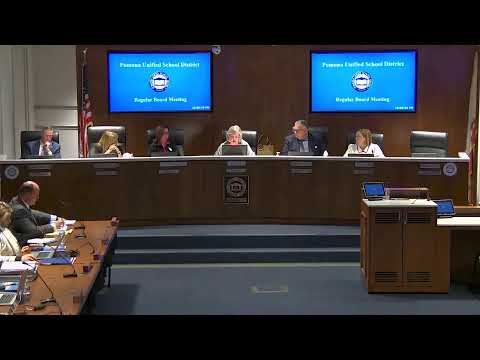
Pomona Unified School District staff presented the first reading of a proposed ethnic studies course and pacing guide at the Feb. 12 board meeting, describing unit content derived from the state model curriculum, supplemental texts and a service‑learning capstone that asks students to apply research to a local issue.
Ms. Fuentes, a PUSD staff member, and Mr. Salcedo Fierro, a district curriculum lead, walked trustees through a six‑unit course sequence that uses the California Ethnic Studies Model Curriculum (2016–2022 model documents) and chapters from Ronald Takaki’s A Different Mirror for Young People. The pacing guide includes: Unit 1 (What is Ethnic Studies?, planned about 4 weeks); Unit 2 (Movement of peoples and oral history, with an oral‑history assignment); Unit 3 (systems of power and consequences including housing discrimination and Japanese American incarceration); Unit 4 (social movements and solidarity, including contemporary movements such as Black Lives Matter); Unit 5 (identity, intersectionality and cultural contributions); and Unit 6 (a YPAR‑style service learning capstone where students develop an action plan and present research at a symposium).
Mr. Salcedo Fierro said the course emphasizes disciplinary historical skills—chronological thinking, historical interpretation and research—and that lessons would be drawn from the state model curriculum, Takaki’s text, and other supplemental materials. He said the district is building professional learning around the course and intends to interweave ethnic studies context into teacher training so classroom instruction reflects the course’s frameworks.
Before the presentation, Anita Jan, a professor in the Ethnic and Women’s Studies department at Cal Poly Pomona and a member of the Ethnic Studies Task Force, urged the board to support teacher training. “We understand that they’re trained historians and social scientists and can pick it up, but what they won’t have are the frameworks and the paradigms,” Jan said. She cited studies that show ethnic studies courses can improve attendance, grades and student self‑esteem.
District staff said the item is the first read and will return next month for a second read; they also emphasized the need for professional learning dollars provided by the state to train teachers who will deliver this content. The presenters noted that the course includes comparative perspectives (African American, Native American, Chicanx/Latinx, and Asian Pacific Islander studies) and will feature local material and lessons on interethnic solidarity, including historical examples such as Mendez v. Westminster. Trustees thanked staff for the detailed curriculum and asked for continued dialogue about implementation and teacher supports.