Get Full Government Meeting Transcripts, Videos, & Alerts Forever!
Get email alerts on the Education Technology topic
No spam. Unsubscribe anytime.
Yorktown middle school teachers and students show classroom use of AI tools
Summary
Yorktown Central School District middle school teachers and students demonstrated day-to-day classroom uses of artificial intelligence tools — including writing support, image generation and AI podcasts — and emphasized teaching responsible, supervised use.
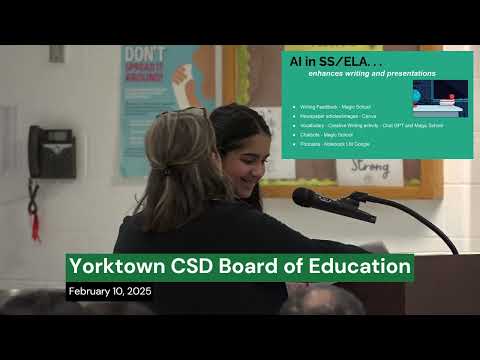
Yorktown Central School District middle school teachers and students on Feb. 10 demonstrated how the district is using artificial intelligence tools in humanities and writing lessons, and described classroom safeguards and teaching practices intended to keep students “the brains behind the technology.”
The presentation, given during the Board of Education meeting, featured a classroom teacher, special education teacher Cheryl Denoia, who said she was initially skeptical but found AI tools aided differentiation and saved teacher planning time. “I was blown away with the possibilities and the outcomes,” Denoia said.
The teachers described several platforms and uses: Magic School (teacher and student tools), a Magic Media/Dreamwebs workflow via Canva for student illustrations, generative-text tools used for paragraph starters and planning, and an AI podcast generator used to create auditory study supports. Student presenters gave concrete examples: one student said the “expand on my idea” tool helped when planning fictional narratives, another said sentence starters and a text proofreader made writing and revising easier, and a third described a wholly AI-generated study podcast that sounded natural and helped with test preparation.
Teachers framed AI as a tool alongside Chromebooks and calculators that can speed work but does not replace students’ thinking. Seventh-grade teacher (presenting as part of the team) said students learn that they must guide AI with prompts and that the output is “not always right.” Teachers said they emphasize repeated review, human editing and verification after AI-assisted drafting.
Board members praised the classroom demonstrations. Superintendent Doctor Hatter and several board members thanked teachers for integrating “responsible use” instruction and noted that AI instruction will be expanded, including the development of a future course and more units of instruction in AI.
The presentation included student work samples and a brief description of planned classroom activities (for example, character chatbots tied to an upcoming novel study). Teachers said they will continue to refine prompts and use AI to provide alternate access points for learners, such as audio summaries for auditory learners.
The board framed the work as part of a wider educational strategy to teach students digital literacy and content creation skills alongside critical thinking about AI outputs. No formal board action was recorded during the AI presentation; the segment was presented as part of the meeting’s “good news” and instructional updates.
For context, presenters named specific vendor/product tools during demonstrations (Magic School, Magic Media/Dreamwebs, Canva, ChatGPT). Teachers and students emphasized classroom supervision, the need for teacher prompting skill, and repeated human review of AI output.