Get Full Government Meeting Transcripts, Videos, & Alerts Forever!
Get email alerts on the Clear Lake Hitch topic
No spam. Unsubscribe anytime.
Lake County, state and federal scientists report mixed Clear Lake hitch results; task force, community science and grants advance conservation work
Summary
Lake County and state and federal partners reported mixed monitoring results and stepped‑up coordination on Clear Lake hitch conservation during a presentation to the Lake County Board of Supervisors.
Lake County and state and federal partners reported mixed monitoring results and stepped‑up coordination on Clear Lake hitch conservation during a presentation to the Lake County Board of Supervisors.
The presentations on the species’ status, led by the California Department of Fish and Wildlife (CDFW), the U.S. Geological Survey (USGS) and Lake County Watershed Protection District staff, reviewed long‑term survey methods, described a high but short‑lived increase in 2023 that did not continue in 2024, and laid out near‑term actions including a revised conservation strategy, expanded tribal and agency coordination, community science training and additional monitoring studies.
The Clear Lake hitch (a fish listed as threatened under California law in 2014) is the focus of a local emergency proclamation the board adopted in February 2023 and renewed in 2024. The U.S. Fish and Wildlife Service has proposed listing the hitch as threatened and is accepting public comment during a 60‑day period.
Filippo La Luz, senior environmental scientist with the California Department of Fish and Wildlife, summarized CDFW’s visual and electrofishing surveys. He emphasized the surveys’ limitations — they are indices, not absolute censuses — and said they do not detect larvae hatched that same year: “we currently do not have a method to, well we don't have a study, to observe larval fish that are hatched in that year.” CDFW’s tributary visual survey recorded a high raw count in 2023 (2,548 fish observed), but the department’s draft population target—three criteria the department proposes to use—is not met by the 2023 or 2024 data. The draft target requires (a) a visual survey count greater than 8,360, (b) a relative population estimate greater than 75,000, and (c) the hitch being the fifth most abundant species in general lake surveys for six consecutive years. La Luz said the draft strategy needs reorganization and clearer performance measures before CDFW will sign it.
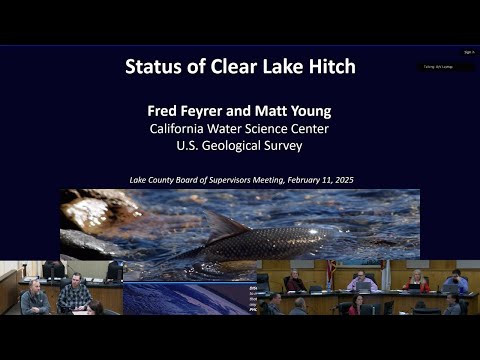
Fred Fira, a research fish biologist with the U.S. Geological Survey, described USGS lake‑wide gill‑net surveys conducted during summer, when fish have returned to the lake. USGS uses catch‑per‑unit‑effort indices to compare years rather than produce an absolute population total. Fira said the surveys recorded very low in‑lake abundance in 2022 (six fish overall in the survey) and a surprising surge in 2023 that has not produced the expected corresponding age‑class carryover in 2024. He said the cause of the 2023 spike remains unknown and listed ongoing studies intended to clarify movement and origin of fish, including otolith chemistry and expanded sampling of adjacent water bodies. “We found quite a few Clear Lake hitch within Blue Lake,” Fira said, noting that populations outside Clear Lake may be buffering the lake population.
Chris Childers of the Lake County Watershed Protection District summarized the district’s first year of tributary spawner observations (14 sites), community science planning and local field work. Childers reported that district crews observed 23 adult hitch in several tributaries and reported a large school of juvenile fish: “we observed 23 adult hitch ... and then also we observed 2,000 juvenile hitch, and that was all in Burns Valley Creek.” He described partnerships with tribes, CDFW, USGS and others on PIT‑tag pilot studies, fish rescues, carp removal, riparian assessments, and outreach. Taylor Woodruff, district hitch technician, added that the juvenile schools observed at the Burns Valley site were close to the lake mouth and not higher in the watershed: “the school juveniles there and not higher up on the other sides.”
Speakers and public commenters urged continued emphasis on creek restoration and flood management. Multiple presenters and members of the public highlighted Coal Creek and associated stormwater infrastructure and flooding as priority issues for both fish and residents; public comment cited repeated summer stranding of hitch where creeks overflow and later dry. Supervisors and speakers noted the district and partners have secured or applied for more than $5,000,000 in grant funds for hitch‑related projects and listed active and planned grants for water‑quality monitoring, creek restoration, lake restoration and planning.
Presenters outlined next steps: (1) revise and reorganize the Clear Lake Hitch conservation strategy with a single author and clearer goals, criteria and timelines; (2) formalize the Clear Lake Hitch Task Force and schedule monthly technical meetings with periodic leadership summits; (3) continue and expand PIT‑tag and otolith studies to trace fish movements; (4) complete a county district second year of tributary spawner surveys and launch community science spawner trainings (announced February 27 and March 5 trainings); (5) pursue coordinated carp management and habitat restoration projects (including fish passage work such as Kelsey Creek and Coal Creek planning); and (6) maintain public data access via the County Water Resources website. USGS also said it has funding to resume its in‑lake survey in 2025 and invited officials and community members to observe field work.
No formal board action or vote occurred at the presentation; the item was an informational update. County staff said they will continue to report progress, finalize the conservation strategy through a transparent process and prioritize projects that align with funding cycles and grant competitiveness.
The county posts presentations and monitoring data at the Lake County Water Resources Department Clear Lake Hitch web page and staff encouraged residents to contact the department for details on volunteer and data opportunities.