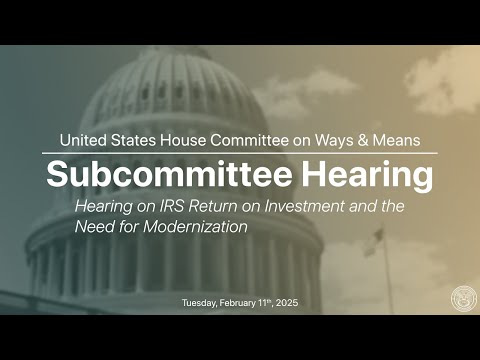
House Ways and Means subcommittee presses IRS witnesses on modernization and IRA return on investment
Get AI-powered insights, summaries, and transcripts
SubscribeSummary
A House Ways and Means Subcommittee hearing focused on whether the Inflation Reduction Actfunding given to the IRS has produced the expected collections and service improvements and on options to modernize the agency, including use of commercial software and AI.
Chairman David Schweikert convened the House Ways and Means Subcommittee on Oversight hearing to examine IRS modernization and the return on investment from funds Congress provided in the Inflation Reduction Act. Ranking Member Rep. Terri Sewell and a panel of witnesses including former National Taxpayer Advocate Nina Olsen, Pete Sepp of the National Taxpayers Union, Minesh Ladwa of SAP, and a Government Accountability Office managing director discussed the agency's technology, service levels and fiscal performance.
Why it matters: Congress set aside roughly $80 billion in the Inflation Reduction Act for IRS enforcement and modernization. Witnesses said early results do not yet show the large fiscal returns that some fiscal scorers expected and that the agency's decades-old IT landscape constrains service and oversight.
Several witnesses questioned the projections used to justify enforcement spending. One witness summarized the shortfall: "For every $1 in new revenue gained, these enforcement efforts had cost a dollar and 4¢," reflecting witness testimony that first-year collections tied to enhanced enforcement fell well short of earlier projections. The witness also cited CBOrevisions that changed earlier deficit estimates for the IRA into substantially different outcomes in later updates.
Former National Taxpayer Advocate Nina Olsen argued modernization must be paired with protections for taxpayer rights and retention of institutional knowledge. "Taxpayer dignity is closely correlated with taxpayers' trust of the tax agency and willingness to comply," Olsen said, adding that digitalization requires both retaining experienced staff and hiring new technical talent.
Industry witness Minesh Ladwa urged a technology-first approach and phased pilots rather than bespoke systems built from scratch. "The IRS stands at a pivotal crossroads, so modernization isn't a choice. It's an economic necessity," Ladwa said, recommending commercially available, cloud-based tools, secure FedRAMP-capable environments and AI-driven case management to reduce manual work and improve accuracy.
Pete Sepp of the National Taxpayers Union urged prioritizing taxpayer service and measurable benchmarks for modernization: "The IRS needs more money. It needed more prior to the Inflation Reduction Act. However, the IRS must prioritize any additional funding it receives toward taxpayer services and modernization," he said, adding that Congress and the agency should require transparent milestones and accountability.
The Government Accountability Office representative described limits encountered in financial audits and said GAO and Treasury continue to report problems that impede a full audit opinion on the General Fund schedules. GAO testimony highlighted longstanding control and data challenges that affect accurate reporting and oversight.
Panelists differed on correct near-term emphasis: some urged shifting funds from enforcement to core IT and service programs; others said enforcement remains necessary but must be implemented with stronger metrics and oversight. Witnesses also debated programs such as the IRSdirect-file pilot and whether it represents a good use of scarce modernization dollars.
Looking ahead, members asked for additional documentation, including data-sharing and access agreements, and signaled potential legislative follow-up. Members also noted pending bills on data protection and refund-recovery mechanisms and said they would submit written questions to witnesses for the hearing record.
The hearing combined technical recommendations for system architecture and data management with fiscal scrutiny of IRA-era enforcement spending; lawmakers on both sides pressed witnesses for concrete milestones, transparent benchmarks and the fiscal metrics necessary to evaluate modernization progress and return on investment.