Get Full Government Meeting Transcripts, Videos, & Alerts Forever!
Get email alerts on the Budget topic
No spam. Unsubscribe anytime.
Medina Valley ISD projects roughly $3.5 million revenue gain as enrollment rises; flags $1.4 million bus pay shortfall
Summary
At a Feb. 12 budget workshop, Medina Valley ISD staff reported higher enrollment and attendance driving about $3.5 million in additional revenue for 2024–25, but warned an underbudgeted $1.4 million in bus-driver pay and anticipated startup and staffing costs for upcoming new schools.
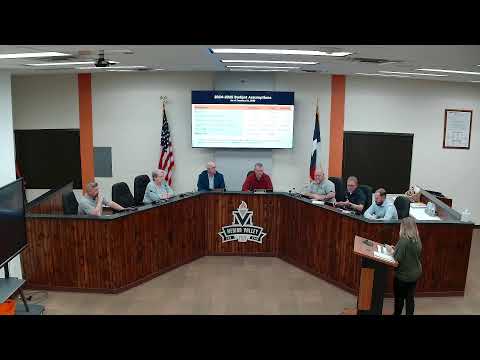
Medina Valley ISD Board of Trustees President Dr. Kalos convened a workshop Feb. 12, 2025, where district finance staff reported a projected roughly $3.5 million increase in revenue for the 2024–25 budget year driven by higher enrollment, stronger attendance and upward adjustments in property values — while flagging a roughly $1.4 million shortfall tied to bus-driver and bus-aide pay that was not fully accounted for in the current budget.
The presentation by finance staff member Crystal framed the numbers as preliminary and said the district expects to carry about $600,000–$650,000 net positive into year-end after known adjustments, but that several one-time and recurring costs remain to be refined before formal adoption. "This is kind of our first swing at our 2025–26 budget," Crystal said as she walked trustees through certified values, attendance and staffing assumptions.
Why it matters: higher enrollment and attendance increase state and local funding but also require immediate spending on staff, buses, portables and building systems. Trustees heard that if growth continues the district will need to budget for ongoing personnel and startup costs for new campuses scheduled in coming years; voters would be the only mechanism to raise additional maintenance-and-operations pennies beyond the district’s current 5 of 17 available.
Key figures and drivers - Enrollment and attendance: The district reported higher-than-budgeted counts for 2024–25, producing an estimated $2.2 million increase attributable to additional students and higher attendance. Finance staff noted average daily attendance (ADA) and weighted ADA (WADA) both rose above the prior budget assumptions. - State and local values: Crystal said changes in state (Comptroller/T2) values and the district’s certified property values produced about $1.2 million in additional revenue. Bexar County was tested in the statewide property value study and passed; Medina County was not tested this year and remains within the assigned-value threshold. - Per-capita and other adjustments: A higher-than-expected per-capita distribution (reported at $622 for the district’s first year of the biennium) added to the increase. Together the enrollment, per-capita and property value changes totaled about $3.5 million in additional revenue versus last year’s adopted assumptions.
Underbudgeted bus pay and other pressures Finance staff identified a significant budgeting issue in transportation pay. The district’s budgeted staffing assumption for bus drivers used a 20-hour workweek; many drivers actually work 30–40 hours. That mismatch meant roughly $1.4 million in straight-time pay for drivers and aides was not captured in the budget; additional overtime and facility- and child-nutrition staffing pressures were noted in other departments. Crystal said the district will include more realistic driver-hour assumptions in next year’s budget.
Projected 2025–26 assumptions and costs For 2025–26 the district used current demographic estimates (third-quarter report) to model a potential enrollment of 10,617 and a budget ADA of about 9,512 (92% attendance assumed). Staff estimated an average funded revenue per student — after weights for special programs — at about $9,500; a cohort of roughly 1,000 new students would therefore add roughly $9–9.5 million in annual revenue under current law, subject to legislative change.
Staffing and compensation: Staff presented a scenario that adding 1,000 students could require roughly 60 new teacher/related positions and about $4.5 million in new recurring staff costs. Trustees were told a 1% across-the-board raise would cost about $720,000.
Capital and openings: Trustees heard ongoing capital needs including HVAC work at Medina Valley High School and Potranco Elementary (identified as the oldest/most problem-prone units), playground replacements (one campus retrofit cited at about $850,000), bus replacements, portables and a possible data-center upgrade. The board also reviewed a multi-year model for opening a new high school in 2026–27, a middle school in 2027–28 and elementary capacity in 2028–29, with startup and reallocation assumptions that staff said will continue to evolve.
Policy and revenue context Crystal reminded trustees that the primary local funding lever is student count and attendance; the only mechanism to raise more M&O (maintenance and operations) revenue locally outside enrollment-driven growth is a voter-approved tax election to add pennies to the M&O rate. She also noted the district is subject to the state property value study and assigned-value rules (5% threshold) and that recent state homestead exemptions and related "hold harmless" mechanisms affect who ultimately pays for education locally.
Decisions and next steps No budget resolution or formal spending vote occurred; the session was a workshop for information and direction. Trustees instructed staff to return with updated models in April (preliminary certified values arrive April 30) and a more detailed five-year plan and campus-level estimates ahead of a May budget workshop. Staff also said they would pursue an HVAC engineering evaluation and bring more precise portables and maintenance cost estimates.
Formal action The only formal action on the agenda was adjournment. Board member Matt Casigliani moved to adjourn; Board member Joe Beater seconded. The motion passed with four trustees voting in favor.
The board meets next for its May budget workshop, when staff expects to present updated enrollment projections, preliminary state values and revised staffing and capital cost estimates.