Get Full Government Meeting Transcripts, Videos, & Alerts Forever!
Get email alerts on the Housing Infrastructure Bonds topic
No spam. Unsubscribe anytime.
Senate committee hears $400 million request for housing infrastructure bonds to expand affordable housing
Summary
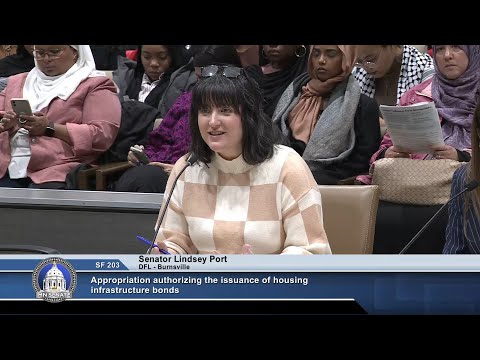
Senator Port presented Senate File 203 to the Minnesota Senate Committee on Housing and Homelessness Prevention, asking the committee to authorize $400 million in housing infrastructure bonds (HIBs) to build and preserve affordable housing across the state.
Senator Port presented Senate File 203 to the Minnesota Senate Committee on Housing and Homelessness Prevention, asking the committee to authorize $400 million in housing infrastructure bonds (HIBs) to build and preserve affordable housing across the state.
Supporters told the committee that HIBs are among the state’s most flexible capital tools for affordable housing. “Housing infrastructure bonds are an extremely flexible tool. And they are the state's largest source of capital for developing and preserving affordable housing,” Senator Port said. Testifiers said HIBs help fund projects that other tools do not support and are critical to preservation and development.
Mandy Pant, director of real estate development and asset management at the American Indian Community Development Corporation, described a recently financed project, Anishinabe 3, a 40-unit permanent supportive housing development serving people with substance use disorders and homelessness. “Without HIBs, these units may not have been built,” Pant said, adding that preservation is urgent as operators face rising insurance, utilities and turnover costs.
Gunnar Carlson, community engagement manager for Riverton Community Housing, described how HIBs could allow cooperatives to convert leasehold properties into shared-equity ownership that would add affordable ownership units to the local housing stock. Tyrone Shields, a housing advocate with Alliance Housing who said he was formerly unhoused, credited affordable housing with helping him regain stability. John Thorson of LiUNA Minnesota and North Dakota said the request includes $400 million for HIBs and $100 million in general obligation bonds for public housing, and emphasized jobs created by construction.
Fiscal staff provided a debt-service picture for the committee. Mr. Olson said debt-service costs for a $400 million HIBs authorization would begin in fiscal 2028, with an estimated $8 million in the first year, $22.4 million in fiscal 2029 and roughly $32 million annually from fiscal 2030 through 2047; using the modeling provided, he reported a 20-year total cost to the general fund of approximately $606.4 million. Mr. Lisonbee explained legal differences between HIBs (appropriation bonds) and general obligation (GO) bonds, noting appropriation bonds are repaid only if the legislature appropriates debt service and do not pledge the state’s full faith and credit the way GO bonds do.
Committee members asked for more granular fiscal data and questioned whether the state would get “the best value” for its money. Senator Abler urged scrutiny of development costs and fees, saying some projects show elevated per-unit costs that deserve review. Kelly Law of the Minnesota Consortium of Community Developers said nonprofit, mission-driven developers use HIBs as gap financing and that the program serves communities statewide.
The committee did not take a final vote on the bill. Senate File 203 was laid over for possible inclusion in a future omnibus bill; no formal recorded committee vote on passage was taken during the hearing.
Ending: The committee laid Senate File 203 over for possible inclusion in an omnibus bill and requested additional fiscal information for future consideration.