Get Full Government Meeting Transcripts, Videos, & Alerts Forever!
Get email alerts on the Education topic
No spam. Unsubscribe anytime.
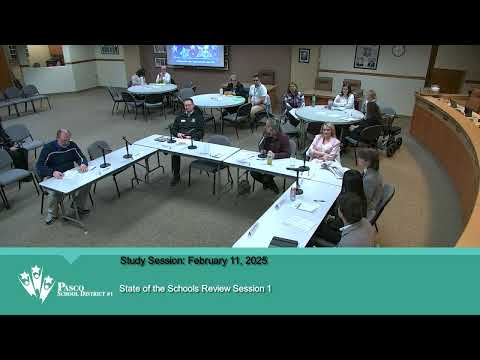
Pasco School District holds State of the Schools review with three elementary schools focusing on literacy, math and attendance
Summary
At a Pasco School District study session, Assistant Superintendent Goble led a State of the Schools review in which principals from Curie STEM (Marie Curie), Columbia River and Livingston elementary schools presented midyear progress-monitoring data and improvement strategies for literacy, math and attendance.
Assistant Superintendent Goble opened a Pasco School District study session titled the State of the Schools review and said the event’s purpose was “for the school teams to share their school improvement efforts, with key stakeholders.”
The session featured table-rotation presentations from principals of Curie STEM (Marie Curie), Columbia River and Livingston elementary schools. Each table received the same two-sided data “one-pager” showing midyear progress-monitoring measures in literacy, math and attendance. Goble described the data set as fall-to-fall STAR scores and assessments presented in both English and Spanish where applicable, and said attendance was included “because that’s 1 of the key indicators we’re looking at for student engagement.”
Nut graf: District staff said the reviews are designed to let school teams present their improvement goals, strategies and action steps and to explain how they are adjusting strategies based on data; the session was not intended as a formal evaluation of school work.
Presentations followed a 20-minute rotation format so board members and attendees could hear each school’s summary of strengths, areas for growth, the strategies tried so far, results and planned adjustments for the remainder of the school year. Goble asked table participants to use personal timers to keep rotations on schedule.
District materials provided to attendees were described as a midyear progress-monitoring snapshot distinct from the summative data (such as prior-year state testing) submitted with school improvement plans in November. Schools were asked to focus remarks on: the data summary, specific improvement strategies, evidence of how those strategies worked or did not work, and next steps.
A board member thanked the presenters for candidly identifying areas needing improvement, saying, “I appreciate hearing that. Not because it makes it real and we understand that, your guys' job is difficult and it's things are never perfect.” A student representative told the assembled group, “all 3 of these elementary schools are doing their own things to get their students where they want them to be,” and praised the schools’ commitment to students.
The study session concluded with the chair thanking the principals for sharing their data “so transparently” and noting the district emphasis on academic, social-emotional supports and attendance as drivers of student performance. No formal board action, motions or votes were recorded in the transcript of this session.
Ending: The district invited attendees to remain for the regular board meeting scheduled to follow; the study session adjourned after the rotations and brief board comments.