Get Full Government Meeting Transcripts, Videos, & Alerts Forever!
Get email alerts on the Manufactured Housing Zoning topic
No spam. Unsubscribe anytime.
Odessa council hears plan to limit mobile and manufactured homes to MH/MHE zones; staff to return with citywide option
Summary
City planning staff outlined two options to restrict mobile/manufactured homes to MH/MHE zoning; council members expressed support for a citywide approach and asked staff to start the formal notice and ordinance process at the next meeting.
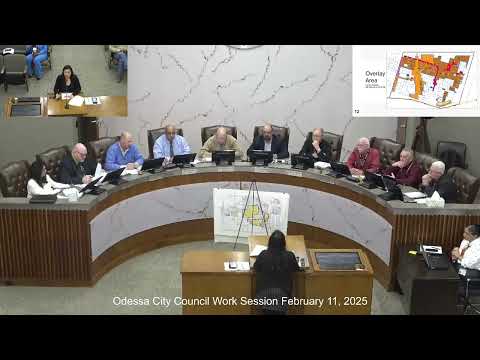
At a Tuesday meeting, Odessa City Council members and city planning staff discussed a proposal to limit placement of mobile and manufactured homes to properties zoned MH or MHE, with staff recommending either an overlay for a targeted area or a citywide zoning change.
Elizabeth “Liz” (Staff member) opened the presentation with definitions and data, saying the city currently treats mobile homes and manufactured homes as a single category and noting that HUD differentiates units built before and after 06/15/1976. She told the council the study-area boundary contained about 3,070 homes, including 746 mobile homes and 2,324 single-family dwellings, and that an overlay district showed 1,244 lots with 522 mobile homes (about 42% of residential lots in that overlay).
The plan staff presented offered two options: (1) create an overlay zoning that would remove mobile/manufactured homes as an allowed use only inside the study-area boundary (staff estimated 6,591 lots would need mailed notice, at a calculated mailing cost), or (2) amend the citywide zoning so mobile/manufactured homes would only be allowed in MH and MHE districts (staff estimated 9,762 lots would require notice and higher mailing costs). Either approach would preserve existing units as legal nonconforming uses, Liz said, and units damaged up to a certain threshold could be rebuilt under existing rules; complete loss from an event such as a fire could trigger compliance with the new standard.
Council members focused discussion on neighborhood appearance, infrastructure costs, and the city’s goal of increasing taxable value. Councilman Mitchell criticized the placement of new mobile homes within established neighborhoods, saying, "What good does that do to the community? Why would you build homes and then allow 10 mobile homes to cover up all the houses?" Several council members urged caution about fragmenting rules by district and argued for a consistent, citywide policy.
Members and staff discussed implementation details raised during the presentation: vacant lots identified in the overlay (577), recent building-permit counts for 2024 (11 new residential permits in the study area; six in the overlay; 17 new mobile-home permits citywide for the same period), and infrastructure obligations for infill development (water/sewer connections and foundation/tie-down requirements differ by site). Liz said notices, public hearings (P&Z), and two council readings would be required for either option.
There was no formal ordinance vote at the meeting. Council consensus favored pursuing the citywide option and directing staff to bring the item back for formal action at the next meeting, with Councilman Fitch asking staff to start the process and include option 2 on the next agenda. The meeting adjourned after a procedural motion.
Why it matters: The zoning change being considered would restrict where new mobile or manufactured homes may be placed inside city limits, while allowing existing units to remain. The proposal carries implications for neighborhood character, infill development costs, developer incentives, and the city’s property-tax base.