Get Full Government Meeting Transcripts, Videos, & Alerts Forever!
Get email alerts on the Workers Compensation Statutory Employer topic
No spam. Unsubscribe anytime.
Tennessee Supreme Court hears argument over whether vendors are "statutory employers" under workers' comp law
Summary
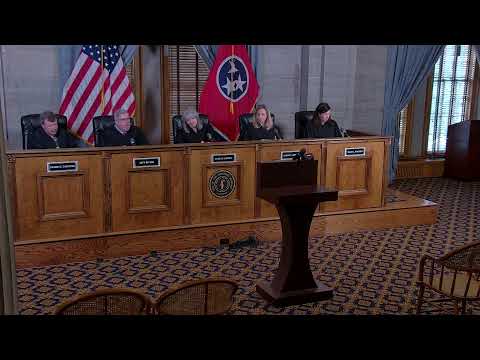
At an on‑site February 12 oral argument at the Tennessee Capitol, the Supreme Court considered whether a vendor–vendee relationship can make a retail customer a "statutory employer" under Tenn. Code § 50‑6‑113(a), a question that could affect retailers, suppliers and injured sales representatives across the state.
The Tennessee Supreme Court heard oral arguments February 12 on whether Tractor Supply Company should be treated as a "statutory employer" of a visiting sales representative injured inside one of its stores, a determination that turns on how the court interprets Tenn. Code § 50‑6‑113(a).
The dispute arises from a premises injury that Brian Koblenz suffered when barn‑door rails fell at a Tractor Supply in Fayetteville while he was working as a sales representative for Stanley National. Rick Colbert, counsel for the plaintiff‑appellant, told the court the long‑standing three‑factor Murray/Lindsey test does not fit a vendor–vendee relationship and urged the justices to analyze the relationship’s factual details rather than automatically treating the retail purchaser as a principal contractor.
Why it matters: the issue controls whether certain businesses can be held liable under Tennessee’s workers’ compensation statute for injuries to non‑employee vendors’ workers. If the court narrows or expands the statutory‑employer rule, large numbers of delivery drivers, route salespeople and suppliers who enter retail premises could gain or lose a route to compensation or civil recovery.
Colbert said the typical vendor’s activity in retail — visiting stores every few weeks, checking inventory, ordering replacement product and occasionally tidying a display — is "as incidental as incidental can be" and therefore should not make the store a principal contractor under the statute. "It just doesn't fit a vendor, vendor–vendee relationship," Colbert told the court, arguing that the statutory concept of a "principal contractor" historically contemplated construction‑type subcontracting arrangements.
Counsel for Tractor Supply, Colton Jones of Spencer Fane, asked the court to read the statute broadly and to decline what he called a judicially created exception for vendors. Jones framed the question as one of statutory interpretation and stare decisis, saying the court should defer to the legislature if a narrower rule is desired. "This court should decline to carve out an exception," Jones told the justices, warning that a court‑created exception would leave injured workers with uneven protections.
A central point of contention was which legal test should control. The court of appeals applied the state’s Murray/Lindsey three‑factor test, focusing in this case on whether the vendor’s work is part of the retailer’s regular business. Colbert urged the justices to adopt a predominant‑purpose or "substantial services" inquiry, used by several other states, which looks at the entire factual record and whether services accompanying a goods sale are substantial rather than merely incidental.
Jones and other defenders of the broader reading pointed to long‑standing Tennessee precedent — including Williams (1924) and McVay (1945) as discussed in argument — that courts have interpreted "subcontractor" expansively and to policy goals in Lindsay: assuring injured workers receive compensation, preventing employers from shifting work to avoid liability, and encouraging hiring of insured subcontractors. Jones repeatedly referenced the statute's text, Tenn. Code § 50‑6‑113(a), and argued that changing the court’s established approach would amount to a policy decision for the legislature.
Justices probed both sides on practical consequences. Several asked how a rule favoring a narrow vendor exception would operate in everyday retail settings — for example, distinguishing a once‑a‑year delivery from a regular, contractual supply relationship — and whether the court would be required to overturn decades of precedent to adopt such an exception. Colbert suggested the court should analyze the "totality of the facts" and apply a predominant‑purpose framework; Jones urged fidelity to existing precedent and emphasized legislative authority to change the rule if necessary.
The arguments concluded with both sides acknowledging the practical stakes for retailers, suppliers and workers but differing on whether the court should adjust the legal test or leave change to the legislature. The court announced the case "will be submitted," a routine conclusion to argument indicating the justices will consider briefs and argument before issuing an opinion.
For now, the case remains pending and no decision was announced from the bench.