Get Full Government Meeting Transcripts, Videos, & Alerts Forever!
Get email alerts on the Education Funding topic
No spam. Unsubscribe anytime.
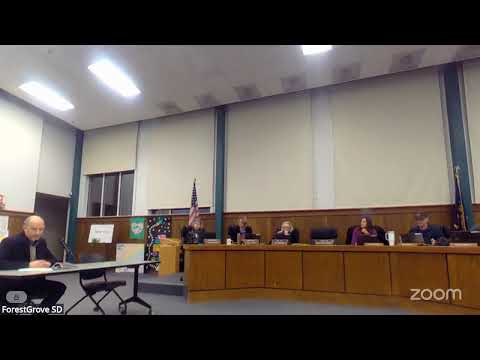
Forest Grove board debates state school funding, test scores and new mandates
Summary
Superintendent Suzanne West framed a statewide debate over increased school spending and stagnant test scores, warned of rising unfunded mandates, and outlined the district’s legislative priorities during the Feb. 11 board meeting.
Superintendent Dr. Suzanne West told the Forest Grove School District Board of Directors on Feb. 11 that recent state-level reports showing rising school spending alongside falling test scores require careful interpretation and local context.
West said the district’s legislative priorities include the state school fund, special-education funding caps, ECSC services and addressing unfunded mandates. She warned that changes passed at the state level can create significant implementation costs for districts. “Every time we are asked to do something new … we have to turn our attention from instruction to that new thing,” West said.
The superintendent walked the board through a series of charts showing that expenditures per pupil in Oregon have increased since 2013 while academic performance on state tests has not risen in step. “The expenditure per pupil does not parse out how much of that never makes it to the classroom,” West said, citing pension (PERS) costs, statewide program expansions and district-level requirements such as planned LED lighting replacements.
West also questioned the reliability of Oregon’s state test scores as a performance measure. She noted statewide participation rates below levels she considers representative and said the way participation is counted can inflate results: “To make any kind of meaningful inference from it, we have to be up at about 95 percent,” she said, adding that some students are counted as having participated after completing as few as five questions.
Board members said they want better context rather than headlines that equate spending with outcomes. Director Mark (last name not specified) summarized press coverage and national trends, noting the National Assessment of Educational Progress (NAEP) shows declines nationwide even where spending rose. Other board members urged state-level conversation about system design, not just mandates.
West told the board she has been tracking bills in the Ways and Means process and urged that legislators consider implementation impact when drafting new content-area requirements, citing computer science as an example that would require curriculum, hardware, software and staff training. She recommended that accountability expectations be matched with commensurate supports from the state.
The board’s discussion ended with members agreeing a larger conversation is needed on how state policy can better align funding, required programs and the supports districts need to implement them.
Less-urgent material: West said federal ESSER funds helped districts through pandemic-era shortfalls but that ongoing state-level funding trends leave districts still recovering from a small pandemic-era biennial increase.