Get Full Government Meeting Transcripts, Videos, & Alerts Forever!
Get email alerts on the Civilian Oversight topic
No spam. Unsubscribe anytime.
Providence PERA meets with national oversight trainer on records access, independence and community outreach
Summary
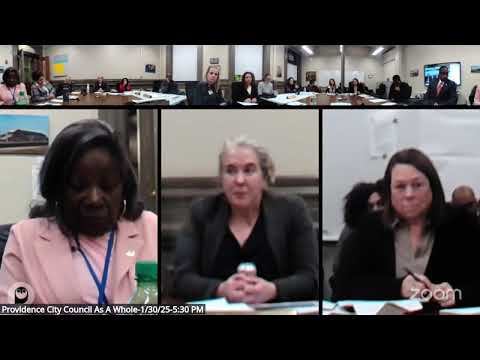
The Providence Police Oversight Review Authority (PERA) and Providence City Council held a joint informational session featuring Tina Barr, director of training and education at the National Association for Civilian Oversight of Law Enforcement (NACOLE), who reviewed the organization’s 13 principles for effective civilian oversight of police.
The Providence Police Oversight Review Authority (PERA) and Providence City Council held a joint informational session featuring Tina Barr, director of training and education at the National Association for Civilian Oversight of Law Enforcement (NACOLE), who reviewed the organization’s 13 principles for effective civilian oversight of police.
Barr told the assembled PERA members, councilors and staff that "there are approximately 300 oversight entities in this country that we know of, and no two are exactly alike," and explained that the principles aim to increase oversight effectiveness by clarifying authority, ensuring independence and improving access to records.
Those points framed the meeting’s main concerns: (1) structural, political and operational independence for PERA; (2) direct access to police records and data to prevent delays and incomplete investigations; (3) a proactive auditing and monitoring role beyond case-by-case reviews; and (4) a stronger public-engagement program to raise community awareness of oversight functions.
Why it matters: Barr said better-designed oversight can protect constitutional and civil rights, reduce institutional risk and increase public trust by identifying patterns of problematic policy or practice before they produce serious incidents or lawsuits. "If someone is being observed or watched...they are more likely to alter their behavior," she said, describing the so-called "hallmark effect."
Key takeaways from Barr’s presentation included: - Independence: Barr described three dimensions — structural (organizational separation from the police), political (limits on elected officials’ control over appointments and budgets) and operational (ability to initiate investigations, issue subpoenas where authorized, and set timetables without undue interference). She noted 2021 data showing about 26% of oversight bodies nationally have independent legal counsel. - Records and data access: Barr recommended that investigators and auditors have access to complete internal-affairs files, body-worn-camera and in-car footage, dispatch recordings, training records and relevant databases. She cited a survey of large U.S. oversight bodies showing roughly 47% rely on enabling legislation, 33% on memoranda of understanding and 50% on department policies to secure access; many cities use more than one mechanism. Barr pointed to Portland, Denver and New York’s Civilian Complaint Review Board as examples of offices with broad access. - Proactive auditing and monitoring: Barr recommended oversight offices move beyond purely reactive review of completed investigations toward regular audits and monitoring of department practices so problems can be identified earlier. - Community engagement and transparency: Barr urged a public-facing approach — an annual report, public trackers for recommendations, listening sessions, rotating meeting locations and partnerships with community organizations — and advised that transparency include explaining obstacles or resource constraints to the public.
Local discussion and next steps: Councilwoman Harris said the council is "very much interested in making sure that what we have, we're doing our best," and asked Barr to identify targeted changes that would strengthen Providence’s ordinance. Barr offered to follow up with written recommendations after a closer review of the proposed amendments.
Staff and board members confirmed several local constraints and current practices: PERA has no memorandum of understanding (MOU) with the police department (a staff member responded "No" when asked if an MOU exists), the PERA database was offline for a period but is being reactivated, and the board’s investigator has identified four cases that will proceed to hearing. Board members and councilors expressed support for tracking PERA’s policy recommendations and for the council to consider endorsing targeted ordinance amendments to increase PERA’s effectiveness.
On funding, participants noted that oversight offices are typically funded by the local municipality; Barr said she is not aware of oversight bodies that routinely receive private foundation funding for core operations. Several council members offered to help secure resources and to work with PERA on strategic planning, public reporting and faster access to records where legally permissible.
Ending: PERA and council members agreed to pursue follow-up steps including: (1) Barr’s written recommendations after reviewing Providence’s draft amendments; (2) better tracking of PERA policy recommendations and police responses; (3) reactivation and public use of PERA’s database; and (4) a strategic planning process to prioritize achievable short-term reforms. The informational session closed with an adjournment of the joint meeting.