Get Full Government Meeting Transcripts, Videos, & Alerts Forever!
Get email alerts on the Zoning Amendments topic
No spam. Unsubscribe anytime.
Providence zoning overhaul advances as council reviews Phase 1 of Title 27 amendments
Summary
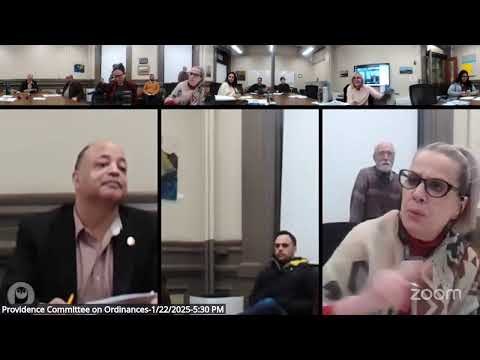
Providence City planning staff on Jan. 22 presented a package of Phase 1 changes to Title 27 of the City of Providence zoning ordinance to implement the recently adopted comprehensive plan; the committee entered the map changes into the record and agreed to carry the matter to a public hearing in February.
Providence City planning staff on Jan. 22 presented a package of revisions to Title 27 of the City of Providence zoning ordinance intended to implement the city’s recently adopted comprehensive plan, and the council’s zoning committee voted to enter the proposed zone changes into the record and to carry the matter to a public hearing in February.
The amendments would update the zoning and overlay maps, add or remove properties from historic overlays, establish new dimensional and density rules for several residential zones (including a new R‑4 approach), tighten some C‑2 commercial uses such as vehicle repair and certain drive‑through permits, create clearer rules for row houses, and align the local household/occupancy definition with recent changes in state law. Planning staff also proposed new rules on significant tree removal, refuse container screening, and a requirement that anyone seeking a zoning change have a pre‑application conference with the planning department.
Planning Director Robert Aysa, presenting the package to the committee, said the amendments are a first phase of changes to bring zoning into alignment with the comprehensive plan. “We have been working for, many months now, on these zoning changes that are intended to implement the comprehensive plan,” Aysa said. He described the Phase 1 package as map changes, overlay adjustments, and a set of text edits and standards that staff said are legally required or needed for clarity.
Key proposals and details
- Map and overlay changes: The package would implement the comprehensive‑plan future land‑use map by rezoning multiple parcels (examples discussed include conversions from R‑2 to R‑3 and the creation of new R‑4 areas) and by adjusting overlay districts. Staff said three properties (including two on the Providence College campus, with owner consent) would be added to historic overlays and four properties would be removed where the historic structures had been demolished or where lot lines changed.
- Capital Center and state action: Staff recommended sunsetting the Capital Center Commission’s role and said doing so requires action at the state level. Aysa said the city plans to introduce legislation at the General Assembly to revise the state law sections that govern the commission. "It's time to sunset that commission," he told the committee, while noting any city changes would not take effect until the state acts.
- C‑2 commercial and drive‑throughs: The draft would remove vehicle repair as an allowed use in C‑2 zones while retaining vehicle rental; staff said legally established repairs could continue as nonconforming uses. Drive‑through standards would be tightened to require traffic studies as part of any special permit.
- Unmerging lots: The ordinance would allow certain previously merged lots to be unmerged where owners are disadvantaged by past merger rules; newly re‑created lots could not be smaller than 2,500 square feet and reconstitution could not increase the number of lots beyond the historic count, staff said.
- R‑4 density and multifamily rules: Staff said R‑4 will include a minimum land area per unit (presenter cited 500 square feet per unit as the standard used to cap density in R‑4, i.e., a 5,000 sq. ft. lot would allow up to 10 units under that calculation). Multi‑family development in lower‑density zones would remain subject to a special‑use permit and would be limited to densities consistent with what detached housing would allow on the same land area. The committee also heard that short‑term rentals would be defined as rentals of 28 days or less and would be restricted in certain residential contexts; and that in R‑1 and R‑1A zones a separate student occupancy rule (no more than three students per property) would remain in force where it already applies.
- Row houses (roadhouses): The draft clarifies a row‑house building type where each unit sits on its own lot with lot lines drawn through party walls; staff said the proposal would allow narrow lot widths (down to about 12 feet for interior units, 18 feet for end units in some zones) where appropriate and still require lot‑by‑lot subdivision approvals after construction.
- Household / occupancy definition: Staff recommended updating the local household definition to reflect the state law formulation discussed in recent General Assembly changes. Aysa said the state language provides for occupancy limited to roughly "no more than 1 per bedroom and not to exceed 5 in a dwelling unit." The city’s prior standard of three unrelated people citywide would be replaced by the new wording; staff said student‑specific rules would remain a separate local regulation that applies in specified zones.
- Trees, dumpsters and site controls: The draft defines a "significant tree" and strengthens replacement requirements: unauthorized removal would trigger a zoning violation, a $500 fine (the maximum permitted for a zoning violation under current court interpretation) and tree replacement obligations — staff said the standard restitution is three large trees unless the forester allows fewer for dying/hazardous trees. The proposal also closes a loophole to require enclosures for large private refuse containers in properties with four or more units; currently the requirement did not apply to 1‑3 family houses.
- Technical and clarity edits: The ordinance includes a series of technical fixes such as consistent terminology for "nonconforming" or "substandard" lots, tweaks to front‑yard measurement so porches are not unintentionally penalized, clarification of standards for stairs and front‑yard encroachments, and guidance for retaining wall materials and landscaping to reduce runoff.
Committee action and next steps
The committee voted to enter the proposed zoning map changes into the record as an exhibit (moved by Councilor Shelly Peterson; seconded by Councilor Boyle). The committee then agreed to continue the matter to a public hearing scheduled for February; the meeting transcript records the hearing window but does not specify an exact calendar date in committee discussion. Staff said Phase 2 of the zoning amendments — which planners described as a later package that could address parking minimums, gas station prohibitions, design standards and other elements — will be brought forward to the planning commission and council in coming months.
Questions from council members in the hearing focused on enforcement (inspections handled by the Department of Inspection and Standards), the interaction between student‑occupancy rules and the household definition, how the city would treat existing legally established nonconforming uses (they continue unless expanded), potential affordability effects from occupancy limits, and the limits of city authority (noting some elements such as sunsetting the Capital Center Commission require state legislative change).
Quotes
"We have been working for, many months now, on these zoning changes that are intended to implement the comprehensive plan," Planning presenter Robert Aysa said.
Councilor Shelly Peterson, raising concerns about household limits and affordability, said: "While I'm definitely a supporter of limits ... I am cognizant of the fact that this could potentially also impact affordability, as increasing rents continue to be an issue for our city residents." (remarks during committee Q&A.)
Ending
The committee’s action put the Phase 1 edits into the public record and set a February public hearing; staff told the committee it will return with Phase 2 amendments in the coming months. Several council members asked staff to provide additional detail on enforcement, likely impacts on housing affordability, and more precise draft language before the public hearing. The committee then moved to adjourn and to continue the matter per the hearing schedule.