Get Full Government Meeting Transcripts, Videos, & Alerts Forever!
Get email alerts on the Procurement Local Economic Impact topic
No spam. Unsubscribe anytime.
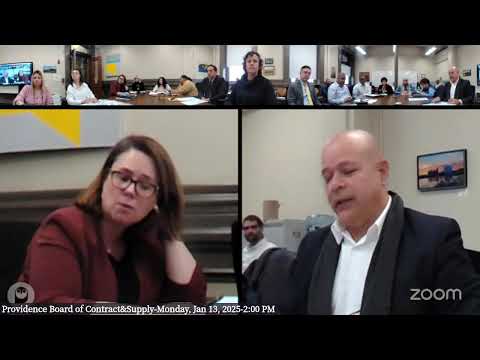
Providence board seeks clearer accounting of school-construction subcontracting and local economic impact
Summary
The Providence Board of Contract and Supply on Jan. 13 asked city staff to produce more detailed data showing how school-construction dollars flow to Providence residents, including subcontractor payment amounts and where subcontractors are located.
The Providence Board of Contract and Supply on Jan. 13 asked city staff to produce more detailed data showing how school-construction dollars flow to Providence residents, including subcontractor payment amounts and where subcontractors are located.
Board members said city documents for ongoing school-construction projects list prime contractors and some subcontractors but do not break out how much each subcontractor receives or whether work and spending benefit Providence households. A board member said the city should be able to document the dollar amounts that remain in the city to measure economic impact from roughly $700,000,000 in planned school construction that was discussed during the meeting.
The request came during Section E of the board’s agenda, a standing discussion item. Staff said they have some compliance and dollar-level data at the vendor level and can combine that with first-source and MWBE (minority- and women-owned business enterprise) compliance records as a first step. Staff cautioned that asking subcontractors for employee-residence data raises legal and practical questions and said some of the information vendors can reasonably provide will vary by contract and the size of the subcontractor.
Board members pressed two lines of inquiry: (1) a clearer, contract-level report of dollars paid to each prime and subcontractor on school projects and (2) whether the city’s purchasing ordinance or state law allows the city to add scoring or preference points for vendors based on local hiring or the percentage of staff who live in Providence. Staff said the city’s purchasing rules currently mandate awarding to the low bidder in many procurements and that changing that practice would require ordinance-level adjustments and coordination with legal counsel.
Members also asked for reporting on how the city currently accounts for MWBE participation and whether veterans’ status is considered in current procurement processes. An NWBE coordinator was referenced as tracking some participation data; board members asked staff to include MWBE and first-source reporting alongside any new vendor-level dollar breakout.
Separately during the meeting the board conducted routine bid openings and administrative votes. Highlights recorded on the agenda included an Arts, Culture and Tourism procurement listed at $300,000; several Department of Housing and Human Services grant rebids (Clinica Esperanza: $10,000; Integrative Healthcare Solutions: $50,000; Rhode Island Black Storytellers: $49,200); a Providence Police recruit medical-plan bid (Concentra); and a five-year lease bid for city property known as Camp Cronin, which included a submitted budget showing roughly $640,000 in revenue and $571,800 in expenses. The board referred opened bids to the city clerk’s office for further processing and voted to approve the items listed on Section A of the agenda.
Votes at a glance - Elect acting chair by seniority: Motion made by Director DePina, seconded by Director Bellini; outcome: approved (voice vote). - Refer opened bids to the city clerk’s office: Motion made by Director Dukmina, seconded by Trevor Dura Husband; outcome: approved (voice vote). - Approve items 1–5 in Section A (consent items including several grant and procurement items): motion mover/second not specified in transcript; roll call recorded 9 ayes, 1 nay, 2 absent. Vote record from the roll call: Courtney Hawkins — Aye; Council President Pro Tempore Rey Petrado — Aye; Councilman Dunsel — Absent; Councilwoman Anthony — Aye; Miss Silvani — Aye; Miss Richards — Aye; Mister DePina — Aye; Miss Kornfig — Aye; Mister Husbands — No; Mister Arzemanian — Aye; Mister Delaney — Aye; Mister Grobel — Absent. Tally: 9 yes, 1 no, 2 absent — motion approved. - Approve advertisements in Section C: Motion made by Director Richards, seconded by Director Bellini; outcome: approved (voice vote). - Approve minutes from the Dec. 30, 2024 meeting: Motion made by Councilman Anthony, seconded by Director Richards; recorded result shows 5 ayes and 5 abstentions (several members noted they were not present at that meeting). The transcript lists named abstentions including Councilman Petrardo, Courtney Hawkins, Director Quinn Figg, and Director Arzemanian; one additional abstention was recorded but not specified by name. Outcome: approved with 5 ayes and 5 abstentions. - Adjourn: motion made and seconded; outcome: approved (voice vote).
Board direction and next steps Board members asked staff to return with (1) a vendor-level summary showing total dollars paid per prime and, where available, per subcontractor for school-construction projects, and (2) existing MWBE/first-source compliance data the city already maintains. Staff agreed to start with vendor-dollar totals and the city’s compliance reporting and report back to the board. Members discussed whether ordinance changes would be needed to create procurement preferences for local hiring; staff said that would require legal review and possible ordinance amendments.
Why it matters Board members framed the request as a transparency and local-benefit question: large capital projects have multiplier effects when dollars are spent with local firms and employees, and the board said it cannot assess that effect without clearer reporting. At the same time, staff highlighted legal and administrative limits to what bidders can be required to disclose and what the purchasing office can consider when awarding contracts; changing how bids are scored would require policy changes.
What the board did not decide No ordinance changes or new scoring criteria were adopted at the Jan. 13 meeting. The board’s action was a request for additional data and for staff to return with more-detailed reporting and the possible legal implications of requiring additional vendor disclosures.