Get Full Government Meeting Transcripts, Videos, & Alerts Forever!
Get email alerts on the Enrollment Projections topic
No spam. Unsubscribe anytime.
UW–Madison projects Sun Prairie Area School District enrollment could fall or rise slightly over five years
Summary
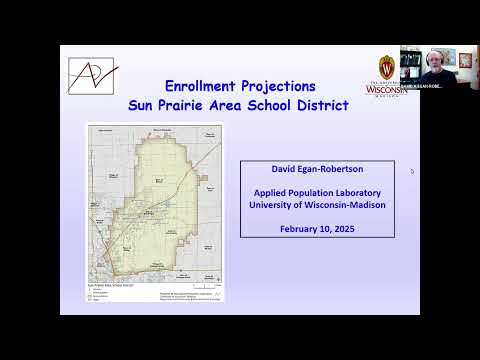
David Egan Robertson, a demographer at the UW–Madison Population Laboratory, told a presentation that the Sun Prairie Area School District’s total preK–12 enrollment is projected to range from roughly 8,400 to about 9,100 students in five years — a numeric change of about “minus 2 to plus 6 percent” from current levels, he said.
David Egan Robertson, a demographer at the UW–Madison Population Laboratory, told a presentation that the Sun Prairie Area School District’s total preK–12 enrollment is projected to range from roughly 8,400 to about 9,100 students in five years — a numeric change of about “minus 2 to plus 6 percent” from current levels, he said.
The projections matter because they give district leaders a range of potential student counts to consider for near-term planning. Robertson said the results come from four models that rely on three primary building blocks: projected births, kindergarten counts and grade-progression ratios (GPRs), which capture year-to-year cohort change.
Robertson summarized the district’s recent history: total enrollment rose about 6 percent over the past decade (about 470 students), with an early three-year gain, a subsequent four-year dip and renewed growth in the last two years. He said lower grades have been smaller while middle- and high-school grades have grown: 4K declined about 70 students (roughly 14%) over the decade, kindergarten through fifth declined by about 100 students (about 3%), grades six through eight increased by nearly 200 students (about 12%), and grades nine through 12 rose by about 450 students (about 19%).
Robertson noted an increase in open-enrolled students: the district averaged about 370 open-enrollment incoming students in the past three years versus about 300 in the prior six years, producing a net open-enrollment gain of about 80 students over the last two years. He also said household counts with children in the district rose 13 percent between the 2010 and 2020 censuses, while the state saw a decline over that same period.
On model results, Robertson said the four projection variants produce a districtwide five-year range of about 8,400 to a little over 9,100 students (numeric change of about –200 to +520). He gave subgroup ranges: elementary (kindergarten–5th) about 3,400 to 3,575 (about –80 to +90); middle schools about 1,710 to 1,920 (about –145 to +65); and high schools about 2,725 to 3,130 (about –60 to +350).
Robertson explained methodological choices that affected results. He said GPRs are averaged over different time frames and that the 2-year trend GPRs are higher than 5-year or baseline GPRs because recent cohorts have grown; for high schools he used a shorter trend (two years) because the most recent two years showed a pronounced uptick. On births, he reported historical birth counts generally between 500 and 600 annually and noted births reported for 2023 were 44 fewer than in 2006; depending on whether long- or short-term birth trends are used, projected kindergarten cohorts vary modestly.
He emphasized that the group produces a range of projections to reflect uncertainty: “We produce a range of projections and this is to reflect uncertainty in projections. Predicting is not an impropriately precise science,” Robertson said. He also described GPRs as a way to capture implicit migration: “The grade progression ratios or GPRs for short are the only way we can capture year over year change in enrollment.”
The presenter said the team carries projections out 10 years but emphasizes the first five years because most children entering school after five years have not yet been born, increasing uncertainty. Robertson said he will be available at the board meeting on February 10 to answer questions about the report and projections.