Get Full Government Meeting Transcripts, Videos, & Alerts Forever!
Get email alerts on the Land Use Rezoning topic
No spam. Unsubscribe anytime.
City council rejects rezoning for proposed "Nevada Flats" reuse of old hospital; developers had state incentives
Summary
The Nevada City Council on Feb. 10 voted 1–4 against rezoning 630 Sixth Street so a developer could convert the former Story County Medical North Campus into roughly 60 market-rate apartments, leaving the project without the change needed for the proposed reuse.
The Nevada City Council on Feb. 10 voted down the second reading of an ordinance to rezone the former Story County Medical North Campus at 630 Sixth Street from R-3 (urban family) to R-4 (multiple-family), a change the developer has said is needed to convert the vacant hospital into a roughly 60-unit market-rate apartment project known in materials as "Nevada Flats." The motion failed on a 1–4 vote.
Brenda Dreyer, economic developer and representative of the Nevada Economic Development Council, told the council the project team led by Capstone Group LLC has secured state of Iowa incentives including workforce housing tax credits and brownfield redevelopment tax credits that together were described in council materials as approximately $2.5 million in award value. Dreyer said the awards require a local commitment to support the state application and that the NEDC and city agreed to split a minimum local match of $1,000 per unit if required, a sum described as $60,000 total as a payment in lieu of taxes if the property would otherwise be non-taxable.
Dreyer said the Capstone Group is a nonprofit 501(c)(3) housing owner with two existing senior-housing projects in Iowa and has aligned with Aspect Architecture and a coordinating financing partner. She said a contractor has been identified, demolition/cleanup crews planned to begin work the following week, and the developer estimated construction completion in about a year.
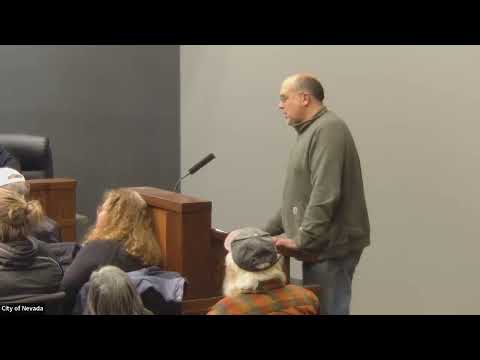
Neighbors and other residents who spoke at public comment strongly opposed the rezoning. Speakers said the scale — repeatedly identified as 60 units in council materials — would produce traffic and parking pressure in an area already containing several apartment buildings. Multiple commenters said no site plan had been circulated, questioned where off-street parking would be placed, and said the visual and historic character of the Fifth/Sixth Street corridor would be harmed. Several speakers compared the proposal to a Capstone project in Cedar Rapids (Kingston Landing) and said that building’s context and parking were not comparable to Nevada’s residential neighborhood.
Council discussion focused on parking, the absence of a circulated site plan, impacts on walkability and emergency egress for adjacent homes, and long-term tax consequences. Staff and Dreyer described negotiations that had produced a proposed payment-in-lieu structure (the $1,000/unit minimum) and said the Story County assessor will determine actual taxability; staff also described a property-tax ramp if a long abatement is used (staff described a 10% increase per year starting in year two as part of an example). Project documentation shown to council lists storage space for tenants and climate-controlled storage designated for Nevada Food at First.
Councilmembers repeatedly told residents they heard the concerns but differed on whether redevelopment was preferable to leaving the building vacant or facing demolition costs. Dreyer and staff noted a 2022 estimate for demolition had been cited at roughly $2.4–$2.6 million (the estimate dates to 2022 and pre-dates more recent inflation). Dreyer said the state incentives are not city funds and that the tax credits are typically sold at a discount to reduce project debt; she also said some construction work was expected to be done by local contractors when possible.
Because the vote failed on second reading, the rezoning ordinance did not pass. Staff told residents the developer could return with a different proposal or a revised application; if a different rezoning application or materially changed proposal is filed, the city would hold additional public hearings.
What happened next: the council moved on to other business. Residents and council members asked staff to provide additional material in future sessions, including the demolition-cost estimate and any site plan if the developer elects to submit one.
(Article provenance: council meeting presentation and the public comment record form the factual basis of this report.)