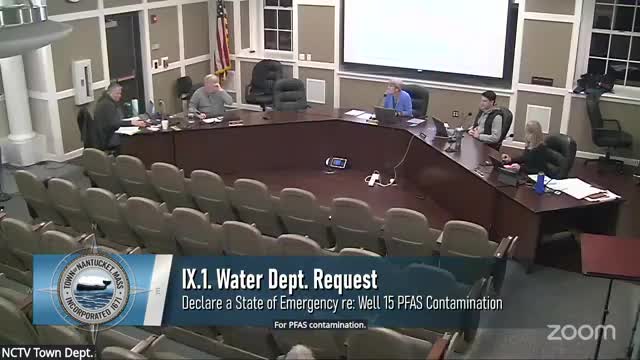
Select Board declares emergency for Well 15 after PFAS confirmation
Summary
The Select Board on Feb. 12 approved an emergency declaration under Massachusetts General Law Chapter 44, Section 31 to let the town and the water company accelerate design, procurement and installation of a filtration system for Water Department Well 15 after confirmatory PFAS results.
The Town of Nantucket Select Board voted unanimously Feb. 12 to declare an emergency under Massachusetts General Law Chapter 44, Section 31 to allow the Water Department to move quickly on design, procurement and installation of a filtration system for Well 15 after confirmatory PFAS results.
The declaration will let the town seek emergency authorization from the state Department of Revenue to spend in excess of appropriations and use expedited procurement procedures. Mark Turban, who presented the item, told the board, “we're asking for the declaration under Mass General Law, Chapter 44 section 31,” and said the water department had already engaged a consultant to design filtration after the December 2024 confirmatory results.
Why it matters: the board and Water Department said the costs for filtration and related work would be sizable and beyond the department’s current appropriation. The emergency declaration clears procedural obstacles so design and installation work can proceed while a warrant article to cover the appropriation is added to the town meeting capital articles.
Town officials said the declaration also enabled procurement waivers. Turban said Finance and Procurement staff had already discussed emergency purchasing rules with the Commonwealth and had secured a waiver of advertising requirements for procurement tied to the project.
Board action and next steps: The board voted by roll call to approve the declaration. Select Board members recorded as voting “aye” were Matt, Don, Malcolm, Tom and the chair; the board chair closed the action by voting aye as well. Officials said the Water Department will continue design work, pursue DOR authorization and follow up at future board meetings and at town meeting for funding authorization.
Public reaction and context: Public commenters raised questions during the meeting about PFAS detection, the proximity of other wells, potential health impacts and future regulation. During public comment, residents urged careful review of development proposals near the aquifer and asked for transparency on testing and timelines for remediation.
The board did not adopt a specific filtration design or a funding amount at the meeting; those technical and budget details will follow once design work and state approvals proceed.