Get Full Government Meeting Transcripts, Videos, & Alerts Forever!
Get email alerts on the Artificial Intelligence Workforce topic
No spam. Unsubscribe anytime.
Senate labor committee hears wide-ranging testimony on AI’s effect on Minnesota workers
Summary
Researchers, unions, business groups and a university AI director told the Minnesota Senate Committee on Labor that artificial intelligence is spreading rapidly and will reshape jobs, surveillance and workplace decision-making unless state policies — including task-force oversight, worker training and transparency rules — are adopted.
St. Paul — The Minnesota Senate Committee on Labor held an informational hearing on artificial intelligence and its effect on the state’s workforce on Oct. 12, hearing evidence that AI adoption is accelerating and could reshape jobs, workplace surveillance and hiring practices across both white‑ and blue‑collar occupations.
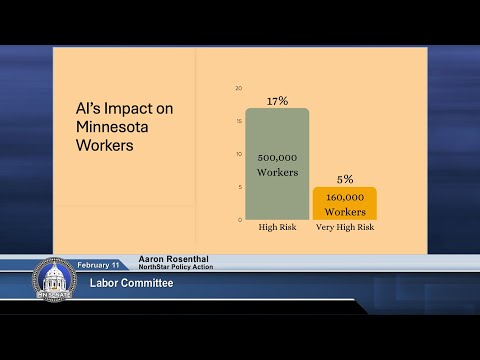
Aaron Rosenthal, research director for North Star Policy Action, told the committee that "17 percent of Minnesota workers, approximately 500,000 people, are at high risk of being impacted by AI with 5 percent or 160,000 workers at very high risk," and that the pace of adoption is unprecedented.
The audience heard contrasting perspectives from labor representatives, technology industry officials and an academic. Labor groups described real‑world pilot programs that use automated systems to replace or monitor workers, urging protections and worker voice in design and deployment. Business and industry representatives said AI offers productivity gains and a way to address worker shortages, warning that heavy regulation could drive employers out of state. A University of St. Thomas AI expert recommended fast, practical steps such as reskilling and a standing state advisory body to keep pace with change.
Why it matters: Testimony presented a consistent theme that AI’s technical capacity and speed of diffusion are outpacing existing workplace rules and oversight. Committee members and witnesses argued that Minnesota has a choice between using AI to complement workers or allowing it to reduce wages, concentrate economic gains and increase workplace inequality.
Most important details
- Research and scope. Rosenthal said North Star Policy Action’s analysis—based on mapping AI patent language to occupational duties—finds 17 percent of Minnesota jobs at risk of AI impact and that Minnesota ranks high nationally in exposure. He warned that the figure is a floor and that generative AI adoption has doubled between 2023 and 2024.
- Worker concerns. Melissa Heising, legislative director at Minnesota AFL‑CIO, said "Workers are experts in the use of technology" and argued for early worker involvement in development, statutory guardrails on surveillance, and legal protections for organizing and bargaining. Hattie Idelski, a registered nurse with Minnesota Nurses Association, said, "AI is being introduced in ways that threaten our jobs," citing surveillance, staffing‑decision algorithms and unclear liability for AI‑driven clinical guidance.
- Industry perspective. Jeff Tollefson, president of the Minnesota Technology Association, said AI can help address labor shortages and boost competitiveness, and cautioned that excessive regulation could drive companies and jobs from Minnesota. He recommended workforce adaptation investments, public‑private partnerships and targeted, risk‑smart policy rather than broad prohibitions.
- Sector‑specific examples. Wade Lunenburg of Unite Here Local 17 described algorithmic management systems used for hotel housekeepers and urged systems be used as "guidance rather than mandate," with transparency, training and negotiation with workers. Casey Lewis, president of SAG‑AFTRA Twin Cities, summarized protections the union won in recent contracts emphasizing "informed consent" and "fair compensation" for digital likenesses.
- Academic guidance. Manjeet Rege, director of the Center for Applied Artificial Intelligence at the University of St. Thomas, urged reskilling from K‑12 through adult programs and creation of an ongoing AI advisory body to monitor developments and recommend adaptive regulation.
Discussion and committee direction
Witnesses and several senators repeatedly recommended three near‑term policy directions: (1) establish a standing AI task force or advisory council that includes worker representatives and technical experts; (2) strengthen transparency, audit and consent requirements for AI used in hiring, surveillance or healthcare decision‑making; and (3) expand worker training and transition programs to reduce displacement harms. Several witnesses also urged the state to use procurement to set standards and to require algorithmic audits for government use.
What was not decided
The hearing produced no formal committee votes or legally binding actions. Senators and witnesses discussed possible draft legislation and models from other states, but the committee did not adopt or refer bills at the hearing.
Context and next steps
The committee packet included the North Star Policy Action report discussed by Rosenthal; presenters and members asked for rapid follow‑up because witnesses said the technology and industry practices change quickly. Multiple witnesses volunteered to assist the committee in drafting or advising potential statutory approaches, and a number of senators expressed interest in pursuing task‑force legislation or targeted transparency rules in upcoming sessions. The committee adjourned with staff directed to consider next steps and scheduling.