Get Full Government Meeting Transcripts, Videos, & Alerts Forever!
Get email alerts on the Municipal Assistance Program topic
No spam. Unsubscribe anytime.
State planning office outlines MAP grants, deadlines and eligibility in webinar
Summary
The Pennsylvania Office of Community Planning walked local officials through the Municipal Assistance Program (MAP) including eligible projects, 50/50 match rules, application requirements and the program's March 1 and Sept. 1 deadlines. Presenters described examples of funded projects and guidance on using the ESA online application system.
The Pennsylvania Office of Community Planning summarized the Municipal Assistance Program, known as MAP, in a state webinar, describing what projects are eligible, how the 50/50 match works and the application steps for local governments.
The briefing matters because MAP provides planning and implementation funding to municipalities across Pennsylvania: from fiscal 2019–2023 the office issued 108 grants totaling about $4,000,000, affecting 221 municipalities in 48 counties, the presenters said. The program supports multi-municipal projects, comprehensive plans, emergency services studies and implementation items such as zoning and official maps.
Katie Wicker, a local government planning specialist in the West, and Rachel Resnick, a local government planning specialist for the Central region, described two broad MAP categories: shared services and community planning. Shared-services grants require two or more participating municipalities and an intergovernmental agreement and can fund startup or expansion costs for regionalization or shared positions; the program does not fund replacement of existing vehicles or current staff positions. Resnick said, "If you are ever unsure if your project is eligible for MAP, please reach out to your regional planner and we can help direct you to the correct funding source."
Community-planning grants can fund single- or multi-municipal projects including comprehensive plans, economic development plans, corridor and downtown plans, and some implementation tasks such as zoning updates, official maps and design guidelines. The presenters said MAP can also support transportation capital-improvement plans, tax-revenue and fee-sharing programs, and feasibility or trade studies tied to a plan.
Emergency-services funding through MAP can cover merger or regional feasibility studies for fire, police and ambulance services, cost analyses, efficiency evaluations and apparatus or equipment needs; presenters noted MAP provides technical assistance and peer consultants for emergency-service operations.
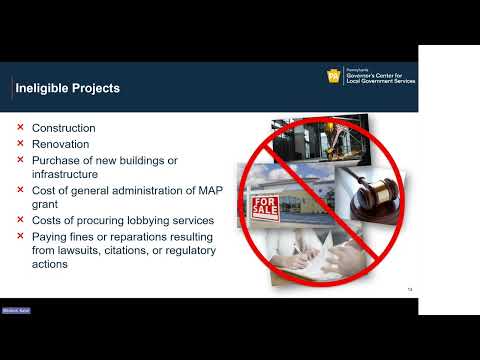
Wicker emphasized common ineligible uses: MAP does not pay for construction or renovation of facilities, purchase of new buildings or infrastructure, general grant administration fees, lobbying services, or fines and reparations resulting from lawsuits or regulatory actions. The office requires documentation for match and reimbursements: MAP is generally a 50/50 cash match, with local cash match sourced from general funds, participating municipalities, partner organizations or accepted in-kind services (for example GIS). The presenters said at least 25% of a project’s total cost must come from a non-state source when MAP is combined with other state grants.
Applicants must provide a project description, budget, scope of work, and signed resolutions stating local share commitments; presenters said all partners typically need a resolution when a county applies on behalf of multiple municipalities. A county support letter is required to note coordination with county plans. The presenters advised applicants to include specific support letters from county planning offices, MPOs/RPOs, state representatives, redevelopment authorities, school districts and nonprofits where relevant.
The webinar covered application mechanics: MAP applications use the Electronic Single Application (ESA). Presenters recommended drafting narratives outside ESA and saving frequently; ESA sessions time out after about 30 minutes. Required identifiers include the entity’s UEI (formerly DUNS) from SAM.gov, the SAP state vendor code, EIN, and the project NAICS code. The presenters advised applicants to secure local-match commitments and pass governing-body resolutions before applying; otherwise the application is held for the next round.
MAP operates on the Commonwealth fiscal year and awardees receive a three-year contract period to complete projects. As an example, presenters said a spring award tied to fiscal-year timing would have a July 1 contract start; projects initiated before award may fall outside the contract period and risk local cost exposure. Invoicing is reimbursement-based, typically submitted in up to three draws, and awardees must keep organized proof of payment for closeout.
The presentation included case studies: Sharon (Mercer County) used MAP for a five-year downtown strategic plan tied to a Main Street designation; Ambridge Borough (Beaver County) completed a Heart and Soul project adopted in December 2024; Chambersburg used MAP to produce a user-friendly comprehensive plan with action items, timelines and partner lists; and Lackawanna County pursued regional comprehensive plans covering multiple municipalities to enable shared services and zoning coordination.
Presenters urged applicants to read MAP guidelines closely, consult their regional planner early, consider multiple consultant proposals, and provide specific (not form) letters of support. They listed partners and resources—Penn State Extension, MPOs/RPOs, county planning agencies, municipal associations and state partners—on the DCED planning web pages.
The Office of Community Planning closed by pointing attendees to the regional contact list on the DCED planning page for email and phone follow-up.