Get Full Government Meeting Transcripts, Videos, & Alerts Forever!
Get email alerts on the Candidate Employment Protections topic
No spam. Unsubscribe anytime.
Senate committee advances bill to bar employers from firing employees for running for office
Summary
The Senate Elections Committee voted to add an amendment and recommend passage of Senate File 863, which clarifies that running for elected office is protected political activity and removes a proposed board-imposed civil fine, restoring a gross-misdemeanor provision.
Senate File 863, a bill that would expand protections against employment reprisals to explicitly cover candidates running for elected office, was advanced by the Senate Elections Committee on Feb. 11, 2025, and sent to the Judiciary Committee.
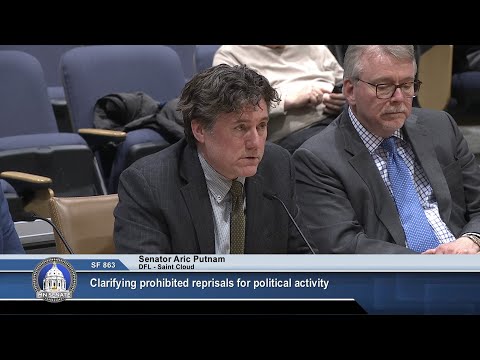
Sponsor Senator Putnam told the committee the measure responded to a constituent’s case in which an employer explicitly terminated an employee for running for mayor of Saint Cloud. “He was fired for running for office,” Putnam said. “In a country that aspires to democracy, everyone should be able to run for office without fearing retribution or the end of their livelihood.”
The bill adds “running for office” to the statute that already bars economic reprisal, termination and coercion for political activity and, as initially amended in committee, included a civil penalty of up to $3,000 enforceable by the Campaign Finance Board. The committee accepted an author’s A2 amendment early in the hearing to put the bill into the form the sponsor preferred.
Testifier Stephen Duane Schiller, who described himself as a retired combat-disabled veteran and a 2024 Saint Cloud mayoral candidate, told senators he was fired after his employer learned of his campaign. Schiller described being asked to turn over keys and a phone and receiving a message that pending commissions would not be paid unless customers filed paperwork by midnight. He said he pursued unemployment benefits, which he ultimately received after a hearing with an unemployment judge. “They discharged me because I entered the mayor’s race,” Schiller said, and later added that the experience caused “a huge setback” to his health and finances.
Committee members debated two central questions: whether the existing statute was sufficiently clear to cover candidates, and whether civil penalties assessed by the Campaign Finance Board were the right enforcement mechanism. Senator Grama and others asked whether current language covering “political activity” already reached running for office; Senator Putnam and supporters said expressly naming candidacy removes ambiguity. Senator Matthews and several members questioned whether it was appropriate to give the Campaign Finance Board authority to impose civil fines on private employers, arguing that the board’s purpose is oversight of campaigns rather than general employer sanctions.
Jeff Sigurdsson, executive director of the Campaign Finance Board, told the committee that chapter 10A currently places jurisdiction in the board and that the board’s authority to issue penalties for unregistered entities already exists in other contexts. “This provision, $3,000 I believe was added as a suggestion... because the current statute says you bring the complaint to the board, but then the board can’t do anything about it,” Sigurdsson said.
After debate, the committee considered an oral amendment to remove the proposed board-imposed civil penalty and reinstate language making violation a gross misdemeanor. That amendment was read into the record and adopted following a division. Senator Port then moved to recommend passage; the committee approved the bill as amended and referred it to the Judiciary Committee.
During questioning, senators raised ancillary concerns the bill does not resolve: whether the statute would nullify voluntarily accepted employment contract terms that bar political activity, how the measure would treat organizations that are by nature partisan (which current statute already exempts), and whether criminal enforcement was a practical remedy when county attorneys decline prosecuting misdemeanors. Senator Limmer noted a criminal gross-misdemeanor provision exists in the statute’s cited lines, and senators pressed Mr. Schiller about prior legal options; Schiller said his attorney advised a civil lawsuit was unlikely to succeed under current law and would be costly.
The committee record reflects the policy trade-offs members discussed: clarifying protected political activity for candidates versus how to enforce violations and avoid unintended interference with legitimate conflict-of-interest or partisan hiring rules. The committee’s action sends the clarified protection to the Judiciary Committee for further consideration.
The bill’s next procedural stop is Judiciary; no timetable for further hearings was announced at the committee meeting.