Get Full Government Meeting Transcripts, Videos, & Alerts Forever!
Get email alerts on the Substance Use And Regulation topic
No spam. Unsubscribe anytime.
City study session hears drug-awareness briefing on kratom, nootropics, whippets and other youth-targeted products
Summary
A Renton School District safety director briefed Shelton councilors on a wide range of legally sold and online-only substances — including kratom, TNF/Zaza, kava, high-dose THC drinks and nitrous-oxide “whippets” — and Mason County public-health staff urged local policy and education responses.
John Holbrook, safety and security director at Renton School District, told a Shelton City Council study session on Feb. 11 that a growing number of legal or loosely regulated products are being used by teenagers and young adults and that some have been tied to hospitalizations and deaths.
"This is killing people," Holbrook said during his roughly 50-minute presentation, citing a Washington Post review that he said linked kratom to almost 4,200 overdose deaths nationally from 2020 to 2022 and two recent high-profile deaths in Cowlitz County that led to a lawsuit against a manufacturer.
Holbrook described a broad set of substances often marketed as dietary supplements or sold as novel hemp- or plant-derived products — kratom, the synthetic nootropic known as TNF (sometimes called Zaza), Finibet, kava, hemp-derived HHC, magic and Amanita mushrooms, Datura, high-dose THC drinks and nitrous-oxide cartridges known as whippets. He said many of those products are available in convenience stores or online and are promoted through social-media platforms and encrypted messaging channels such as Telegram.
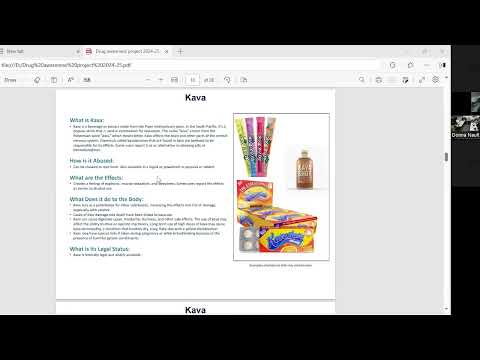
The presentation included examples of product packaging and point-of-sale displays and raised two recurring local concerns: that Washington state does not uniformly set a minimum purchase age for kratom and similar products, and that some synthetic compounds can complicate emergency treatment. Holbrook said some jurisdictions have adopted age limits or bans while Washington has not.
"The thing about kratom is it's not age regulated here in Washington," Holbrook said. "I talked to 14- and 15-year-old kids who can walk into AMPM, Chevron and buy this." He urged more public education and noted state- and local-level differences: some states and cities set purchase ages or bans, while other municipalities regulate retail sales on their own.
Ben Johnson of Mason County Public Health, who said he has worked with Holbrook and local partners on community outreach, described retail availability in the county after a brief store survey. "When you walk into a convenience store, all kinds of stuff is at the front counter ... some of it is kratom," Johnson said, and he reported finding whippets and dozens of kratom product variations during recent checks of local retailers.
Council members and staff asked about policy options. One council member (not named in the transcript) said they had forwarded Holbrook's presentation to state legislators and that they would sign a local ban if one was drafted. Holbrook and Johnson said their next steps include continuing education, engaging county commissioners (Johnson said Mason County commissioners will consider the issue in March) and sharing examples of legislation from other jurisdictions.
Health staff at the meeting reported the Washington State Department of Health recently considered state scheduling for some of these products but concluded it did not have enough information to place them in Schedule I; the department planned to move related recommendations into the legislative process for further action.
Holbrook also warned that some synthetic compounds can blunt the effect of naloxone (Narcan) used in opioid overdoses, citing reports from other states where first responders saw reduced Narcan effectiveness when fentanyl was mixed with certain synthetics.
Speakers at the session urged a mix of strategies: restricting retail sales or purchase age where possible, running school- and community-based education, and linking prevention with broader youth-engagement programs. Ben Johnson said local prevention work will include a community mapping project and conversations with retail owners and county commissioners.
The presentation emphasized education and harm reduction rather than immediate punitive measures for students. "We're not out to discipline kids for having it. It's really just that education piece and confiscating it and having that conversation," Holbrook said, describing school-district practice when staff encounter students in possession of these products.
The council did not take formal action during the study session. Council members directed staff to receive the presentation and invited Holbrook and public-health partners to share sample legislation and additional information with city and county leaders. Mason County Public Health indicated it will continue outreach and meet with the county commissioners in March to discuss possible local responses.