Get Full Government Meeting Transcripts, Videos, & Alerts Forever!
Get email alerts on the Property Tax Homestead Exemption topic
No spam. Unsubscribe anytime.
Spalding County holds first of three public hearings on stateHouse Bill 581 and floating homestead exemption
Summary
County staff warned that staying in House Bill 581 could lower the tax digest and force higher millage rates; commissioners opened a public hearing and heard seven citizens urge the board not to opt out or to pursue local alternatives.
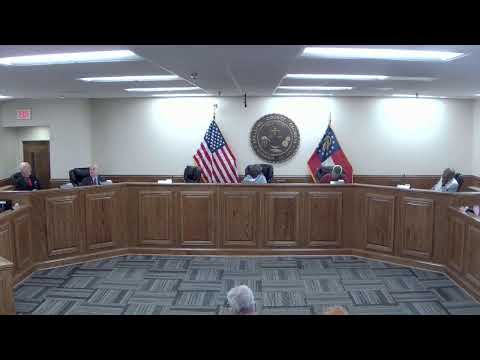
The Spalding County Board of Commissioners on Feb. 12 opened the first of three required public hearings on House Bill 581, the statewide "floating" homestead exemption passed by the Georgia legislature and placed before voters with an opt-out provision. County Manager Dr. Ledbetter outlined technical effects of the bill and said the county's financial model shows that, as written, the law could shrink Spalding's taxable digest and require higher millage rates to maintain current services.
The matter matters because HB 581 would change how homestead exemptions are calculated and allow counties that "opt in" to link the exemption to an inflation index while also making counties eligible to seek a floating local option sales tax (FLOST) to offset property tax revenue losses. Spalding is holding three public hearings (Feb. 12 at 10 a.m., Feb. 12 at 6 p.m., and the final on Monday at 6 p.m.) before the board must complete the procedural steps required to opt out if it chooses to do so.
Dr. Donna Ledbetter, county manager, said 2024 is the base year the Department of Revenue will use for valuations under the law and that the exemption applies only to homesteaded properties, not rentals or commercial property. "The taxable value of the homesteaded property is to increase annually," Ledbetter said, explaining that the exemption would grow each year using the CPI-U and that the exemption, not a revaluation, is what changes for homesteads. She told the board the county's gross digest is $3,137,342,592 and said the county's net digest is roughly $2.7 billion, figures staff used in modeling fiscal outcomes.
Ledbetter presented a financial model showing three scenarios: (1) opt out of HB 581, (2) opt in without a FLOST, and (3) opt in with a FLOST. The model assumed no change in staffing levels, a 2.5% annual pay adjustment and a 5.6% annualized growth rate in revenues. Under those assumptions, she said, "maintaining the opt out option actually reduces the millage rate year over year." By contrast, she said the opt-in scenarios reduce property tax revenue and would force increases in the millage rate to keep the same level of county services; an opt-in with a FLOST shows a temporary drop in the millage rate once a FLOST could be used, but then the millage rate would resume increasing and eventually outpace the opt-out path.
Commissioner Dutton framed the policy trade-offs for residents: Spalding's tax base is heavily residential, he said, and the county lacks a large industrial or commercial tax base that neighboring counties use to keep millage low. "If we cut taxes then we have to cut services," Dutton said, emphasizing limited margin in the county budget and citing recent unplanned capital expenses such as a $250,000 chiller repair and a roughly $460,000 courthouse elevator repair. Dutton also repeated staffreported modeling that a FLOST collected under current distribution rules would generate roughly $8.2 million annually and be roughly equivalent to 2.12.2 mills in property-tax relief, while noting that any FLOST must be collected for a year before its revenue can be used to offset property taxes.
Seven residents spoke during public comment. Michelle (312 Whispering Pines Way) told commissioners that property assessments in Spalding had jumped substantially and urged the board not to opt out of HB 581 because "the citizens of Spalding County voted for HB 581." Todd Pratt recounted nearly doubling mortgage costs after a home purchase and urged tighter budget management. Bill Brent said he voted against the referendum because the law is complicated and tied to CPI in ways he found risky. Brandy Byer, Deborah Turnsey and other speakers said rising property taxes make it hard for longtime residents to remain in the county.
Commissioners did not vote on whether to opt in or out during the hearing. The board took three procedural votes during the meeting: to open the public hearing (motion moved and seconded; vote 5-0), to close the public hearing (motion moved and seconded; vote 5-0), and to adjourn (motion moved and seconded; vote 5-0). County staff reiterated that the board has not made a decision and encouraged residents to attend the two remaining hearings and to submit questions to staff.
Staff and members also discussed local options outside HB 581. Ledbetter said if the board opts out it could still pursue local legislation to create a locally tailored floating homestead exemption and, separately, could propose a SPLOST designed to include debt reduction or other mechanisms to lower millage over time. County staff and the county attorney noted that crafting local legislation would require quick work with the legislative delegation if the board wanted a change in the current legislative session.
The board scheduled the remaining public hearings as announced; staff reminded residents the county's next fiscal year begins in July and that the opt-in/opt-out decision will affect the FY2026 budget. The county manager encouraged attendees to review detailed materials and meet with staff for follow-up questions.
The board's comments and staff's fiscal modeling make clear this is a technical, long-term budget decision rather than an immediate tax vote. The commissioners will hear additional public testimony tonight and Monday before any formal opt-out action is taken.