Get Full Government Meeting Transcripts, Videos, & Alerts Forever!
Get email alerts on the Contractor Rates 2025 topic
No spam. Unsubscribe anytime.
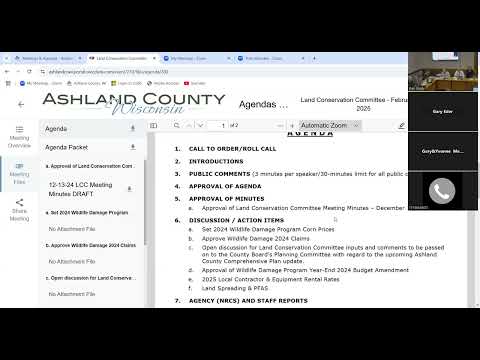
Land Conservation Committee updates 2025 contractor and equipment rental rates
Summary
The Ashland County Land Conservation Committee approved revised local contractor and equipment rental rates for 2025 to align payments to producers and contractors with current market ranges. Staff said updates reflect recent local contractor pricing and will modestly affect how far the county’s fixed cost‑share funding will stretch.
The Ashland County Land Conservation Committee approved updated local contractor and equipment rental rates for 2025 to reflect current market pricing and to ensure local producers and contractors receive fair compensation under county cost‑share programs.
Why it matters: Rates set by the committee are used to reimburse landowners or contractors who install conservation practices under the county’s cost‑share programs; raising the rates helps ensure local equipment owners are compensated fairly but may modestly reduce the number of hours or projects that the county’s fixed annual cost‑share allotment can support.
A staff presenter explained the proposed rates were derived from a sampling of local contractors and rental companies and from the highway maintenance manual supplement; rates had not been updated in depth since 2021–22. The presenter said the recommended rates were rounded up from the local averages and noted the county’s DACP (cost share) funding is a fixed pot (staff said $50,000 per year), so higher rates could slightly reduce the number of projects funded but are not expected to cut projects from six to nine per year down to only a couple.
Committee members asked whether increasing rates would constrain program capacity and whether higher rates should be raised with state representatives; staff and committee members said typical annual program volumes (six to nine projects) would not be severely curtailed by these adjustments.
The committee moved and approved the 2025 rates by voice vote. Members discussed implementation details, including that rates apply to either landowners performing in‑kind work or to contractors and that higher, fair rates could encourage greater participation in cost‑share projects.
The committee recorded no roll‑call vote tallies in the transcript; the motion to adopt the 2025 rates was carried by voice vote. Staff said the updated rates will be used when processing cost‑share reimbursements and should be posted in the county’s program guidance and handouts.