Get Full Government Meeting Transcripts, Videos, & Alerts Forever!
Get email alerts on the Pfas Land Spreading topic
No spam. Unsubscribe anytime.
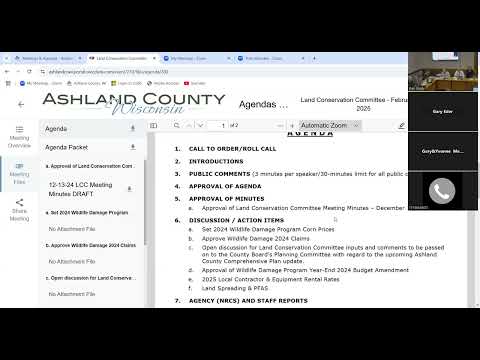
Committee opens discussion on PFAS, recommends county testing and Health & Human Services briefing
Summary
Ashland County Land Conservation Committee members urged a countywide PFAS profile and discussed restricted sewage-sludge land spreading, testing costs and next steps. Members requested the item be added to Health & Human Services and suggested pursuing grants, regional partnerships and public education.
Committee members discussed concerns about PFAS (per‑ and polyfluoroalkyl substances) contamination tied to historical sewage sludge and septic spreading and recommended steps for Ashland County to establish a testing and information baseline.
Why it matters: PFAS are persistent chemicals that accumulate in soils and water and can migrate into wells and food chains. Committee members said several local fields have received biosolids or septage historically and recommended a county “PFAS profile” to identify potentially affected lands and wells before deciding on policy or land‑use changes.
Charlie Ortman, a committee member, urged the county to determine its PFAS profile and described recent federal and USDA rule changes that affect conservation easement eligibility where biosolids or sludge have been spread. He said some easement programs may disallow lands with certain PFAS histories.
Mary Jo, Land Conservation Department staff, explained the practical steps and constraints: PFAS testing is costly (she cited a lab cost previously encountered of about $600 per test), soil and well testing are different and the county currently runs an annual well‑testing program that subsidizes testing for bacteria and metals at roughly $60 per participant; PFAS testing would be far more expensive and grant funding is not presently identified. Mary Jo said the county will need to map permitted sludge‑spreading locations and determine landowner permissions before any sampling effort.
Several committee members raised next steps: George (committee chair/planning committee chair) asked that the PFAS issue be added to the Health and Human Services agenda for wider public‑health discussion. Dan (committee member) said the state appropriated funds for PFAS research and grants in the biennial budget but noted distribution was delayed pending state budget actions. Other members recommended exploring Great Lakes Restoration Initiative (GLRI) funding, collaborating with Northwest Regional Planning Commission, or coordinating with nearby counties on testing and possible legal action in the future if industrial PFAS sources are identified.
Committee members also discussed options for handling contaminated biosolids, including whether landfilling or other containment was feasible locally, and noted remediation options are limited and expensive. Several speakers stressed that a countywide mapping of where biosolids and septage have been spread is a necessary first step and that landowner consent and funding will constrain any testing program. Mary Jo said she will coordinate with staff (GIS and grant contacts) and with the League of Women Voters and the Northwest Regional Planning Commission, both of which have expressed interest, and said creating a PFAS profile will be a process rather than a single, quick action.
No formal motion was taken to change county policy at this meeting. The committee directed staff to add PFAS to the Health and Human Services agenda, to inventory permitted sludge spread sites and to investigate possible grant sources and regional partners for testing and outreach. Members also suggested public‑education steps such as publishing lists of consumer products that contribute PFAS to household waste streams and broader outreach about proper disposal of hazardous materials.
The discussion closed with agreement that testing strategy should include separate soil and well tests and that identifying priority locations (for example, sites with long histories of sludge spreading) is the immediate next step.