Get Full Government Meeting Transcripts, Videos, & Alerts Forever!
Get email alerts on the Wildlife Damage Claims topic
No spam. Unsubscribe anytime.
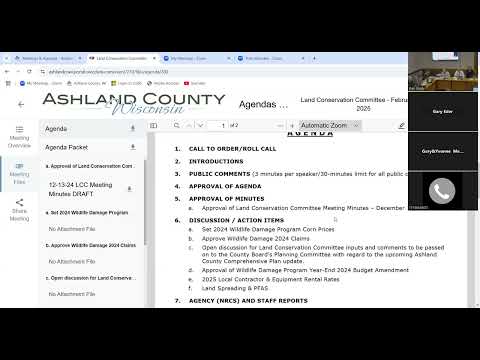
Ashland County committee approves 2024 wildlife damage crop prices and five claims totaling about $21,534
Summary
The Ashland County Land Conservation Committee set standardized crop prices used to calculate wildlife damage claims and approved five claims from the 2024 season. USDA Wildlife Services staff described higher-than-usual bear activity and trapping and explained how claims were calculated and funded.
The Ashland County Land Conservation Committee voted to adopt the 2024 wildlife damage crop prices used to calculate payments and approved five final damage claims from the 2024 season.
The price schedule and the claims were presented by Ethan Rosing, USDA Wildlife Services administrator for the DNR coverage area that includes Ashland, Bayfield and Iron counties. Committee members voted to set the crop prices as recommended and then voted to approve the five claims that together amounted to $21,533.93 in reported losses before program limits and deductions.
Why it matters: The committee’s action determines the base prices used to convert field sample losses into claim payments and clears the individual participant payments for state reimbursement. USDA Wildlife Services staff said higher-than-normal bear activity in 2024 produced more trapping and more claims than in 2023, and the payments will be routed through the Wisconsin DNR reimbursement process.
Ethan Rosing, identifying himself as “USDA Wildlife Services, administrator for the wildlife damage and abatement claims program for the DNR” for Ashland, Bayfield and Iron counties, told the committee the price sheet is produced by averaging market sources monthly over the year and that corn and soybean prices used for the calculations were the same across Ashland and Iron counties. He said the sheet lists the sources used to compute the averaged prices and that those prices were used to compute the five final participant claims.
Rosing provided an overview of the season: five enrolled participants filed claims that reached the required deductibles, producing combined submitted claims of $21,533.93; the program’s maximum single-participant payout is $10,000. He said the program trapped and relocated a large number of nuisance or agriculture‑raiding bears in 2024 (reporting 53 more bears trapped in the counties he serves compared with 2023) and that the DNR used repellents and bait crops in some places to reduce elk damage.
Committee questions focused on how beekeeping losses were valued and on the sampling method used to estimate bushels per acre. On beekeeping, Rosing said he had the claimant’s receipts for replacement equipment and that, in that case, the damage occurred after honey production was finished so there was no lost honey revenue to claim. On sampling, he described going to each affected field and taking three undamaged samples and three to four damaged-area samples to estimate the producer’s yield and the lost yield.
The committee handled the approvals in two steps. A member moved to set the USDA/DNR-recommended crop prices and the committee approved that motion. Later the committee moved to approve the five individual claims; the motion passed on a voice vote. The meeting record does not list individual recorded roll-call votes; the minutes state the motion was carried.
Program funding and payment flow were explained: the county pays for any abatement measures billed locally (for example, repellent spraying) and then seeks reimbursement from the DNR; approved claims are submitted to DNR, and DNR sends payments directly to participants. Rosing also noted the department receives a fixed, percentage-based reimbursement to help administer the program.
The packet identifies the five claimants and the committee record lists final claim payments (after applicable deductions) for four claimants: Mark Joma (final payment, $10,000), Morgan Peck (final payment, $6,398.86), Dave Kretschmar (final payment, $521.33) and Thomas Cunningham (final payment, $1,008.75). The transcript included a final payment figure for the fifth claimant, listed as John Bridal; that amount in the record was not clearly stated and is therefore not specified here.
The committee also discussed program effectiveness. Rosing said most trapped bears were relocated 20–40 miles into public lands and that return to fields in a crop-damage timeframe was rare; he said trapping and relocation, combined with repellents and targeted measures such as bait plots, helped reduce damage in several cases during 2024.
The committee approved the price schedule and the five claims and directed staff to obtain required signatures on the finalized paperwork so DNR reimbursement can proceed. The DNR will process the reimbursement to the approved participants under the program rules.
Votes at a glance: the committee adopted the USDA/DNR price schedule for 2024 (motion carried by voice vote) and later approved the five final claims listed in the handout (motion carried by voice vote). No roll-call tallies were recorded in the transcript.
The committee moved on to other agenda items, including a separate discussion of contractor rates and a county comprehensive-plan input session.