Get Full Government Meeting Transcripts, Videos, & Alerts Forever!
Get email alerts on the Urban Trees topic
No spam. Unsubscribe anytime.
Committee denies tree‑removal variation, debates insurance and ordinance guidance
Summary
The Human Services Committee denied a request to remove a privately owned tree under the city’s tree preservation rules and discussed creating a clearer decision framework and possible ordinance revisions after members raised concerns about homeowner insurance, mitigation fees and consistency of standards.
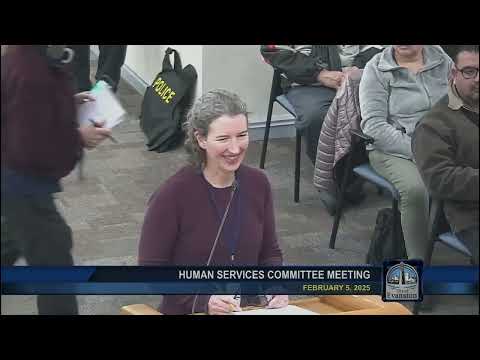
The Evanston Human Services Committee on Feb. 5 denied a variation request to remove a privately owned tree and spent the meeting debating how the city applies its tree‑preservation ordinance and how to address homeowners’ insurance and mitigation‑fee impacts.
Committee members discussed two separate permit pathways and whether the current ordinance provides enough specificity for consistent decision‑making. Council Member Ravel, who moved to deny the variation, said the exemption standards in the code — which require a finding that a protected tree is dead, extremely hazardous, or imminently dying — did not clearly apply to the tree at issue. “It really doesn't sound like that applies to this particular tree,” Ravel said.
Council Member Harry Harris raised constituent concerns about homeowners losing insurance coverage after the city denies tree removal. “I've had a resident who got dropped because we said they couldn't cut this huge tree,” Harris said, adding that mitigation costs can be steep for residents on fixed incomes.
City arborists and staff described the assessment and mitigation processes. Angela La Vernier, True Preservation Coordinator in the Public Services Bureau, said some applicants seek a level‑2 risk assessment — a full, written evaluation performed by a qualified assessor — and that such assessments typically cost several hundred dollars. The city’s arborist explained that a level‑2 assessment provides a point‑by‑point report of conditions and mitigation recommendations and remains valid for five years; if a tree is found to be high risk the permit to remove it would be approved.
Assistant City Attorney Catherine Penrose clarified applicable code sections during the discussion. “It is in Title 7, Chapter 8, Section 8,” Penrose said, referring to the exemption standards; she also cited Title 7, Chapter 8, Section 8‑10 for the committee’s variation and appeal standards and noted that an applicant can appeal the committee’s decision to the city manager.
Committee members also discussed a desire for a formal framework or guidance the committee could adopt by resolution to create more consistent decisions in future applications. Several members suggested the arborist prepare a recommended framework and that the committee consider originating a resolution to send to the City Council. The committee’s interim chair said staff would return with a proposal for discussion at the next meeting.
Practical facts discussed at the hearing included the specific property location mentioned in committee discussion (a tree on Greenwood Street, identified as 1326 Greenwood) and an example mitigation calculation discussed by staff: the arborist noted the mitigation payment for the tree in question was calculated at $1,725 for a tree with a 13.8‑inch DBH (diameter at breast height). The arborist also estimated a level‑2 risk assessment generally costs “between $500 and $800,” but said she had not collected formal quotes.
The committee handled two related motions: it tabled a separate variation request (HS2) until March at the mover’s request, and it voted to deny the variation under consideration (HS3). Council Member Ravel moved to deny HS3; the motion was seconded by Council Member Harris and the chair called the ayes, which carried.
Committee members said they would continue work to provide clearer guidance to balance tree preservation goals with individual homeowner concerns about safety, insurance and financial burden.