Get Full Government Meeting Transcripts, Videos, & Alerts Forever!
Get email alerts on the Labor Rights topic
No spam. Unsubscribe anytime.
Human Services Committee advances worker-retention ordinance to council
Summary
The Evanston Human Services Committee voted Feb. 5 to send Ordinance 21‑O‑25 to the City Council. The ordinance would require successor contractors at large institutions to retain existing food‑service and hospitality workers for a 90‑day transition period and match their wages and benefits during that period.
The Evanston Human Services Committee on Feb. 5 voted to move Ordinance 21‑O‑25 — the proposed worker‑retention ordinance — forward to the full City Council for consideration.
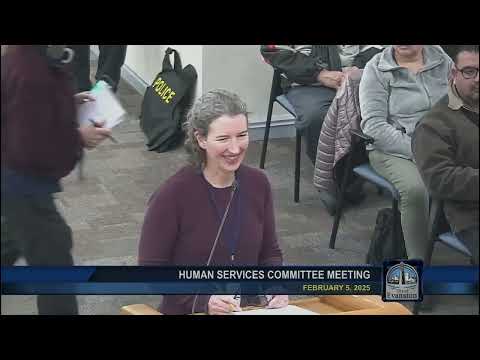
Committee members advanced the measure after public testimony from Northwestern University food‑service workers and from union representatives who said the policy would protect employees when campus contractors change.
Supporters described the ordinance as a job‑security measure for subcontracted workers at large institutions. “The worker retention ordinance will make sure we continue serving the Northwestern community no matter who the contractor is,” said Veronica Reyes, an Evanston resident and Northwestern food‑service worker. Dan Abraham, organizing director with Unite Here Local 1, told the committee: “Today, we ask you to vote yes for that simple protection for these hardworking Evanston residents, and vote yes for the Evanston that we all can be proud of.”
City staff described how the ordinance would operate. Liza Robertson Young, chief legislative policy adviser for the city, said the measure would require a successor contractor to retain the previous contractor’s workforce for a 90‑day transition period and to pay those workers at least the same wages and fringe benefits during that period. “During the 90 days the successor contractor would pay those workers at least the same wages and fringe benefits they received from the original contractor,” Robertson Young said. After 90 days the successor contractor may offer continued employment based on satisfactory performance during the transition period.
The draft ordinance applies to workers employed 15 or more hours per week (excluding employees in executive, administrative or professional capacities) and to on‑site food‑preparation, service and cleanup and on‑site housekeeping or janitorial services when those services are supplied by contractors that, in the aggregate, employ at least 200 people in the city. Robertson Young told the committee that, under the current draft, hospitals and public school districts are not expected to be covered because those employers typically employ workers directly rather than through a contracting firm.
Enforcement would be assigned to the city’s Health and Human Services Department. The ordinance would allow the department to adopt administrative rules, impose civil penalties and fees, and it would preserve a private cause of action — permitting workers or their collective bargaining representative to sue in circuit court.
Committee members asked staff to clarify implementation details and potential gaps in coverage. Committee members noted the ordinance targets the set of subcontracted workers most at risk when contracts change and invited staff to return with final drafting to answer remaining questions about franchises, specific employer examples and enforcement procedures.
The committee’s vote to send the ordinance to the City Council was made by motion of Council Member Ravel and carried when the chair called for the ayes. The ordinance will next appear on the City Council agenda for formal voting.