Get Full Government Meeting Transcripts, Videos, & Alerts Forever!
Get email alerts on the Debt Management topic
No spam. Unsubscribe anytime.
Finance committee OKs reimbursement resolution and begins drafting debt-management policy
Summary
The Evanston Finance & Budget Committee voted to recommend adoption of Resolution 20R-25 allowing the city to reimburse certain capital expenditures from future bond proceeds, and discussed a proposed standalone debt-management policy including measures such as debt-per-capita and percent-of-EAV limits.
The Evanston Finance & Budget Committee voted 6-0 to recommend adoption of Resolution 20R-25, a reimbursement resolution that allows the city to recover specified capital expenditures from the proceeds of future General Obligation (GO) bond issues.
The resolution and accompanying discussion matter because the city has begun spending on capital projects before issuing associated debt; the reimbursement authorization lets staff restore fund balance from future bond proceeds if the bonds are sold within federal timing rules.
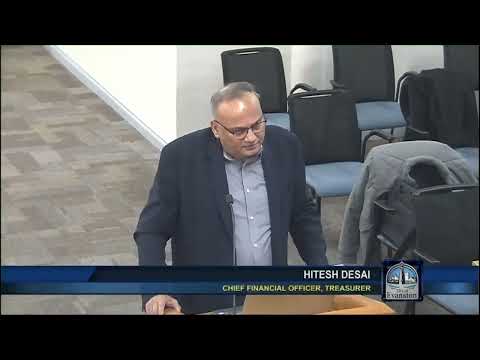
Staff member Hitesh summarized the reimbursement resolution to the committee, saying the measure "gives us the ability whenever we issue the bonds later on to reimburse the [funds] and put it back in our fund balance." He explained the practical effect: the city can use available fund balance to proceed with capital work now and seek reimbursement from a later bond sale, and under tax rules the city must complete a bond sale within about 18 months to preserve the reimbursement eligibility. Hitesh also noted one project added to the bond list this year: a change order for the Ecology Center that exceeded that project's current budget, and that staff reduced consulting funds for a Service Center master-plan electrical/HVAC consulting line by about $126,000 to keep the total GO bond authorization unchanged.
Committee members spent the bulk of the meeting discussing a separate but related effort: creating a stand-alone debt-management policy. Staff member Clayton laid out five suggested components for the policy: (1) an inventory of outstanding debt, (2) benchmarking vs. peer communities, (3) a debt limit or limit structure, (4) guidance on funding incremental future debt service, and (5) steps to maintain current bond ratings. Clayton noted Evanston currently maintains a self-imposed GO debt limit of $155,000,000 (about 4.1% of equalized assessed value, or EAV) and that total tax-supported debt stood at roughly $133,000,000 (about 3.6% of EAV). When tax-supported and non tax-supported GO debt are combined the share is about 4.9% of EAV; including loans pushes the total to about 6.0% of EAV. For comparison, the statewide non-home-rule debt ceiling is 8.625% of EAV, which the staff memo equated to roughly $323,000,000 for Evanston.
The committee debated which categories of debt should be included in any City policy. Some members urged that enterprise loans used for water-plant projects be treated separately because those loans are typically repaid through water rates and, for several wholesale customers, not by Evanston property taxes. Staff cautioned the council that certain water-plant borrowing (for example IEPA or WIFIA loans) is legally abated to the enterprise funds and is repaid through water rates, and that wholesale customers are contractually obligated to pay their share; staff also said those projects can increase long-term rate receipts. Council Member Burns argued that such loans should still be included in the inventory because the city remains ultimately obligated and the amounts are "fungible" in broader financial planning.
On limits, several members said they favored adding both a percent-of-EAV measure and a debt-per-capita measure to the policy so residents could see a straightforward per-person number; staff agreed to prepare both measures and further comparisons to peer cities (Skokie, Oak Park and others) on an apples-to-apples basis. Committee discussion also covered timing choices for bond sales (staff said the city has in prior years timed issuance to capture favorable market conditions) and the importance of preserving Evanston's AA-range bond ratings through disclosure, fund-balance discipline and aligning debt with the useful life of projects.
The formal committee action was to recommend to the City Council the adoption of Resolution 20R-25 (the reimbursement resolution). The motion carried on a roll call vote with all six committee members present voting yes: Council Member Kelly (Aye), Committee Member McMillan (Aye), Council Member Wynne (Aye), Council Member Neussmann (Aye), Chair Ryches (Aye), Council Member Burns (Aye).
Staff said they will return with a draft debt-management policy that reflects the committee's feedback, including options for which debt categories to include (tax-supported GO, non-tax GO, enterprise loans, pensions, leases) and with proposed numerical limits and funding approaches for incremental debt service.
Looking ahead, staff flagged two timing and implementation issues: the federal tax timing rule that generally requires bond sale within 18 months to preserve reimbursement eligibility, and a pending national policy discussion about tax treatment of certain advanced refundings that could affect municipal borrowing costs. Committee members asked staff to return with per-capita and EAV-based measures calculated consistently with peers, and to show the effect on debt service if new bond issues of varying sizes were authorized.
Ending: Staff will prepare a draft debt-management policy for the committee’s next meetings that incorporates the types of debt to be counted, alternative numerical limits (percent of EAV and debt per capita), and scenarios for funding incremental debt service; staff also will report any material updates on the tax-exempt bond market if federal policy changes appear imminent.