Get Full Government Meeting Transcripts, Videos, & Alerts Forever!
Get email alerts on the School District Budget topic
No spam. Unsubscribe anytime.
Centennial SD 28J projects $3.5–$4 million shortfall for 2025–26 as PERS, pay increases and enrollment pressure outpace state revenue
Summary
Centennial School District 28J officials told the Budget Committee on Jan. 22 that rising PERS costs, collective-bargained pay increases, expiring federal COVID relief funds and lower enrollment combine to create a projected $3.5–$4.0 million deficit for the 2025–26 school year unless the district chooses reductions or finds new revenue.
Centennial School District 28J officials warned the district’s Budget Committee on Jan. 22 that the district faces a projected structural shortfall of $3.5 million to $4.0 million for the 2025–26 school year unless administrators and the board take reductions or identify new revenue.
The projection comes as the state moves into a new biennium, district leaders said. "The state of Oregon is not projected to provide sufficient funds to do the same things next year that we are doing this year," Superintendent James Owens said during the presentation.
The district’s leaders said four dynamics create the gap: the scheduled expiration of pandemic-era federal Elementary and Secondary School Emergency Relief (ESSER) funds, increases to the Public Employee Retirement System (PERS) employer rate, collective-bargained cost-of-living adjustments (COLAs) and continuing declines in enrollment.
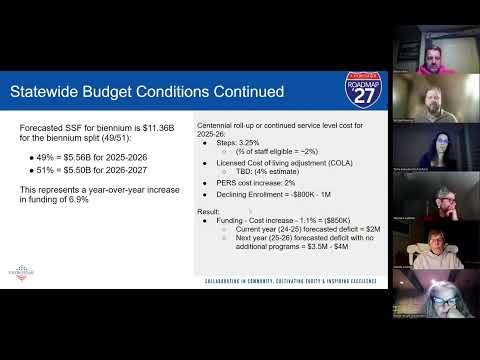
"These dynamics are certainly not specific to Centennial," Owens said. "Payroll costs — and more specifically PERS and cost-of-living increases — continue to outpace our revenue." Director of Business and Operations Paul Sotherton added that the district projects expenses will increase by about 8 percent next year while state school fund allocations, after accounting for declining enrollment, are expected to produce a net increase of roughly 5.5 percent.
Nut graf: Why it matters
Centennial’s combination of rising fixed personnel costs and falling per-pupil revenue means the district plans to spend down reserves this year and next. District officials said a modest, planned deficit in 2024–25 was anticipated; a sustained $3.5–$4.0 million deficit in 2025–26 would be unsustainable and would require targeted reductions to avoid larger cuts in subsequent years.
Key details
- ESSER: Owens and Sotherton said ESSER funds that offset some 2024 costs expired in September 2024 and will not be available to support 2025–26 operations. Owens said the district used residual ESSER this year to pay for certain summer and temporary expenses.
- PERS: Owens explained that PERS rates have risen substantially from roughly 6 percent in the system’s early years to roughly 28 percent in the last biennium and are projected to be about 30 percent in the coming biennium. "Said another way, when PERS began, the district paid $60 to PERS for every thousand dollars of salary. This year it was $280 per thousand dollars of salary and next year it will be $300 per thousand," Owens said.
- Compensation: Two-thirds of staff are eligible for step increases; classified staff bargained a 5 percent increase for the current year and a 2.5 percent increase for 2025–26. The district used a 4 percent COLA forecast for licensed staff in the 2025–26 budget projections.
- Enrollment: District enrollment has declined from about 6,700 a decade ago to roughly 5,400–5,500 currently. District staff said midyear patterns (withdrawals and transfers) historically reduce the October headcount by roughly 120–160 students by the end of the year; that dynamic is built into revenue forecasting.
- Special education and "hot spot" staffing: Sotherton and Owens said special education costs are over budget this year and that the district added three "hot spot" teaching positions midyear to address high class sizes at specific schools. Those added positions increase near-term costs.
What the district plans next
Officials said they will continue a planned, modest drawdown of the district’s ending fund balance to smooth transitions, but the projected 2025–26 deficit is large enough that administrators will bring options for targeted reductions and efficiency improvements to the Budget Committee and school board. "A deficit of $3.5 to $4,000,000 is unsustainable as that would snowball into larger and larger annual deficits," Owens said.
Chair Jess Hardin opened the Budget Committee work session and the committee adopted the meeting agenda by voice vote; the committee also discussed timing and next steps for the draft budget, which will be delivered to the committee in April. The Budget Committee provides feedback to administration; the school board adopts the final budget in June.
Quotes
"Expenses outpace CSL," Owens said, referring to current service level discussions in the legislature. "Costs outpace CSL. Having discussed the broader landscape for school funding in Oregon, let's narrow in on how things look for Centennial."
"Hope is not a plan, so we remain diligently and acutely aware," Director Sotherton said when asked about potential changes in federal funding.
Ending / Looking ahead
Sotherton told the committee the administration will present a draft budget at the April 23 meeting and a final recommended budget on May 28, with the school board’s public hearing and possible adoption scheduled in June. District leaders said they will also provide a follow-up survey to Budget Committee members to rank budget priorities and will supply the slide deck and supporting documents to the committee electronically.
Votes at a glance
- Budget Committee: Motion to adopt the Jan. 22 work-session agenda — moved and seconded on the record; approved by voice vote (individual tallies not specified in the transcript).
- Centennial School Board (same evening): Motion to approve the board meeting agenda as presented — moved and seconded; approved by voice vote. Motion to approve Jan. 8 minutes and motion to approve listed confirmation items — each moved, seconded and approved by voice vote. Individual vote tallies were not specified in the transcript.
Speakers
- James Owens — Superintendent (spoke throughout the budget presentation and Q&A); affiliation: government (Centennial SD 28J); first referenced Jan. 22, 00:04:04–00:04:19 (presentation start).
- Paul Sotherton — Director of Business and Operations (presented process, finance details and budgets); affiliation: government (Centennial SD 28J); first referenced Jan. 22, 00:04:04–00:04:19.
- Jess Hardin — Budget Committee Chair (called the meeting to order); affiliation: government (Centennial SD 28J); first referenced Jan. 22, 00:02:09–00:02:30.
- Vice Chair Shields — Board Vice Chair/Budget Committee member (comment and questions; referenced availability of presentation on website); affiliation: government; first referenced Jan. 22, 00:34:10–00:34:28.
- Multiple committee members and community participants — Amber Topham, Rod Boettcher, Michael Newman, Claudia Andrews (Director Andrews), Director Lynn, Myrna Jensen, Karen Wolfgang, Director Morin — asked questions and provided input during the session.
Authorities
- Public Employee Retirement System (PERS) — other; referenced by Superintendent James Owens and Paul Sotherton.
- Elementary and Secondary School Emergency Relief (ESSER) — other (federal grant program); referenced by Superintendent James Owens.
- State School Fund (Oregon) — other; referenced throughout presentation.
- Student Success Act (2019) — statute; referenced in relation to the Student Investment Account (SIA) funding.
- Individuals with Disabilities Education Act (IDEA) — statute (federal); referenced by Owens in describing underfunding for special education.
Clarifying details
- Projected 2025–26 deficit range: $3,500,000–$4,000,000 (stated by Superintendent Owens and Director Sotherton).
- Projected payroll/PERS impacts: PERS employer rate described as moving from roughly 28% to approximately 30% (equivalent to $300 per $1,000 of salary; cited by Owens).
- Projected state school fund biennium proposal cited: governor’s proposed total $11,360,000,000 statewide with 49% in the first year and 51% in the second (presentation slide cited by Owens); local net assumed increase ~5.5% after enrollment netting.
- Enrollment: current October-style headcount ~5,400–5,500; decline from roughly 6,700 ten years ago; typical midyear drop 120–160 students.
- Staffing: three additional "hot spot" teacher positions added midyear; special education costs reported above budget.
Community relevance
- Geographies affected: Centennial SD 28J (Multnomah County, East County).
- Impact groups: students receiving special education services, students experiencing poverty, English-language learners and students affected by enrollment declines.
Meeting context
- Engagement level: high — the presentation plus extended Q&A with multiple Budget Committee members and district directors; committee size reported at roughly 8–9 members present.
- Implementation risk: medium — the district can sustain modest deficits in the short term with reserves but must adopt reductions or identify new revenue to avoid larger future cuts.
- History: district has planned fund balance spenddowns in prior years (noted as deliberate strategy); ESSER funds used in 2023–24 but expired September 2024.
Searchable_tags:["budget","PERS","ESSER","enrollment","special education","Centennial SD 28J","state school fund","Roadmap 27","Student Investment Account"] ,
provenance:{"transcript_segments":[{"block_id":"s244.99-e294.41","local_start":0,"local_end":300,"evidence_excerpt":"Great. Thank you, Chair Hardin. Good to see everybody this evening. So you've got director of business and operations, Paul Sotherton, and me for the next little bit. So, buckle up and stay tuned because we've got quite a bit of information that we'd like to share...","tc_start":"00:04:04","tc_end":"00:04:54","reason_code":"topicintro"},{"block_id":"s997.31-e1032.58","local_start":0,"local_end":400,"evidence_excerpt":"So I'll say that again. We're projected to overspend our budget by 3.5 to 4000000 dollars for next year... This will require us to make some reductions in our budget in the coming year as we did for this year.","tc_start":"00:16:37","tc_end":"00:17:12","reason_code":"topicfinish"}]},
salience:{"overall":0.86,"overall_justification":"The session focused centrally on the district budget outlook and concrete fiscal risks for 2025–26, with quantified deficit projections, funding sources, and suggested next steps.","impact_scope":"local","impact_scope_justification":"Impacts are primarily local to Centennial SD 28J but relate to statewide funding mechanics.","attention_level":"high","attention_level_justification":"Budget deficits affect staffing, programs and require board action; community stakeholders (parents, staff) are directly affected.","novelty":0.45,"novelty_justification":"The district reiterated trends (PERS, ESSER expiry) already reported elsewhere but provided specific local deficit projections.","timeliness_urgency":0.88,"timeliness_urgency_justification":"Budget decisions are time-sensitive: draft budget due in April; final adoption required by June.","legal_significance":0.55,"legal_significance_justification":"Collective-bargaining commitments and state budget law govern options and timing; statutory deadlines are material.","budgetary_significance":0.92,"budgetary_significance_justification":"The projected multi-million dollar deficit equals several percentage points of the general fund and would require program reductions or reserves drawdown.","public_safety_risk":0.05}
,"engagement_forecast":{"newsworthiness":{"national":0.05,"regional":0.10,"local":0.90,"justification":"Local relevance is high for residents, employees and families; regional interest possible due to PERS/statewide trends."},"notify_recommendation":{"audience":"city","reason":"Local parents, employees and municipal partners should be notified about the district’s budget shortfall and opportunities for input ahead of April draft budget.","audience_regions":["US-OR-MULT"],"justification":"Local community members need timely opportunity for public comment and input."},"notify_thresholds":{"local_min":0.5,"regional_min":0.7,"national_min":0.9},"predicted_interest":{"national":0.03,"regional":0.12,"local":0.86,"justification":"High local interest expected among families, staff and policymakers."},"predicted_click_through":0.22,"predicted_click_through_justification":"Budget stories perform strongly with local audiences but have narrower appeal beyond the district.","predicted_read_time_minutes":3.5,"predicted_read_time_minutes_justification":"Article contains technical details that take several minutes to parse.","predicted_shares":35,"predicted_shares_justification":"Likely to be shared among local stakeholders."},
graph_signals:{"jurisdictions":["US-OR","US-OR-MULT"],"jurisdictions_justification":"Centennial SD 28J located in Multnomah County, Oregon.","ontology_topics":["education_finance","pensions","local_government"],"ontology_topics_justification":"Article addresses school finance, pension impacts and local budget processes.","entities":[{"id":"centennial-28j","name":"Centennial SD 28J","type":"organization"},{"id":"pwers","name":"PERS","type":"government"}],"entities_justification":"Primary organizational actors and systems discussed."}}
,