Get Full Government Meeting Transcripts, Videos, & Alerts Forever!
Get email alerts on the Climate Emissions Inventory topic
No spam. Unsubscribe anytime.
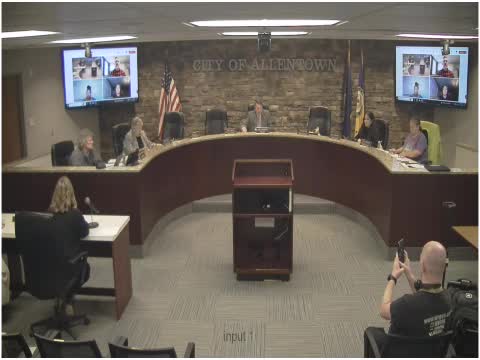
Penn State students present 2023 greenhouse gas inventory to Allentown committee
Summary
Penn State students presented a 2023 greenhouse gas inventory for Allentown City showing commercial and industrial energy, transportation and residential energy as the largest emission sources.
Penn State students presented a 2023 greenhouse gas (GHG) emissions inventory for Allentown City to the Parks and Recreation Committee and described next steps for the city’s Local Climate Action Program work.
Veronica (city staff) introduced the Penn State team: Peter Buck, Keisha (Lakeisha) Riley and Bailey Balog. Lakeisha Riley identified herself as a senior in energy and sustainability policy at Pennsylvania State University; Bailey Balog identified herself as a master’s student in community and economic development.
The presentation reported that Allentown emitted approximately “1,043,000,475 metric tons of CO2 equivalent” in 2023 (phrase and punctuation as read during the presentation). Presenters said the largest emitting sector was commercial and industrial energy, at about 36.6% of the total; transportation and mobile sources were about 29.9%; and residential energy about 27.4%. Solid waste accounted for roughly 5.6% and water and wastewater about 0.6% of the community-wide total.
Presenters described data sources and methods: electricity data provided by the utility (PPL) after follow-up, NREL’s “slip” tool for natural gas estimates as stated in the presentation, Google’s Environmental Insights Explorer (EIE) for location-based transportation data, and the EPA National Emissions Inventory downscaled for off-road transportation. Lehigh County Authority data informed potable water energy use and wastewater emissions calculations. The inventory used a calculation-based approach aligned with US community protocols and used IPCC AR6 global warming potentials, according to the presenters.
The team recommended using the inventory to prioritize reduction actions focused on the largest sectors (commercial/industrial energy, transportation and residential energy), continuing community partnership and outreach, developing targets in a climate action plan, and conducting follow-up inventories every two to five years to measure progress. They also said students will help draft a community survey and provide outreach toolkits during the spring semester.
Committee members thanked the students; one councilor noted corporations account for a large share of emissions. No formal action or vote was taken on the inventory itself during the meeting.