Get Full Government Meeting Transcripts, Videos, & Alerts Forever!
Get email alerts on the Natural Resources topic
No spam. Unsubscribe anytime.
Cherokee Nation leaders detail seed-bank expansion, three-year turkey nesting study and ongoing feral-swine program
Summary
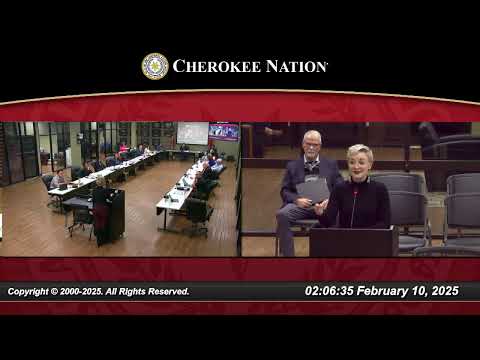
Christina Justice, the Cherokee Nation Secretary of Natural Resources, and department staff briefed the council on an expansion of the tribe—s seed distribution program, a three-year turkey nesting study with Oklahoma State University and ongoing feral-swine control.
Christina Justice, the Cherokee Nation Secretary of Natural Resources, and department staff briefed the council on an expansion of the tribe—s seed distribution program, a new wildlife research partnership with Oklahoma State University and continued work on feral-swine control.
The department—s Harvesting Our Heritage program, described as an expansion of the existing seed-bank work, will open applications on Feb. 18 and "it is a lottery system this year," Sydney Krennick, a staff member in the Department of Natural Resources, told the council. Krennick said the lottery replaces a first-come, first-served approach to reduce the risk that supplies will be claimed within hours.
The seed program expansion is being coordinated with "CCO" and other community organizations, Krennick said; the transcript does not further specify what "CCO" stands for or the size of the seed giveaway. The council did not record funding amounts or a specific distribution timeline beyond the application date.
On wildlife research, the department described a three-year, phased study developed with a department at Oklahoma State University to evaluate how meso-predators affect turkey nesting success. "It basically is just assessing the impact of meso predators on nesting success in turkey populations," Krennick said. The study will use multiple geolocated cameras per tract on the preserve where draw hunts occur; staff will retrieve memory cards and review footage to measure hatching and nesting outcomes.
Council members asked about related wildlife issues. One speaker said similar research has been conducted elsewhere in Oklahoma and welcomed the local validation. Another asked whether a hog problem remains on tribal lands; department staff said the feral-swine trapping program is still active but said they did not have a recent count available in the meeting record.
Members also asked about an electric bus the tribe owns. A council member asked what the electric bus is used for and its range; staff answered that there is an electric bus at Sequoia and at the immersion school but did not provide a confirmed range, and said they would follow up with details after the meeting.
A motion to approve the minutes was made and seconded earlier in the meeting; the recording captures the remarks "So moved. Second." but does not include a vote tally or a recorded outcome in the transcript.
The items were presented as reports rather than ordinance or budget proposals; the council did not adopt new policy or allocate funding on any of the matters during the portion of the meeting in the transcript. Staff said they would provide follow-up information on the electric-bus usage and on feral-swine counts after checking program records.
Harvesting Our Heritages shift to a lottery and the start date for applications give residents a clear near-term date to watch; the wildlife study and continued feral-swine control indicate ongoing natural-resources work that the department said will proceed over multiple years.