Get Full Government Meeting Transcripts, Videos, & Alerts Forever!
Get email alerts on the Housing Affordability topic
No spam. Unsubscribe anytime.
Council hearing spotlights gap between regional AMI and Philadelphia incomes, experts urge deeper local targeting of housing dollars
Summary
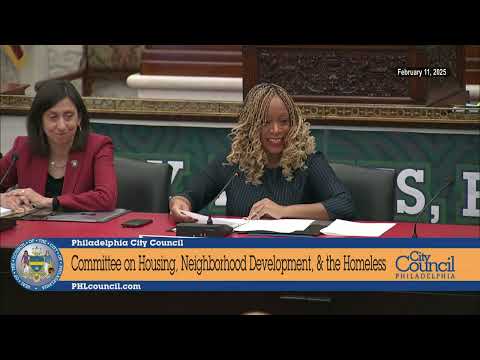
Philadelphia City Council's Committee on Housing, Neighborhood Development and the Homeless convened a public hearing on May 20, 2025, to review how use of the regional area median income (AMI) metric affects eligibility for city housing programs and whether more local funds should be concentrated on the city’s lowest-income households.
Philadelphia City Council's Committee on Housing, Neighborhood Development and the Homeless convened a public hearing on May 20, 2025, to review how using the regional area median income (AMI) metric affects eligibility for city-supported affordable housing programs and whether city funding should be targeted more deeply to the lowest-income Philadelphians.
Chairwoman Jamie R. Gauthier opened the hearing by framing the topic as a look “at the depth of our city's affordable housing crisis and how the city is failing our lowest income residents,” and clarified that the meeting would not consider switching the AMI metric from regional to a Philadelphia-only calculation.
The Department of Planning and Development's Division of Housing and Community Development (DHCD) presented a program-level analysis. Mark Dodds, interim deputy director of DHCD, told the committee that DHCD’s breakdown shows “nearly one third of DHCD funding benefits households in the lowest income category, less than 30% area median income.” He also said DHCD provided the committee a spreadsheet and a two-page explainer and that the agency maintains a public dashboard of program information on phila.gov/dhcd.
Dodds described how funding streams vary and impose different eligibility rules: “These programs are often funded with dollars from more than one source. Each source has its own restrictions on the income range beneficiaries must fall into in order to be served with funding from that source.” He said the department partners with the Philadelphia Housing Authority, PHDC, the Philadelphia Land Bank, more than 90 community organizations, and the Office of Homeless Services.
Council members pressed DHCD on data gaps and program performance. Committee members said the data DHCD supplied covers about 60% of clients and pressed for explanation of the missing 40%. Dodds said some programs—especially those run by legal services partners—are constrained by client-attorney privilege and other program rules, but he agreed to try to identify additional ways to collect or disclose enrollment and expenditure information where legal constraints do not apply.
Advocates, researchers and community organizations urged the council to reorient local funding toward very low-income households. Mindy Watts, a planner from Interface Studio, summarized independent PCAC research showing incomes in the city have lagged housing costs and said the region's AMI “does not represent Philadelphia household income,” producing eligibility thresholds that are too high for many city residents. Watts recommended committing to spend half of city housing dollars on households earning less than $30,000 annually.
Emily Dowdowel of Reinvestment Fund detailed the city’s funding picture and pointed out that most housing dollars come from federal sources, while local funding—though increased recently—remains a smaller share. She testified that PHA controls the largest share of housing funding overall because most of its money is federal, and that the local funds administered by DHCD and OHS provide the greatest local discretion.
Speakers representing community development corporations and tenant-advocacy groups offered program-level recommendations. Andy Toy of the Philadelphia Association of Community Development Corporations (PACDC) and Renee Horst of New Kensington CDC described the shallow rent subsidy program as highly cost-effective and urged expanding it beyond LIHTC buildings. Toy proposed increasing shallow rent funding to $5.25 million per year to serve roughly 800 additional households; Dodds and several council members said the program’s typical per-household annual cost is about $3,000–$4,000.
Community witnesses described personal experience with displacement, housing instability, and inaccessible housing. Dominique Howell, a housing advocate and person with a disability, recounted seeking accessible housing after losing stable housing and said she and her child were placed temporarily in an inaccessible shelter space. Speakers from Rebuilding Together, Mount Vernon Manor CDC, SEBA and neighborhood trusts described repair needs, speculative purchases by LLCs, and the risks rising insurance and construction costs pose to nonprofit developers.
Committee members repeatedly asked DHCD for more transparent, regularly updated data on program enrollment, unit-level affordability, and whether subsidized units are actually affordable to their target households. Dodds said DHCD produces quarterly reports, updates the housing action plan dashboard twice a year, files the federally required CAPER report, and that program-specific evaluations occur at RFP cycle ends or when external researchers propose analyses.
The hearing also included discussion of larger policy tools. Witnesses and council members suggested: preserving or replacing the Neighborhood Preservation Initiative (NPI/MPI) funding as it expires; considering a recurring local bonding mechanism to stabilize housing funding; using public land disposition to prioritize deeply affordable units; expanding shallow rent subsidies and rental counseling; piloting pooled insurance or other supports to blunt rising construction and insurance costs for CDCs; and creating a citywide housing strategic plan with public engagement.
No formal votes or ordinances were taken during the hearing; the session was a data- and testimony-gathering meeting on Resolution 240,297 authorizing the committee to hold hearings on how regional AMI affects program eligibility. The committee recorded requests for follow-up data from DHCD, including fuller breakdowns by council district, the number of tangled-title cases served annually, a broader multi-year look at production/preservation financing, and program-level participation and cost figures.
The committee concluded the hearing after advocates, researchers and DHCD staff finished testimony and council members expressed the intention to work with the administration on a forthcoming mayoral housing plan and on options to direct more local dollars to very low-income households.