Get Full Government Meeting Transcripts, Videos, & Alerts Forever!
Get email alerts on the Drug Trends Fusion Center topic
No spam. Unsubscribe anytime.
West Virginia Fusion Center tells Senate committee out-of-state distributors, fentanyl and xylazine drive rising drug harms
Summary
Jack Lucart, director of the West Virginia Fusion Center, told the Senate Health Committee the center's narcotics intelligence unit has identified primary out‑of‑state source cities and rising use of fentanyl and xylazine; he urged targeting distributors and expanding testing and data-sharing rather than focusing on users alone.
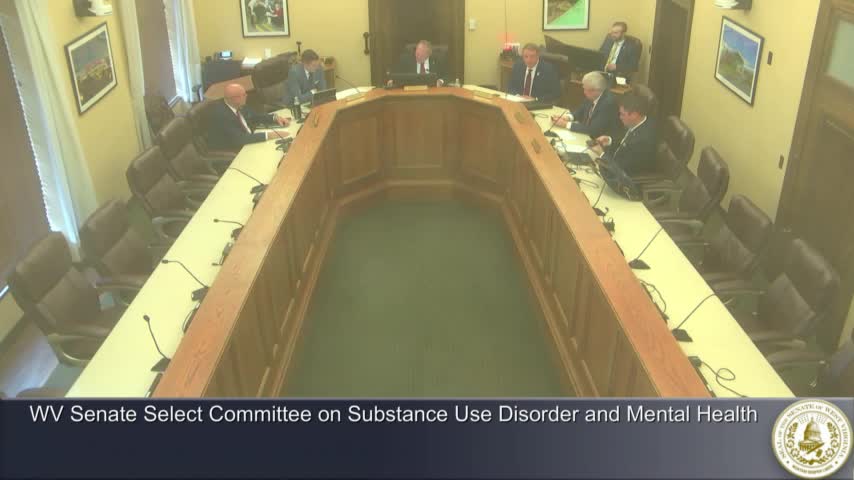
At a meeting of the West Virginia Senate Health Committee, Jack Lucart, director of the West Virginia Fusion Center, presented data showing that most drugs seized in the state originate out of state and that fentanyl, methamphetamine and the cutting agent xylazine are driving recent increases in overdose risk.
Lucart said the fusion center’s narcotics intelligence unit focuses on arrests of non‑West Virginia residents to identify which cities and organizations are “targeting our state.” He said the center compiles seizure and arrest records, shares reports with the Drug Enforcement Administration and local task forces, and can produce a dashboard showing source states and source cities and where seized drugs are distributed within West Virginia. “West Virginia is not a supply state. It’s not a source state for drugs. We are a consumer state,” Lucart told the committee.
The nut of the presentation was that aggregated, out‑of‑state seizure data can let prosecutors and local law enforcement combine separate arrests into larger trafficking or conspiracy cases instead of prosecuting many lower‑level arrests individually. Lucart urged lawmakers to focus enforcement on distributors who “target our state” and to avoid policies that primarily punish people with addiction.
Lucart gave several statistics from the center’s unclassified, high‑level reporting. He said there were 609 total out‑of‑state drug arrests in 2024 and that 32% of those arrests included fentanyl, 33% included methamphetamine and 35% included marijuana; 15% of the 2024 arrests involved heroin. He said fentanyl arrests increased about 35% over a four‑year period and that crack cocaine arrests rose from 37 in 2022 to 92 in 2024. Lucart also described an uptick in xylazine appearing as a cutting agent and said the state police lab is working to provide more detailed lab results that would clarify mixtures in seized samples.
Lucart and the committee discussed testing capacity and costs. He said some day‑report centers—he cited Nicholas County—began sending samples out for specialized testing at roughly $200 per kit, which was not cost‑effective for routine monitoring. After meetings with “Cabinet Secretary Cunningham” and other state officials, Lucart said the fusion center helped secure funding for test strips and local test capacity so anonymized urine‑screen data can be used to detect new drugs earlier. He told senators that anonymized urine‑screen results could be mapped and used for early warnings to law enforcement and health providers.
The presentation named frequent source cities and states sent to the committee staff briefing as Detroit; Columbus; Akron; Cleveland; Baltimore; Atlanta; and reference to southwestern U.S. and northern border sources. Lucart said Ohio, Michigan and Maryland are among the primary states “targeting” West Virginia. He described one multi‑county example in which 51 people from a single city were arrested in two rural counties and many were linked to a violent street gang; he said that kind of pattern is the type of intelligence prosecutors can use to pursue larger organizational cases.
Committee members raised penal policy and treatment concerns. Several senators asked whether stiffer, uniform penalties (including mandatory minimums tied to controlled‑substance schedules) would deter out‑of‑state distributors; Lucart said a mandatory minimum framework keyed to schedule and criminal history—rather than a single drug focus—would be “my personal opinion” for achieving more consistent statewide sentencing. He also cautioned that enforcement must be paired with treatment capacity so people with addiction are not simply cycled through jail.
On treatment and program effectiveness, Lucart recommended data‑driven evaluation. He said Office of Drug Control Policy staff (Dr. Lloyd was referenced) are positioned to analyze recidivism and recovery rates to determine which programs are effective and which need revision or elimination.
Lucart described operational changes at the fusion center: staff have grown from five analysts to 26 analysts since the center expanded its narcotics intelligence unit. He told the committee the center can provide regional breakdowns of arrests and drug types and that it would send the committee “the amount of the number of arrests in regions” and a proposed billboard design for a public messaging campaign at state borders.
Votes at a glance: the committee approved several procedural motions by voice vote at the start of the meeting. Motion texts, movers and outcomes as recorded in committee minutes are: the rules of the Senate be adopted to govern the committee (mover: Vice Chair; outcome: adopted by voice vote); the Chair be authorized to set the committee agenda (mover: Vice Chair; outcome: adopted by voice vote); staff be authorized to make technical corrections to bills and drafts (mover: Vice Chair; outcome: adopted by voice vote); the council be authorized to incorporate bills/resolutions and technical changes into a committee substitute (mover: Vice Chair; outcome: adopted by voice vote); witnesses (except senate staff and elected officials) be required to take the oath per Senate Rule 28(a) (mover: Vice Chair; outcome: adopted by voice vote); and a motion to adjourn (mover: Vice Chair; outcome: adopted by voice vote). These procedural approvals were recorded as voice votes with the chair declaring “the ayes have it.”
The committee asked Lucart to provide follow‑up materials, including regional arrest counts by drug type and a draft billboard concept for a public messaging campaign. Several senators also asked staff to review state sentencing statutes and to consider statutory language that would permit prosecutors to pursue organized‑trafficking prosecutions when the fusion center’s data shows coordinated, multi‑county activity. The meeting closed with no substantive committee votes on new policy or statutory changes; further action would require formal bill filing or referral to committee staff.