Get Full Government Meeting Transcripts, Videos, & Alerts Forever!
Get email alerts on the Health Workforce topic
No spam. Unsubscribe anytime.
Committee hears bill to ease English-proficiency hurdles for nurses licensed in other states
Summary
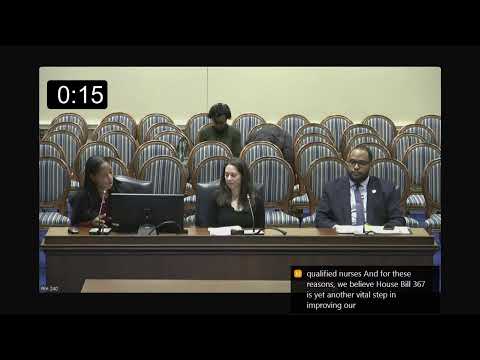
Sponsors and health-care groups told the committee House Bill 367 would reduce duplicative English-proficiency testing for nurses who already hold out-of-state or interstate-compact licenses, easing recruitment during a staffing shortage. The Maryland Board of Nursing and hospital associations supported the change as a way to bring experienced,
Delegate Ashanti Martinez told the committee she filed House Bill 367 to remove unnecessary barriers and speed the licensure of nurses who already proved English proficiency in other states. "Without this bill in place, a licensing board has the discretion to require an individual to display their English proficiency regardless of prior proof," Martinez said, and argued the practice slows recruitment when Maryland faces nursing shortages.
Jane Krenke of the Maryland Hospital Association and Dr. Rachel Jordan of the Maryland Board of Nursing testified in support. Krenke said registered nurses, licensed practical nurses and nursing assistants make up about 40% of hospital staff and face high vacancy rates; she cited quarter‑3 data showing RN vacancies at 28%, LPNs at 17% and nursing assistants at 15%. The board representative said the nursing board already widened the list of accepted English-language examinations and raised alignment with national passing scores, and said the bill would further remove redundant steps without lowering standards.
Committee members asked about the fiscal-note language that mentioned other health occupation boards and a part-time staff position request. The sponsor said the bill principally addresses nursing but that drafting changes during cross-file negotiations had broadened some text; she and staff said they would clarify scope and whether additional boards needed to be included and whether the fiscal estimate accurately reflected implementation needs. No opponents spoke at the hearing.