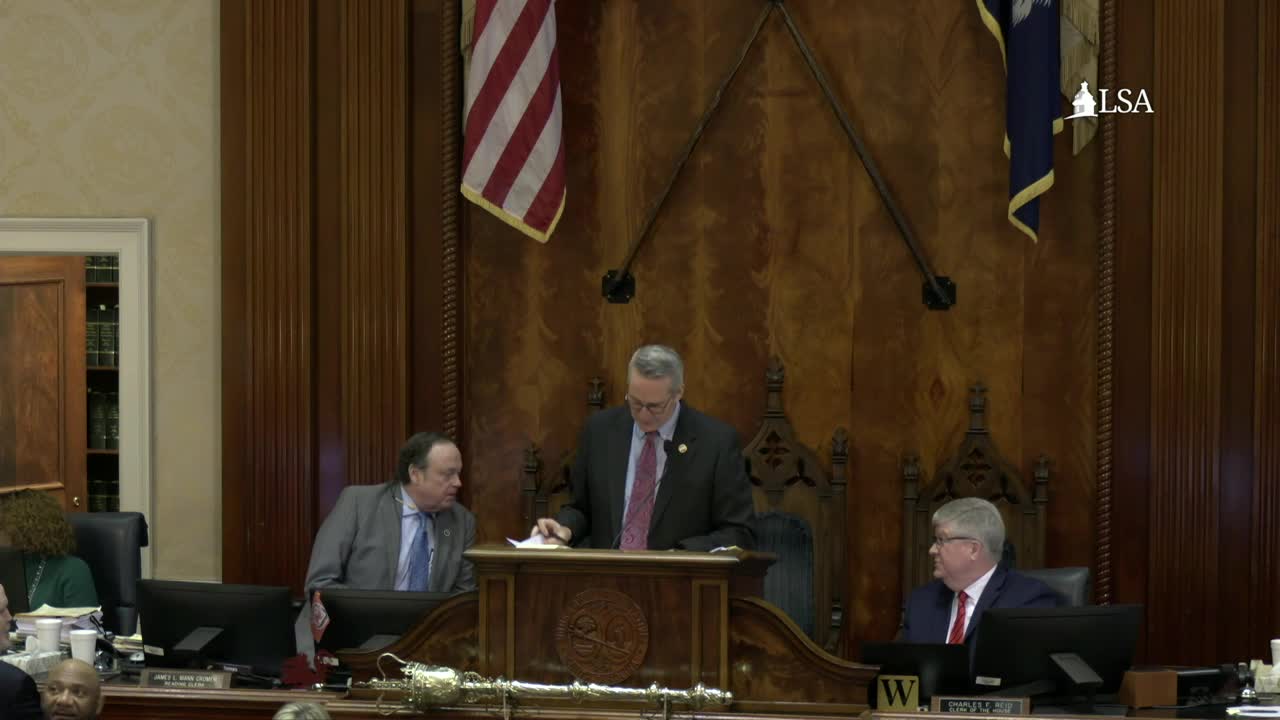
House advances measure giving DSS attorneys discretion on certain child abuse filings amid questions from caseworkers
Loading...
Summary
The South Carolina House of Representatives on the floor gave second reading to House Bill 3502, a measure that would clarify decision-making authority in child abuse and neglect proceedings by granting Department of Social Services attorneys discretion to file or not file petitions in certain limited circumstances.
The South Carolina House of Representatives on the floor gave second reading to House Bill 3502, a measure that would clarify decision-making authority in child abuse and neglect proceedings by granting Department of Social Services attorneys discretion to file or not file petitions in certain limited circumstances.
Representative Bernstein, explaining the bill, said its purpose is narrow: to ensure that "child welfare and safety become the predominant consideration" when DSS is deciding whether to pursue family court actions. She described a fact pattern in which judges, prosecutors and lawyers agreed not to pursue an action but a caseworker's insistence caused the matter to proceed; the bill would allow the DSS attorney to make the filing decision in those situations if pursuing the action would not serve the child's welfare.
The proposal drew sustained questioning on the floor. Representative Cobb Hunter said she was concerned about giving attorneys the final word without clear DSS input and worried the change would undercut the role of caseworkers, who have day-to-day contact with children and families. "It does not give me comfort to know that we are about to change a policy for the Department of Social Services, and the Department of Social Services has not weighed in on it," Cobb Hunter said.
Bernstein told members no one from DSS presented opposition at the subcommittee hearing and that the judiciary committee vetted the measure. She and other supporters said the bill does not strip caseworkers of their role or expertise, but rather addresses a narrow procedural problem when legal expertise about burden of proof and litigation prospects indicates pursuit would not be in the child's best welfare.
Representative Magnuson and others asked clarifying questions; Representative Robert Williams said he shared concerns and asked about the genesis of the change. Bernstein repeated the stated impetus: past instances where litigation could have been foregone except for a single caseworker's insistence.
On the floor the House adopted the measure for second reading by roll call. The recorded result of the second-reading vote was 107 in favor and 1 opposed. The bill will return to the calendar for additional legislative action. Floor debate indicates lawmakers will continue to press for clarity about DSS involvement and safeguards for caseworker input as the proposal moves forward.
Votes and procedural notes: adoption on second reading recorded by roll call (107-1). Supporters described the change as confined to initial filing decisions for child abuse or neglect petitions in family court and emphasized that the child's welfare would remain the predominant consideration.