Get Full Government Meeting Transcripts, Videos, & Alerts Forever!
Get email alerts on the Energy topic
No spam. Unsubscribe anytime.
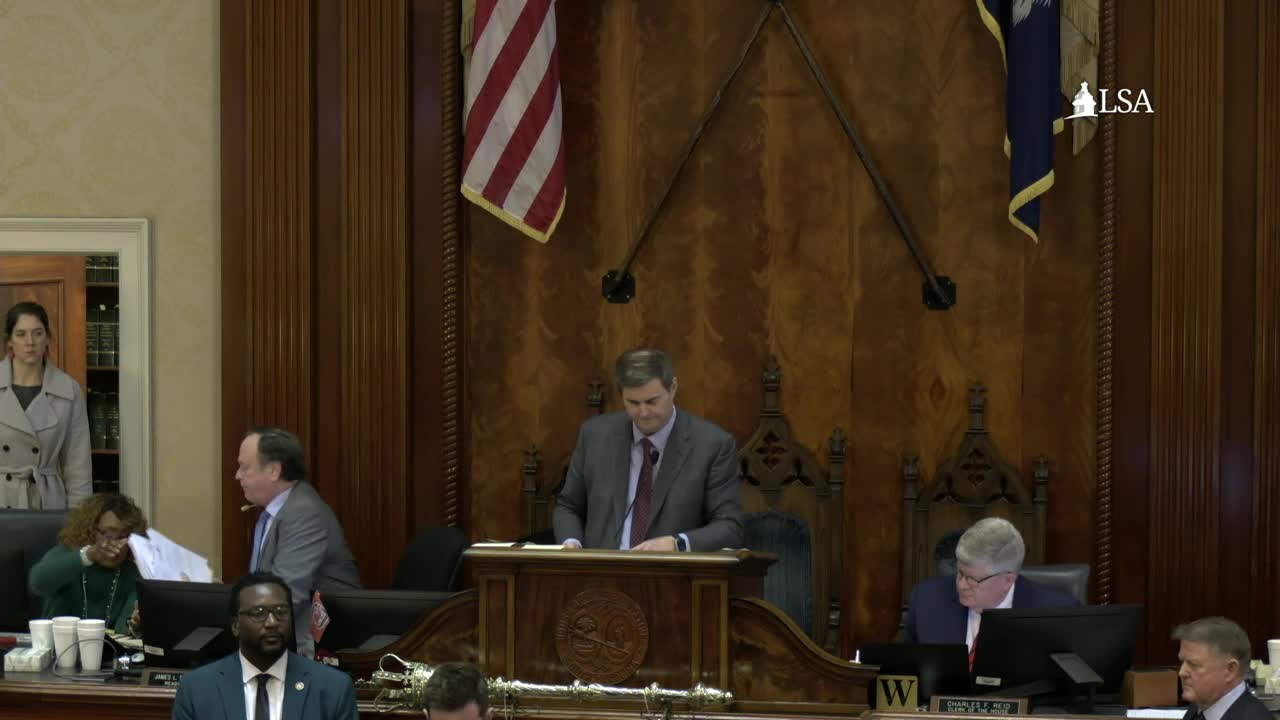
House advances Energy Security Act after hours of debate, approves committee amendment
Summary
The South Carolina House of Representatives on the floor gave second reading to House Bill 3309, the South Carolina Energy Security Act, approving the committee amendment and advancing the measure by a 94-11 vote.
The South Carolina House of Representatives on the floor gave second reading to House Bill 3309, the South Carolina Energy Security Act, approving the committee amendment and advancing the measure by a 94-11 vote.
Representative Gatch, who explained the bill and the committee amendment, said the measure aims to address a growing shortfall in generation capacity and modernize the state's approval process for new energy projects. "South Carolina is at the precipice of an energy crisis," he said, arguing that aging coal plants and double-digit population growth require new generation.
The bill authorizes a range of actions to encourage new electric generation and transmission. Key provisions explained on the floor include authorization for the state public power entity to enter joint-venture partnerships with investor-owned utilities, expanded support for nuclear technologies (including study of small modular reactors), incentives for energy efficiency and demand-side management, and procedural changes to shorten permitting and judicial review timelines.
Supporters repeatedly said the measure does not approve any particular project. "This bill does not approve the Kennedy's project. It simply authorizes Santee Cooper and Dominion to move forward," Representative Gatch said, noting projects would still have to clear siting and Public Service Commission review and have costs audited for prudence before recovery from ratepayers.
Lawmakers debated several concerns on the floor. Representative Cobb Hunter described the bill as a step forward but urged adding a stronger community-benefit analysis for siting decisions and a closer look at the long-term impact of large data centers on local grids. Representative Schuessler asked whether the measure would help lift a natural gas moratorium affecting Horry County; Gatch said the bill addresses that specific Riverneck pipeline dispute by shortening judicial pathways.
The committee amendment adopted before passage kept the Public Service Commission at seven members (rather than the smaller commission size proposed earlier in drafting), retained representation by congressional district, clarified ex parte and inspection provisions for commissioners, and left the state consumer advocate in the Department of Consumer Affairs while requiring annual performance reviews to be run by the oversight body.
On procedure, the bill narrows the judicial route for appeals in siting disputes to reduce years-long delays by removing the court of appeals from an intermediate step and by establishing scheduling orders to avoid open-ended litigation. Supporters said the change will reduce construction delay costs borne by ratepayers; critics warned the change could limit avenues for review.
Representative McDaniel and Representative Cobb Hunter voiced conditional support: McDaniel said she supported the bill for the rural districts she represents and credited the committee for listening; Cobb Hunter said she would back the measure while continuing to press for additional protections for affected communities.
Action and next steps: the House approved the committee amendment and advanced HB 3309 on second reading by voice and recorded votes; the bill will return for additional consideration later on the calendar and requires further votes and regulatory processes before any project can move forward.
Votes at a glance: Amendment 1 to HB 3309 (committee amendment) ' adopted; second-reading vote on HB 3309 as amended ' 94 yes, 11 no; outcome: received second reading and advanced.