Get Full Government Meeting Transcripts, Videos, & Alerts Forever!
Get email alerts on the Municipal Budget topic
No spam. Unsubscribe anytime.
Town manager outlines 2026 budget, proposes $450,000 use of reserves and possible opioid-fund offset for new ambulance unit
Summary
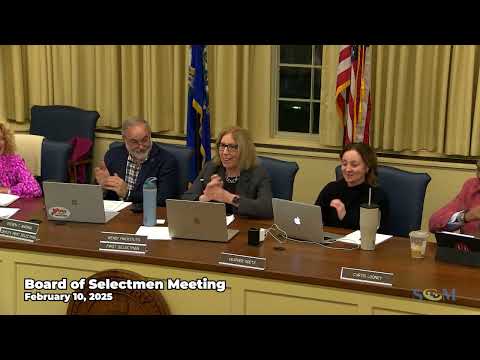
Town Manager Mark Nelson on Feb. 10 presented a proposed 2026 town budget that would raise net town expenditures 3.38% and increase the mill rate to about $33.05 (excluding the fire district).
Town Manager Mark Nelson on Feb. 10 presented a proposed 2026 town budget that he said would increase net town expenditures by 3.38% and would raise the mill rate to about $33.05 (excluding the fire district).
Nelson said the administration is recommending a “strategic use of a small amount of reserves” — $450,000 from the town’s unassigned fund balance — to mitigate a projected tax increase tied in part to a projected $600,000 drop in motor vehicle tax receipts this year and about a $1.5 million rise in debt service.
The recommendation comes alongside other measures meant to restrain borrowing and debt service. Nelson told the board that the Board of Finance had issued guidance limiting bonding to $10 million every two years, and that the capital improvement plan (CIP) and capital nonrecurring (CNR) requests had been scaled back to respect that guidance.
“Anything that is on the CNR ... is obviously cash for capital,” Nelson said. He added the administration’s goal is to reduce debt service by paying more capital with cash where possible and by deferring projects that can safely wait.
Nelson walked members through revenue and expense drivers: a $129 million total-revenue estimate, a projected $2.3 million surplus at fiscal year-end, and an estimated $1.4 million in resumed grand list growth the year after next. On the projected decline this coming year, he said the motor vehicle tax decline accounts for most of a roughly $583,000 shortfall called out in the slides.
On using reserves, Nelson framed $450,000 as a conservative, targeted draw intended to smooth a two-year revenue swing: “If you divide that in half ... it's 450,000 that we're recommending be used from reserves to offset mitigate a potential mill rate increase,” he said. He and finance staff said the town remains within policy targets for fund balance and that the recommended draw would not be expected to threaten the town’s bond rating.
The budget presentation also covered process and tools. Nelson noted the town has moved its budget work into ClearGov, a new automated system that some residents and board members had trouble printing from or viewing on Macs; the administration said IT and ClearGov support tickets were open for formatting issues.
Public-safety and community-service items were highlighted. The town has a three-year memorandum of understanding (MOU) with SVAA to fund a second daytime response unit at a cost of $180,000 in the coming budget year. Nelson said the administration is proposing to offset that expense with opioid settlement funds (the settlement account held about $188,000 at the time of the presentation) and that the use is being vetted with the town attorney and the state attorney general. “We believe it meets with the spirit and the law of the settlement agreements,” Nelson said, adding the MOU is subject to funding.
Nelson also described operating cuts and reassignments across departments (including delaying some training and department hires), modest revenue actions such as a proposed $1-per-$1,000 increase in building permit fees (estimated to raise about $60,000), and continued emphasis on grant-seeking and economic development to expand nonproperty-tax revenue.
The board and staff agreed to continue the budget review at a workshop-style meeting Feb. 24, then to present to the Board of Finance on March 11; members were asked to submit questions to Budget Director Melissa Appleby in advance so staff could compile department-specific answers.
Why it matters: The presentation set the framework for the Board of Selectmen’s review and the Board of Finance debate, including a recommendation to use a limited amount of reserves to smooth short-term tax impacts while continuing to restrain borrowing to limit future debt service pressures.
Nelson: “We think that this is a a better approach.”