Get Full Government Meeting Transcripts, Videos, & Alerts Forever!
Get email alerts on the School Budget topic
No spam. Unsubscribe anytime.
New Canaan officials review $114.2 million school budget; no vote taken
Summary
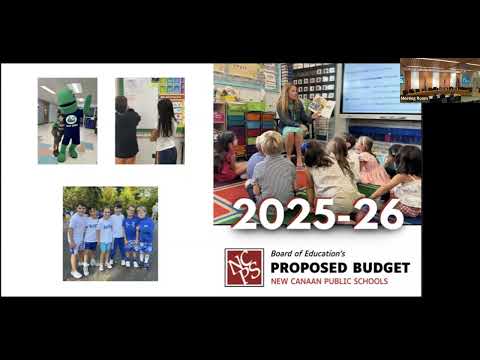
New Canaan school leaders on Feb. 11 presented a proposed $114.2 million operating budget for fiscal 2025–26 — a 4.67% increase over the current year — and described a small net staffing change, ongoing efforts to lower operating costs and several capital requests; no formal vote on the budget was taken at the meeting.
New Canaan school leaders on Feb. 11 presented a proposed $114.2 million operating budget for fiscal 2025–26 — a 4.67% increase over the current year — and described a small net staffing change, ongoing efforts to lower operating costs and several capital requests; no formal vote on the budget was taken at the meeting.
The presentation was led by Dr. Lutzky, who said the budget request reflects the district’s goals for instruction, safety and stewardship and is “an investment in our shared future.” He and school finance staff described the request as a resource plan that funds salaries and benefits — which the presentation said account for more than 82% of the district’s operating budget — and targeted program investments.
District staff told the Board of Finance and assembled board members that the proposed total operating request, including internal service funds, increases the town’s school appropriation from about $109.1 million to $114.2 million, a change staff quantified as $5.1 million or 4.67 percent. Sean, identified in the presentation as the district’s director of finance and operations, walked through the main drivers: salary and benefit increases (the single largest dollar driver), higher projected health-claim stop-loss costs, and contract-service and textbook/license needs that have risen after pandemic-era purchases aged out.
The superintendent outlined a net staffing increase of one full-time equivalent. The budget would add two positions — an elementary classroom coach and a high-school math interventionist — while a one-year grant-funded position sunsets, resulting in a net +1 FTE. Dr. Lutzky and finance staff said the classroom coach model expands in‑house professional supports for non-tenured teachers and instructional transitions; the math interventionist role was described as a push‑in/drop‑in support to help students doubling up on math and those who need targeted remediation.
District officials provided program and performance context: New Canaan remains highly ranked statewide, the presentation said, and staff highlighted participation in athletics and arts, SAT and AP expansion (the district’s AP offerings rose from 18 to 29 courses over time, and recent years showed growing AP participation), the literacy academy (an Orton‑Gillingham–based early‑reading program now in its third year), and work to reduce the number of unilateral out‑of‑district special‑education placements by building in‑district programs.
Staff described several operational cost‑saving measures they said helped hold down utility and transportation costs: switching the bus fleet to propane, renegotiating propane pricing to about $1.19 per gallon with a five‑year fixed price, LED lighting and energy‑management upgrades across buildings, and solar power purchase agreements. The presentation included multi‑year charts showing lower utility and fuel expenditures relative to earlier years.
On special education the district presented two related trends: total special‑education spending as a share of the budget and declining unilateral outplacements as the district has built alternate in‑district programs. Staff noted federal IDEA grant funding and state formulas such as the net current expenditures per pupil (NCEP) and the Educational Cost Sharing (ECS) formula affect district finances and high‑cost special‑education reimbursements.
Capital requests drew significant attention from board members. The largest single capital ask was a district classroom audio/PA modernization that staff proposed for the high school: a classroom‑level amplification and integrated PA system intended to serve daily instructional use and provide an additional safety/alert channel. The superintendent described the vendor option as ceiling speakers plus a teacher lanyard microphone for each classroom, functionality to make targeted announcements room‑by‑room, and an alert button on the lanyard. The proposal was framed as an instructional investment (benefitting hearing‑impaired students and daily classroom instruction) as well as a replacement/upgrading of aging public‑address hardware. The capital list also included the replacement of the stadium scoreboard at Dunning Field (district staff said the existing unit is about 14 years old and parts are obsolete), playground surfacing to comply with recent state playground rules (rubberized surfacing for installations after July 1, 2025), roof and masonry work, elevator refurbishment at Saks Middle School, a new security booth at the high school and a proposed cleaning‑system conversion with an estimated 18‑month payback.
Board members pressed for more detail and specificity in several capital line items that were presented as district‑level contingency or program lines. Multiple finance board members asked staff to sharpen project scopes and, where practical, list the specific school or phase the work will serve (for example, piping insulation, masonry repointing, playground replacement and HVAC repairs). A board member also asked whether fundraising partners — including the New Canaan Athletic Foundation and school booster organizations — could help with the scoreboard cost; staff said they would pursue those leads but noted the district’s urgency because the current scoreboard is showing age‑related failure risks.
On the budget numbers themselves, a board member asked administration to seek $500,000–$700,000 in reductions or offsets before the March town‑council submission; administration said it would continue to review insurance claims, retirements and other variables and report back as the budget process continues. Staff said the district was also awaiting a second demographer’s enrollment model and noted there were 244 kindergarten registrations to date, 11 more than the same point a year earlier.
Formal actions recorded during the meeting were limited to routine procedural motions. A motion taken near the start of the meeting (approval of an introductory/attendance item) passed on an oral voice vote with no recorded no votes; the meeting concluded after a motion to adjourn, which passed on an oral voice vote. The district did not seek or record a final board vote on the 2025–26 operating or capital budget at the Feb. 11 session.
Background and next steps: staff said the Board of Education will present the full budget package to the town council in March. The district also intends to continue negotiating with bargaining units where agreements are not yet finalized (the proposed budget includes assumptions for units not yet signed). Administration told the finance board it will return with refinements to capital line‑item scopes, updated enrollment projections and any further adjustments to salary and benefits estimates as retirements, insurance trends and grant prospects become clearer.
Votes at a glance: - Procedural motion (early meeting attendance/approval item): voice vote; outcome: approved (no recorded no votes). - Motion to adjourn: voice vote; outcome: approved (no recorded no votes). - No vote taken on the 2025–26 operating or capital budget at this meeting.
Community relevance: the presentation and Q&A focused on classroom supports, special‑education placements, long‑term enrollment projections (the district cited a projected increase in kindergarten starting in 2026–27), energy‑efficiency savings, and capital priorities that would affect school facilities and community uses such as graduation and athletic events.
The district and the Board of Finance agreed to continue working through the budget calendar: staff will provide more specific capital scopes and cost detail, continue examining insurance and retirement impacts on benefits, and report back to the finance board and town council in the coming weeks.