Get Full Government Meeting Transcripts, Videos, & Alerts Forever!
Get email alerts on the Judicial Elections topic
No spam. Unsubscribe anytime.
Joint Assembly elects judges across South Carolina courts; several races decided by roll call
Summary
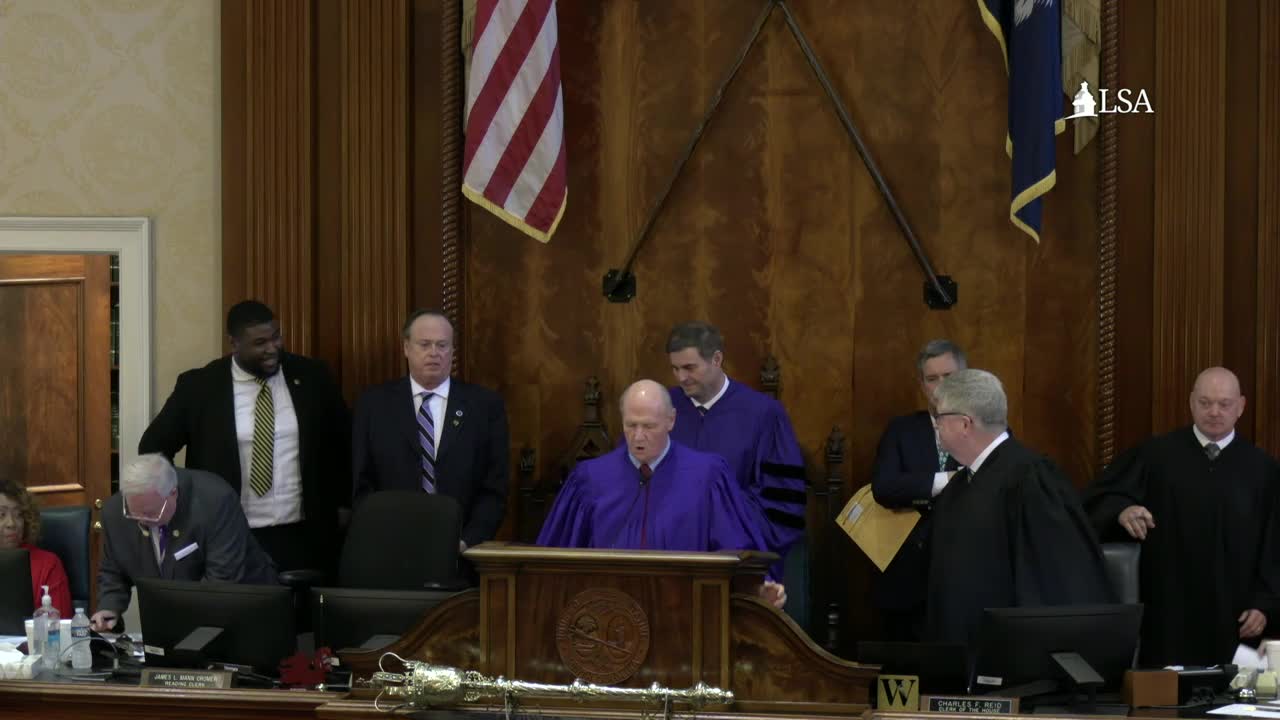
Joint assembly of the South Carolina General Assembly on Feb. 19, 2025, elected judges to fill seats on the Court of Appeals, multiple circuit courts, family courts and the Administrative Law Court after the Judicial Merit Selection Commission presented nominees.
Joint assembly of the South Carolina General Assembly on Feb. 19, 2025, elected judges to fill seats on the Court of Appeals, circuit courts, family courts and the Administrative Law Court after the Judicial Merit Selection Commission presented nominees.
The nominations came under the authority of the Judicial Merit Selection Commission (JMSC); members of the joint assembly conducted a mix of acclamation votes, roll-call ballots and multi-stage balloting for contested seats. Some nominees were elected by acclamation after withdrawals; several contested posts required formal roll calls and, in one race, a second ballot after a leading candidate withdrew.
The most closely watched contested races included:
- Circuit Court, Fifth Judicial Circuit, Seat 1: Christopher Dolan Taylor defeated William K. Witherspoon in a joint-ballot tally. The clerk reported 148 total votes; 75 were necessary for election. Taylor received 112 votes to Witherspoon’s 36. The president of the joint assembly declared Christopher Dolan Taylor duly elected.
- Circuit Court, (unnumbered contested race reported later): Thomas J. Rhodes won by roll call, 125 to 13, and was declared duly elected.
- Sixteenth Judicial Circuit, Seat 2 (Circuit Court): Melissa A. Anzarello was not elected by a joint assembly vote of 54 to 93.
- Circuit Court at large, Seat 7 (three-way contest): The first ballot produced no choice (D. Grant Gibbons 24, William Vickery Metz 70, Jane H. Merrill 65; 80 votes required). After D. Grant Gibbons withdrew, the second ballot between William V. Metz and Jane H. Merrill resulted in Merrill’s election, 84 to 74 (160 total votes; 81 required).
- Administrative Law Court, Seat 2: Two candidates proceeded to a roll call. By a joint total of 152 votes (77 needed), Samuel L. Johnson received 96 votes to Christian Cross’s 56 and was declared elected.
Other races were resolved by acclamation after nomination and, in some cases, withdrawal of challengers. Among those declared elected by acclamation were Christie F. Curtis and John D. Gathers to the Court of Appeals and multiple circuit and family court nominees named on the record during the joint assembly.
Procedural notes recorded on the floor: the JMSC presented its report and nominations and the presiding officer allowed roll calls where objections or multiple candidates required recorded votes. The assembly followed the commission’s procedural direction that nominations be made and, when requested by members, roll-call or ballot procedures were used.
The joint assembly also handled related confirmations and appointment items in the same session before adjourning its proceedings to allow the Senate to resume its separate business.
Votes at a glance (selected contested outcomes):
- Christopher Dolan Taylor (Circuit Court, 5th Judicial Circuit, Seat 1) — elected by joint ballot: 112-36 (total 148; 75 needed). - Thomas J. Rhodes (Circuit Court, 9th Judicial Circuit, Seat 2) — elected by joint ballot: 125-13. - Melissa A. Anzarello (Circuit Court, 16th Judicial Circuit, Seat 2) — not elected: 54-93. - Jane H. Merrill (Circuit Court at large, Seat 7) — elected after second ballot: 84-74 (final ballot total 160; 81 needed). - Samuel L. Johnson (Administrative Law Court, Seat 2) — elected by joint ballot: 96-56 (total 152; 77 needed).
What this means: The joint assembly’s actions set terms for multiple judges across appellate, circuit and family courts. Contested races required lawmakers to cast recorded ballots when nominations produced more than one candidate or when objections were lodged, producing several multi-stage or roll-call votes that changed outcomes from the initial nominations.
The joint assembly adjourned after the elections and returned to separate Senate business later in the day.