Get Full Government Meeting Transcripts, Videos, & Alerts Forever!
Get email alerts on the Animal Confiscation topic
No spam. Unsubscribe anytime.
Committee hears competing views on House Bill 489 to change animal-confiscation process; sponsors seek faster hearings and cost protections for owners
Summary
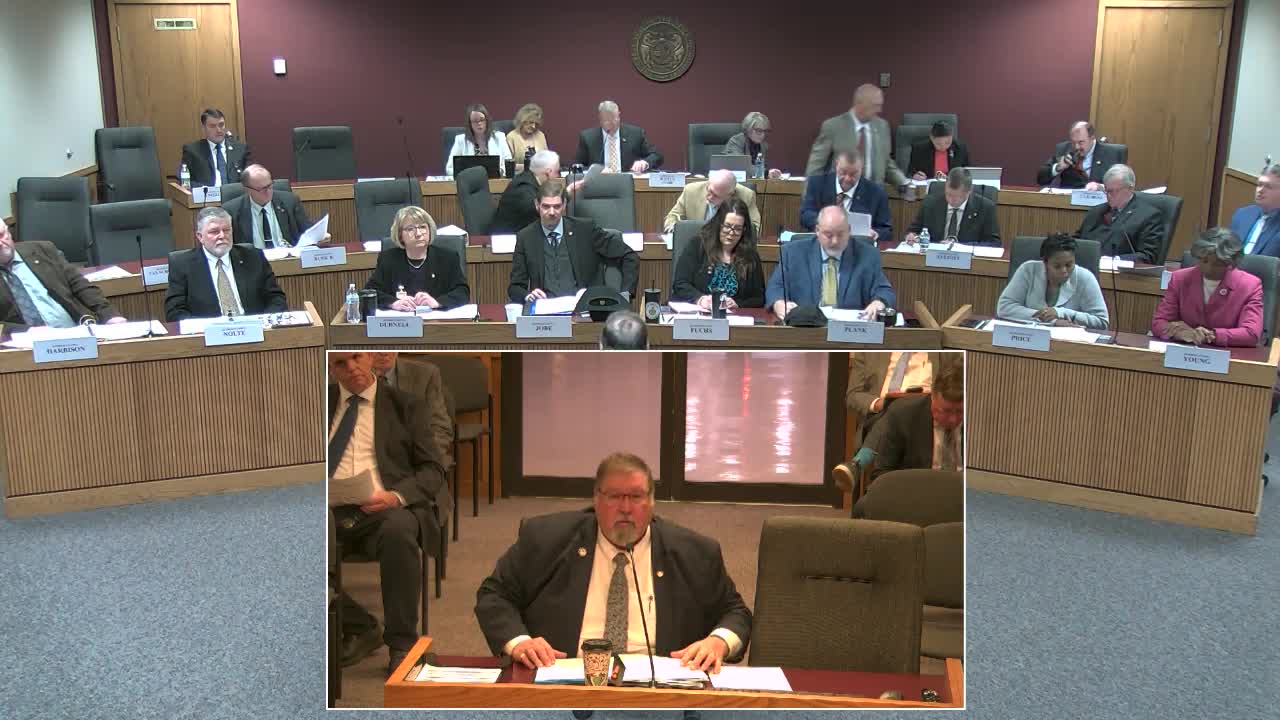
State Rep. Dean Van Swick presented House Bill 489 to the Missouri House Agriculture Committee, proposing to shorten animal-disposition hearing timelines, require warrants and law-enforcement presence for seizures, and shift boarding and veterinary costs to the confiscating authority if owners are acquitted.
State Rep. Dean Van Swick (R), sponsor of House Bill 489, told the House Agriculture Committee that his bill would change Missouri law governing animal confiscation to speed up court disposition hearings, require warrants and law enforcement when animals are seized, and shift the costs of boarding and veterinary care to the confiscating authority if owners are found not liable.
"If a person has their animals confiscated ... and they are found either be not guilty or charges are dropped, they have to pay the fee for the boarding and the feed of their animal to get their animal back, which in most cases is more than the animal is worth," Van Swick said in opening remarks, framing the bill as a property-rights protection for owners. He described the bill's principal changes: shorten the disposition hearing timeline from 30 days (as currently written) to 10 days after confiscation; require a warrant and law‑enforcement presence when animals are seized; allow the court to name a caretaker; permit an owner to post a bond within 72 hours to cover care for 30 days while a case proceeds; and require the confiscating authority to pay care costs and related fees if the owner is acquitted or the charges are dismissed.
Why it matters: Van Swick and several proponents told the committee they have seen cases in which owners could not afford boarding and veterinary fees and thus lost animals even when charges were not ultimately sustained. Supporters argued the bill would protect owners, veterinarians and breeders from financial exposure and better safeguard property rights.
Opponents — including representatives of animal-control agencies, prosecutors, statewide animal-welfare organizations and defense groups — said the bill would weaken existing protections for animals and for the public, impose untenable new obligations on rural counties and shelters, and create logistical problems. Bob Baker of the Missouri Alliance for Animal Legislation and other witnesses argued the current statutory and judicial framework already provides safeguards for innocent owners and that the Missouri Supreme Court has upheld the constitutionality of existing law.
Key testimony and positions:
- In favor: Tony Duggar, registered lobbyist for the Missouri Pet Breeders Association, said the bill "brings fairness" to owners and operators who may be wrongly affected by confiscations.
- In favor: Shannon Cooper, representing the Missouri Cattlemen's Association, told the committee that feed costs for horses and cattle can be substantially higher than for companion animals and asked for clarity on who pays if an owner is later found not at fault.
- In favor (limited): Heath Clarkston, representing the Missouri Veterinary Medical Association, said veterinarians welcome the bill section that would require confiscating parties to pay veterinary care when owners are not liable; the MVMA did not take a position on the bill as a whole in the transcripted remarks.
- Opposed: Bob Baker (Missouri Alliance for Animal Legislation) urged rejection, arguing the current law already provides a 30‑day disposition process and the courts protect owners; he warned the bill would remove protections and could leave animals in worse circumstances while litigation proceeds.
- Opposed: Sarah Spease of the Missouri Animal Control Association, which trains animal-control officers across the state, said shortening the timeline from 30 days to 10 days would be unworkable in many jurisdictions, hamper investigations and could force agencies to return animals to unsafe conditions; she also warned that shifting costs to local governments could reduce agency capacity to respond to future cases.
- Opposed: Cody Atkinson (Humane Society of the United States) said the 10‑day deadline is not practicable for many large cases and cautioned against permitting unlicensed facilities to hold animals during pending proceedings.
- Opposed: Richard McIntosh (Bridal Legal Defense Legislative Fund) urged the committee to consult prosecuting authorities and the Office of Prosecution Services before changing the timeline; he said warrants and probable cause already require specificity and that prosecutors and judges would struggle to meet a 10-day requirement.
Committee questions centered on several recurring concerns: whether local law enforcement and prosecutors had been consulted (Van Swick said his sheriff supported the draft but acknowledged county concerns about unfunded mandates), how often owners who later prevail at disposition actually lose animals because they cannot pay fees (witnesses disagreed; some said it is rare while others offered anecdotal examples), what protections exist for veterinarians asked to care for seized animals, and whether the 10‑day timeline would be achievable in metropolitan courts.
Several members suggested technical changes or carve-outs: Representative Job and Representative Hayden asked about clarifying language on veterinarian liability and euthanasia; Representative Nolan and others urged committee staff to coordinate with prosecutors and legal researchers to reconcile civil vs. criminal burdens of proof and to examine how other states handle timelines.
Outcome of the hearing: The committee took public testimony from proponents and opponents and concluded the public hearing. The transcript records no final committee vote on House Bill 489 during this session; the bill was not voted out in the transcripted portion of the meeting.
What remains unresolved: Opponents pressed that the current 30‑day disposition scheme and related judicial oversight already balance animal welfare and owner protections. Proponents pressed the hardship created when owners cannot pay boarding and veterinary fees. Law-enforcement capacity, potential fiscal impacts on counties and shelters, the 10‑day timeline and veterinarian liability for emergency euthanasia were all raised repeatedly as items needing drafting fixes or further study before the committee would advance the measure.
Representative Dean Van Swick (bill sponsor) requested follow-up conversations with stakeholders on several technical points; committee members asked staff to provide statutory cross-references and consult prosecution offices about feasibility of the proposed 10‑day disposition deadline.