Get Full Government Meeting Transcripts, Videos, & Alerts Forever!
Get email alerts on the Parks And Open Space topic
No spam. Unsubscribe anytime.
La Center planning commission reviews draft parks, recreation and open space element
Summary
Planning staff presented the first draft of the parks, recreation and open space element of the 2025 comprehensive plan, examining inventory updates, climate- and tree-canopy-related policies, trail connectivity and park acquisition needs; commissioners requested edits on language, maps and references and asked staff to return a second draft.
The La Center Planning Commission reviewed the first draft of the parks, recreation and open space element of the 2025 comprehensive plan at its Feb. 11 meeting, discussing inventory updates, tree canopy data, trail connections and policy language tied to the city’s climate resiliency work.
Planning staff emphasized that the parks element was updated using the city’s Parks, Recreation and Open Space Plan adopted in 02/2024 and noted roughly 300 community participants in that planning process. Alex, planning staff, said the element draws on that plan and contains an updated inventory of city-owned neighborhood parks (including Heritage Park, Riverside Park and Elmer Soul Park), a special-use category (for sites such as John Pollock Water Trail Park) and open-space inventories for city-owned, private (within-city) and adjacent county/state lands such as Lisonbee Bottoms.
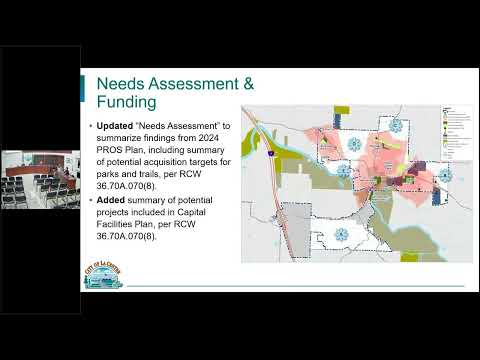
The draft includes a needs assessment and map of acquisition areas labeled a–e. Staff presented the plan’s estimate that, to meet growth through 2045, the city needs 27 community park acres (or the equivalent of one large community park plus eight acres of neighborhood-scale park). The element notes the city’s development code requires residential developments above a specified size to provide parkland; staff and commissioners discussed the applicable threshold in code (the commission indicated current code reference is 39–40 homes rather than older draft language citing 25 homes).
The draft incorporates a new tree-canopy assessment required under the Growth Management Act, which staff reported shows citywide tree canopy coverage at about 32 percent. Alex said the canopy assessment informed a set of new or revised policies to advance climate resiliency and park-system sustainability. "The citywide tree canopy coverage is about a third of the city at 32%," Alex said. Commissioner McLean replied, "We have a lot of trees."
Policy topics discussed - Development and funding: Staff proposed revising policy language to (a) keep existing development-code requirements that require parkland with certain residential projects and (b) allow impact-fee credits where developers provide public facilities beyond code requirements. Commissioners asked staff to ensure the draft correctly reflects current code thresholds for neighborhood or required parks. - Climate and tree canopy: Commissioners supported cross-referencing the climate resiliency element and keeping tree-canopy goals tied to native/low-water species, water conservation, and low-impact development practices. - Trails and connectivity: Commissioners discussed planned trail corridors that would link Paradise Point State Park to John Pollock Park and the city’s trail network. Staff said those planned river-connector segments appear in the draft element (and in the underlying parks plan) and recommended making the trail map more prominent inside the parks element rather than leaving it at the end of the document. - Uses and access: Commissioners asked the plan to explicitly recognize a variety of trail uses — pedestrian, bicycle, ADA-accessible, aging-population access, equestrian, and nonmotorized watercraft — and to consider facility needs associated with some uses (for example, trailer parking or tie-up areas for equestrian users). - Environmental protection and signage: Commissioners asked staff to add or highlight policies encouraging interpretive or regulatory signage to protect sensitive soils, wetlands and other ecologies along trails and at park entrances. - Canoe/boat launch language: The draft includes an older line requiring a large canoe launch; commissioners recommended softening the mandatory language to "consider" or study a canoe launch and to coordinate with affected tribes and stakeholders. - Forestry and mineral-resource language: Commissioners identified one paragraph that appeared to carry over county-level language about forestry and mineral resources; staff agreed that provision appears inapplicable to La Center and recommended removing it from the city element.
Technical and editorial fixes requested Commissioners pointed out duplicated policy language, a slide typo indicating "second draft" when the presenter intended "first draft," and maps that are hard to read on the presentation. They asked staff to (1) correct duplicate policy entries, (2) move the trails map to an earlier location in the element where it better supports the narrative, and (3) provide links to the underlying parks plan maps so commissioners can view clearer legends and details.
Next steps Staff said they will incorporate the commission’s edits and bring second drafts of the parks element and two other capital-facility elements back in May before sending consolidated elements to the city council in June. The commission identified a short list of specific edits (remove or revise the forestry/mineral language, clarify code thresholds for required parks, soften the canoe-launch mandate, add signage and trail-use language, and improve map placement and legibility).
Ending Staff will prepare a redline version showing the requested changes and return a second draft of the parks element for commission review ahead of the next module on the transportation element.