Get Full Government Meeting Transcripts, Videos, & Alerts Forever!
Get email alerts on the Highway Funding District Allocation topic
No spam. Unsubscribe anytime.
Lawmakers and transportation stakeholders spar over proposal to guarantee 70% of district highway revenue remain local
Summary
Sen. John Frederickson introduced LB 449 to require at least 70% of highway revenue raised in each NDOT district be spent in that district; NDOT, contractors and engineering groups warned the requirement would hamstring statewide asset preservation and worsen rural shortfalls.
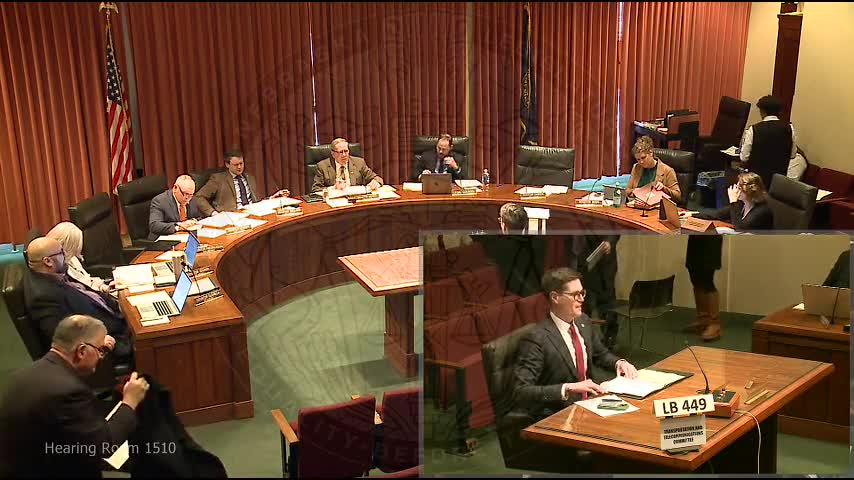
Sen. John Frederickson told the Transportation and Telecommunications Committee that LB 449 would change how Nebraska Department of Transportation (NDOT) dollars are allocated by guaranteeing that no less than 70% of highway revenue raised in each state highway district be spent on projects within that district.
“LB 449 makes a simple but impactful change to the way funds are allocated to projects through the Nebraska Department of Transportation,” Frederickson said. He argued the Omaha metro (NDOT District 2) contributes a disproportionate share of highway revenue — he said the district contributes “around 40%” of certain trust-fund revenues but historically receives about 10–13% back — and that a 70% floor would return more revenue to fast-growing urban districts for congestion, safety and major projects such as the East Beltway.
Supporters — including the city engineer for Omaha, several chambers of commerce, and local elected officials and county commissioners — told the committee District 2 has high traffic counts, growing preservation and expansion needs, and local investments that would leverage state funds. Austin Rouser, Omaha’s city engineer, said NDOT’s traffic-count average for District 2 is “14,000 vehicle vehicles per day on average,” and he said the city currently receives about $700,000 annually for resurfacing state highways within Omaha’s limits while estimating $2.5–3 million would be needed annually to maintain those segments on a 12–14 year resurfacing cycle.
Sarpy County Commissioner Don Kelly described a $90 million local Connect Sarpy investment that his county says generated substantial local development and tax revenue and asked for more state participation on planned expressway projects. “There is an immediate need and potential for a large return on investment of dollars that in District 2 on road and bridge infrastructure,” Kelly said.
Opponents — NDOT, the Associated General Contractors (AGC), Associated General Contractors Nebraska chapter, ACEC Nebraska, and the state’s largest insurance and contractor trade groups — said the bill would interfere with NDOT’s statutory responsibility to manage the state highway network as a system and would force districts to spend their revenue even when preservation of the network elsewhere yields greater overall value. NDOT Director Vicky Kramer told senators the department prioritizes preservation because maintaining roads in good condition is more cost effective than allowing deterioration. Kramer also said the department does not have a revenue-collection system to calculate where motor-fuel taxes are purchased, because fuel taxes are collected at the distributor level by the Department of Revenue.
“LB 449 seeks to impact how Nebraska invests in our highway system through a prescriptive process that is not capable of being implemented within current revenue collecting processes,” Kramer said. She warned a 70% rule would “be detrimental to the department's ability to manage this entire system by requiring what we anticipate to be the majority of revenue to be spent in the most populous counties such as Douglas and Lancaster.” Kramer told the committee NDOT’s needs assessment shows roughly $120–150 million in annual shortfall statewide.
Construction-industry witnesses urged growing the overall funding pie rather than prescribing a percent-of-origin allocation, with AGC representatives and contractors noting rural miles and heavy freight use impose needs that population metrics don’t capture. “When we fail to invest equitably in preservation and capital improvements, we're effectively sidelining the needs of many Nebraskans and jeopardizing their safety and well-being,” Katie Wilson of AGC Nebraska testified in opposition.
Committee members pressed both sides on data: sponsors and proponents asked for clearer accounting showing where fuel taxes and vehicle registration revenue are collected and how that maps to travel patterns and truck traffic; opponents and NDOT cautioned that collections are not presently traceable to individual gas stations or motorists. Several senators noted the conversation raised broader revenue questions and asked whether the Build Nebraska Act or other sources should be increased rather than reallocating current funds.
The hearing produced robust debate but no committee action. Frederickson said he wanted to start a conversation and signaled willingness to continue meetings with NDOT and stakeholders; NDOT opposed the bill as introduced and provided analysis showing winners and losers under a 70% allocation scenario. The committee did not vote on LB 449 during the hearing.